

The Panchang is a traditional Hindu calendar that provides detailed information about dates, lunar days, festivals, fasting occasions, and important timings. Unlike a regular calendar, it explains five key elements Tithi, Vara, Nakshatra, Yoga, and Karana. It is widely used to understand religious events and plan traditional activities throughout the year.
For travelers and spiritual seekers, the Panchang can also be helpful when planning temple visits, pilgrimages, and trips around major Hindu festivals. Since timings can vary by location, sunrise, and local traditions, checking a location-specific calendar is important. This guide explains the main parts of the Hindu calendar in simple language and shows how they can support everyday and travel planning.
Quick Panchang Overview
| Information | Details |
| Subject | Hindu calendar and astronomical timekeeping system |
| Meaning | “Panchang” means five limbs |
| Main Elements | Tithi, Vara, Nakshatra, Yoga, Karana |
| Based On | Primarily the movements of the Sun and Moon |
| Main Uses | Festivals, fasting, rituals, Muhurta, religious planning |
| Calendar Type | Lunisolar traditions, with regional variations |
| Common Users | Hindu families, devotees, priests, astrologers, and travelers |
| Regional Differences | Yes; calculations and traditions can vary by region |
| Important Daily Details | Sunrise, sunset, Tithi, Nakshatra, Yoga, Karana, Rahu Kalam, Muhurta |
| Exact Timings | Depend on date and geographic location |
What Is a Panchang?
A Panchang is a traditional Hindu almanac that combines calendar information with astronomical calculations. It is commonly used to determine religious dates, fasting days, festivals, auspicious periods, and other important timings.
The five primary components are:
Tithi – the lunar day
Vara – the weekday
Nakshatra – the lunar mansion or constellation segment
Yoga – a specific combination of the Sun and Moon’s positions
Karana – half of a Tithi
These five elements give Panchang its name.
A modern Panchang may also contain information such as:
- Sunrise and sunset
- Moonrise and moonset
- Lunar month
- Paksha
- Hindu festivals
- Ekadashi
- Purnima
- Amavasya
- Rahu Kalam
- Yamaganda
- Gulika Kalam
- Abhijit Muhurta
- Choghadiya
- Regional religious observances
For travelers, this information can be especially useful when visiting temples or cultural destinations during important Hindu festivals.
Image Caption: A traditional Hindu calendar showing lunar dates, festivals, and daily Panchang information.
The Five Parts of Panchang Explained
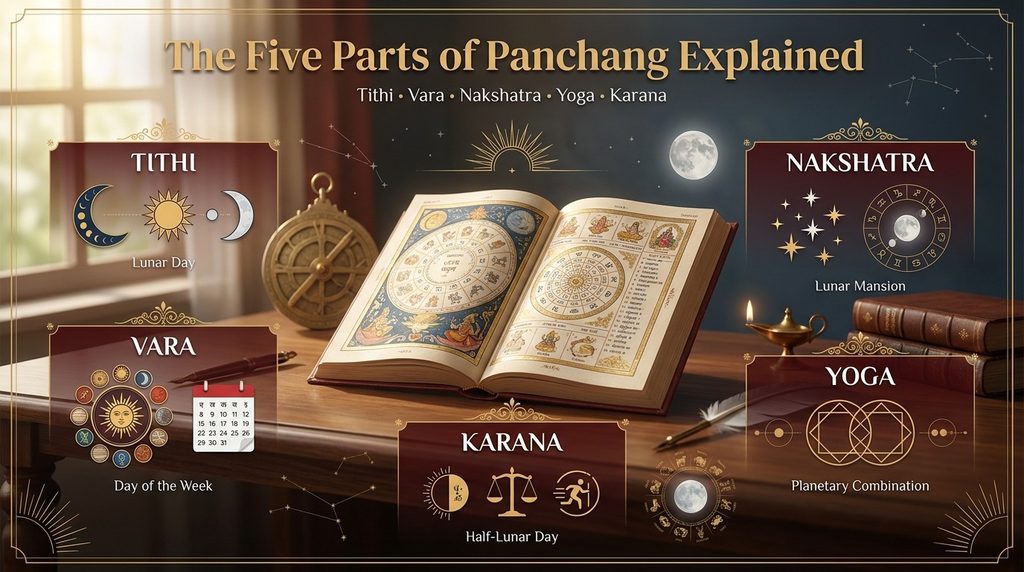
The five main parts form the foundation of the traditional system. Each provides a different type of information.
Tithi
Tithi is a lunar day calculated from the angular relationship between the Sun and Moon. It does not always match a standard 24-hour calendar day.
There are traditionally 30 Tithis in a lunar month:
- 15 during Shukla Paksha
- 15 during Krishna Paksha
The Tithis range from Pratipada through Purnima or Amavasya depending on the lunar half.
Tithi is particularly important for determining:
- Religious festivals
- Fasting days
- Puja observances
- Birth anniversaries in traditional calendars
- Ritual dates
- Temple celebrations
Vara
Vara simply refers to the weekday.
The seven Varas are:
| Vara | English Day |
| Ravivara | Sunday |
| Somavara | Monday |
| Mangalavara | Tuesday |
| Budhavara | Wednesday |
| Guruvara | Thursday |
| Shukravara | Friday |
| Shanivara | Saturday |
Different Hindu traditions associate particular weekdays with specific deities and religious practices.
Nakshatra
Nakshatra refers to one of the 27 divisions of the ecliptic used in traditional Indian astronomy and astrology.
The Moon moves through these Nakshatras as it travels around the zodiac. Each Nakshatra covers a specific section of the sky.
Nakshatra information is often consulted for:
- Religious ceremonies
- Naming ceremonies
- Birth-chart traditions
- Muhurta selection
- Certain festival calculations
- Traditional astrology
Yoga
In Panchang, Yoga is a calculated combination involving the longitudes of the Sun and Moon.
There are traditionally 27 Yogas. Panchang users may consult the day’s Yoga as part of determining the nature and timing of activities.
Yoga should not be confused with the physical yoga practiced for exercise or meditation.
Karana
Karana is half of a Tithi. Since a lunar day is divided into two Karanas, the Panchang uses Karana as another measurement for determining daily timing.
There are fixed and repeating Karanas, and their occurrence is calculated according to the lunar cycle.
How Panchang Helps With Hindu Festivals
One of the most common uses of Panchang is determining Hindu festival dates.
Many Hindu festivals are based on lunar or lunisolar calculations rather than a fixed Gregorian calendar date. As a result, the corresponding date on the Western calendar changes from year to year.
Panchang calculations help determine observances such as:
- Diwali
- Dhanteras
- Holi
- Janmashtami
- Maha Shivaratri
- Ganesh Chaturthi
- Navratri
- Ram Navami
- Dussehra
- Akshaya Tritiya
- Raksha Bandhan
- Ekadashi
- Purnima observances
- Amavasya observances
Festival dates can also differ between regional traditions because different calendar systems and local sunrise or sunset calculations may be followed.
Why Festival Dates Can Differ
A festival may be observed on one civil date in one location and a different date elsewhere if the relevant Tithi crosses midnight or changes according to local astronomical conditions.
For this reason, travelers should not rely only on a generic calendar when planning a temple visit around a major festival.
Understanding Shukla Paksha and Krishna Paksha
A Hindu lunar month is traditionally divided into two parts, known as Paksha.
Shukla Paksha
Shukla Paksha is the bright half of the lunar month. It begins after the New Moon and progresses toward the Full Moon.
The Moon gradually appears brighter during this period.
Krishna Paksha
Krishna Paksha is the dark or waning half of the lunar month. It follows the Full Moon and continues toward the New Moon.
The Moon gradually becomes less visible during this period.
| Paksha | Moon Phase | Ends Around |
| Shukla Paksha | Waxing Moon | Purnima |
| Krishna Paksha | Waning Moon | Amavasya |
These phases are important when understanding festival dates, fasting observances, and other traditional calendar events.
Purnima and Amavasya in the Panchang
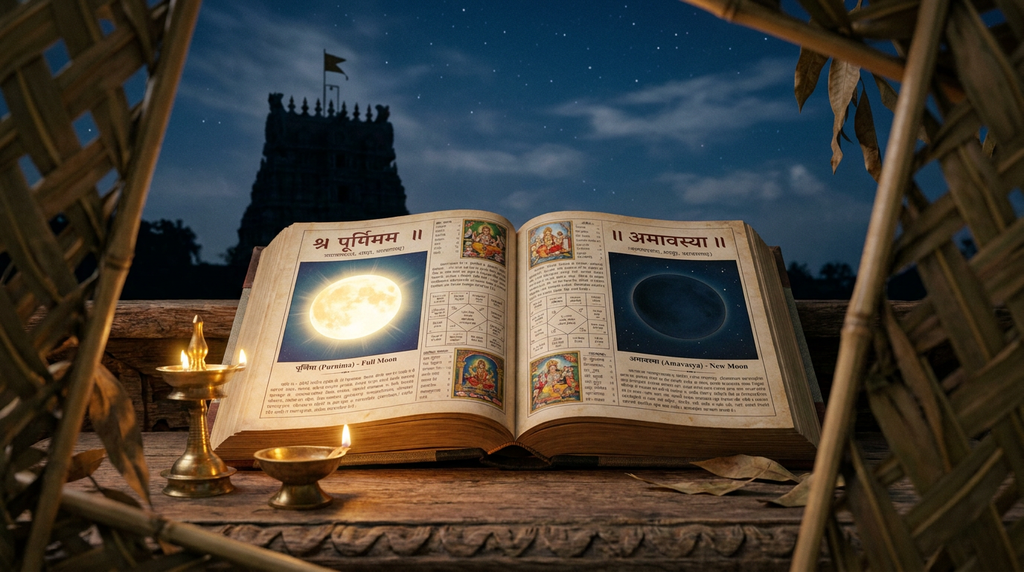
Two especially important lunar days are Purnima and Amavasya.
Purnima
Purnima is the Full Moon day. Many Hindu religious observances and festivals occur on Purnima.
Examples of Purnima-related observances vary by month and regional tradition.
Amavasya
Amavasya is the New Moon day. It is also significant in many Hindu traditions and may be associated with particular religious observances, prayers, and ancestral rituals.
The exact observance depends on the lunar month and local tradition.
Image Caption: The full moon and new moon represent important points in the traditional Hindu lunar calendar.
What Is Muhurta in Panchang?
Muhurta refers to a selected period of time considered suitable for a particular activity according to traditional Hindu calendar and astrological practices.
Panchang resources may list different Muhurtas throughout the day.
Examples include:
- Abhijit Muhurta
- Brahma Muhurta
- Vijay Muhurta
- Godhuli Muhurta
- Amrit Kalam
Different Muhurtas have different traditional uses.
For major events such as weddings, housewarming ceremonies, religious ceremonies, or important beginnings, families may consult a priest or qualified practitioner rather than relying on a general daily calendar alone.
Rahu Kalam, Yamaganda and Gulika Kalam
Many daily Panchang calendars list periods such as Rahu Kalam, Yamaganda, and Gulika Kalam.
These are traditional time divisions used in some Hindu practices.
Rahu Kalam
Rahu Kalam is a daily period traditionally regarded as unsuitable for starting certain important activities.
Its clock time changes from day to day because it is calculated in relation to daylight hours.
Yamaganda
Yamaganda is another traditional period that may be avoided for starting certain activities according to some practices.
Gulika Kalam
Gulika Kalam is also included in many regional Panchang calendars and is interpreted according to traditional astrological practices.
These periods should not be treated as universal rules. Practices vary between families, regions, and traditions.
How Panchang Can Help With Spiritual Travel
Panchang can be useful when planning a pilgrimage or spiritual trip.
For example, a traveler visiting a major temple may want to coordinate the journey with:
- A temple festival
- A special Tithi
- Ekadashi
- Purnima
- Amavasya
- Navratri
- Shivaratri
- Janmashtami
- Regional religious celebrations
Festival periods can also bring larger crowds, special processions, temporary arrangements, and changes to normal temple schedules.
If your main goal is a peaceful temple visit, checking the religious calendar and expected festival dates can help you understand what to expect.
Travel Planning Tips
Before booking a spiritual trip:
- Check the local Panchang for your destination.
- Confirm the festival date with the temple’s official information.
- Check whether special entry rules apply.
- Verify darshan or पूजा timings.
- Expect larger crowds during major festivals.
- Check local accommodation availability early.
- Allow additional travel time during religious events.
Regional Differences in Hindu Calendars
There is no single Panchang format used identically by every Hindu community.
Different regions may follow different calendar traditions, calculations, and conventions.
Examples include traditions associated with:
- North India
- South India
- Maharashtra
- Gujarat
- Bengal
- Odisha
- Andhra Pradesh
- Telangana
- Karnataka
- Tamil Nadu
- Kerala
- Nepal
Some calendars use different conventions for determining when a lunar month begins. Regional festival practices may also influence the date on which an observance is celebrated.
This is one reason travelers should use a Panchang appropriate to the place they are visiting.
Why Panchang Timings Differ by Location
Location is one of the most important factors when reading a daily Panchang.
Astronomical events occur at specific moments, but their corresponding local clock times vary depending on longitude, latitude, and time zone.
For example, the same Tithi can be relevant to two cities while beginning or ending at different local times.
The following details can influence the displayed Panchang:
- Geographic location
- Latitude
- Longitude
- Local time zone
- Sunrise
- Sunset
- Lunar position
- Solar position
- Regional calendar convention
This is why an online Panchang set for one city should not automatically be used for another city when exact timing matters.
How to Read a Daily Panchang
A typical daily Panchang can look complicated at first, but the main sections are relatively easy to understand.
A daily page may show:
| Section | What It Tells You |
| Date | Civil calendar date |
| Vara | Day of the week |
| Tithi | Current lunar day |
| Nakshatra | Moon’s current Nakshatra |
| Yoga | Current Panchang Yoga |
| Karana | Current Karana |
| Sunrise | Local sunrise time |
| Sunset | Local sunset time |
| Moonrise | Local moonrise |
| Moonset | Local moonset |
| Paksha | Waxing or waning lunar half |
| Rahu Kalam | Traditional daily time period |
| Muhurta | Traditionally selected time periods |
| Festival | Religious observances for the date |
When reading a daily Panchang, first confirm that the location is set correctly. Then check the Tithi, Nakshatra, sunrise, sunset, and relevant festival or fasting information.
Panchang for Travelers Visiting Temples
Travelers visiting Hindu temples can use Panchang information as a cultural planning tool.
It can help answer questions such as:
- Is a major festival taking place during my visit?
- Is today Ekadashi or Purnima?
- Is this an important religious day?
- Could the temple be busier than usual?
- Are there special ceremonies during this period?
- Should I allow additional time for darshan?
However, Panchang does not replace official temple information.
Temple authorities may change entry arrangements, darshan schedules, ticketing systems, or visitor procedures during festivals and special events. Always verify these details directly before traveling.
Image Caption: Pilgrims visiting a Hindu temple during a traditional religious festival.
Best Way to Use Panchang for Trip Planning
If your trip has a religious or cultural purpose, you can incorporate Panchang information into your itinerary.
Before Booking
Check:
- Festival dates
- Major temple celebrations
- Regional observances
- Expected peak periods
- Accommodation availability
Before Departure
Verify:
- Temple opening and closing times
- Darshan arrangements
- Special entry requirements
- Local transportation
- Weather conditions
- Official festival announcements
During the Trip
Keep some flexibility in your schedule. Festival days can bring changes to traffic, public transportation, temple access, and crowd levels.
For a pilgrimage, leaving extra time between destinations is often more practical than creating a tightly packed itinerary.
Food and Fasting Traditions
Panchang is also commonly used to identify fasting days such as Ekadashi and other religious observances.
Fasting customs differ considerably between individuals, communities, and regions. Some people follow a complete fast, while others consume selected foods.
Common foods associated with certain fasting traditions may include:
- Fruits
- Milk
- Nuts
- Certain grains or grain substitutes
- Root vegetables
- Water
- Special fasting dishes
Travelers observing a fast should plan ahead, especially when visiting remote temples or traveling between cities.
If you have a medical condition, take medication, are pregnant, or have specific dietary needs, fasting practices should be discussed with an appropriate healthcare professional rather than followed solely because a calendar lists a fasting day.
Panchang and Hindu Temple Festivals
Temple festivals are often connected with particular lunar dates, Nakshatras, or regional traditions.
A Panchang can therefore be useful for identifying periods when a destination may have increased religious activity.
During large celebrations, visitors may experience:
- Processions
- Special pujas
- Decorative displays
- Cultural performances
- Large pilgrim gatherings
- Temporary traffic restrictions
- Special food arrangements
- Extended religious activities
The experience can be very different from visiting the same temple on an ordinary weekday.
For travelers interested in photography, cultural observation, or religious tourism, festival periods may provide unique opportunities, but crowds should be expected.
Family-Friendly Ways to Learn About Panchang
Families can use Panchang as a simple way to introduce children to Hindu calendar traditions.
Children can learn about:
- The phases of the Moon
- Days of the week
- Hindu festivals
- Seasonal celebrations
- Traditional calendars
- Temple customs
- Regional traditions
Parents can also use a physical calendar to show how lunar dates and Gregorian dates work together.
For a family trip, learning about the festival or temple tradition before visiting can make the experience more meaningful and easier for children to understand.
Photography and Cultural Experiences
Panchang itself is not a physical destination, but it can help photographers and travelers plan visits around culturally significant occasions.
Potential photography opportunities include:
- Temple decorations
- Festival processions
- Traditional lamps
- Rangoli
- Religious architecture
- Sunrise temple scenes
- Evening aarti
- Moonrise
- Cultural markets
Always follow temple photography rules. Some religious areas prohibit photography or restrict the use of cameras and phones.
Image Caption: Traditional temple lamps and decorations during a Hindu religious celebration.
Panchang and the Lunar Calendar
The Hindu calendar is generally lunisolar, meaning it incorporates both lunar and solar cycles.
The Moon plays an important role in determining Tithi and many festival dates, while solar movements are also important for various calendar calculations.
Because lunar months are shorter than solar years, traditional calendar systems use adjustments to keep lunar and solar cycles aligned.
This helps explain why Hindu festivals do not fall on exactly the same Gregorian date every year.
Panchang vs. Gregorian Calendar
The Gregorian calendar is the internationally common civil calendar. It is based on a solar year and contains 12 months.
Panchang provides a different type of information.
| Feature | Gregorian Calendar | Panchang |
| Main Basis | Solar calendar | Traditional lunisolar calculations |
| Primary Use | Civil and everyday scheduling | Religious and traditional planning |
| Lunar Tithi | No | Yes |
| Nakshatra | No | Yes |
| Yoga | No | Yes |
| Karana | No | Yes |
| Hindu Festivals | Limited/basic dates | Detailed traditional calculations |
| Muhurta | No | Often included |
| Regional Variations | Limited | Significant |
Both systems can be used together. The Gregorian calendar is useful for everyday appointments and travel bookings, while Panchang can provide traditional religious timing.
Accommodation and Travel Planning Around Festivals
Panchang can indirectly affect travel accommodation planning.
When a major Hindu festival occurs at an important pilgrimage destination, demand for rooms and transportation can increase.
Travelers should consider:
- Booking accommodation early for major festivals
- Staying within reasonable distance of the temple
- Checking cancellation policies
- Comparing multiple accommodation areas
- Confirming transport availability
- Allowing extra time for local traffic
Hotel prices are not determined by Panchang itself and can vary widely according to destination, season, events, room type, and booking date.
Travel Budget Considerations
There is no universal “Panchang travel budget” because Panchang is a calendar system rather than a destination.
The cost of a pilgrimage or cultural trip depends on factors such as:
| Expense | What Affects the Cost |
| Accommodation | City, season, hotel category, availability |
| Transportation | Distance, vehicle type, booking time |
| Food | Restaurant type and destination |
| Temple Visits | Entry or special services where applicable |
| Activities | Tours, guides, cultural experiences |
| Shopping | Personal spending |
| Festival Travel | Higher demand may affect some travel costs |
Always check current prices before booking because transportation and accommodation rates can change.
One-Day Spiritual Travel Planning Example
If you are using Panchang to plan a one-day temple visit, a simple schedule could look like this:
| Time | Activity |
| Early Morning | Check local sunrise and daily Panchang |
| Morning | Visit temple or participate in morning worship |
| Late Morning | Explore nearby cultural attractions |
| Afternoon | Lunch and rest |
| Late Afternoon | Visit another nearby attraction |
| Evening | Attend aarti if permitted and scheduled |
| Night | Return to accommodation or continue onward |
Exact temple schedules must be confirmed with the relevant temple because they vary by location and occasion.
Safety and Practical Tips
Using a Panchang is straightforward, but travelers should avoid treating it as a substitute for practical travel information.
Keep these points in mind:
- Confirm the location before relying on exact timings.
- Check official temple websites or notices for current schedules.
- Keep identification and essential travel documents secure.
- Carry sufficient water during outdoor pilgrimages.
- Dress respectfully when visiting religious places.
- Follow temple photography rules.
- Expect crowds during major festivals.
- Keep valuables secure in busy religious areas.
- Check weather conditions before outdoor travel.
- Use official or reputable transportation services.
- Keep some flexibility in your itinerary.
Panchang gives traditional calendar information, while normal travel planning still requires current transport, weather, accommodation, and destination information.
What to Pack for a Panchang-Based Spiritual Trip
Your packing list depends on the destination and season, but a temple or pilgrimage trip may require:
- Comfortable walking shoes
- Modest and breathable clothing
- A light shawl or covering where appropriate
- Reusable water bottle
- Sunscreen
- Hat or umbrella
- Personal medicines
- Phone and charger
- Power bank
- Identification documents
- Small bag for personal belongings
- Cash and a suitable payment method
- Weather-appropriate clothing
For a festival trip, pack light where possible because crowded areas can make large luggage inconvenient.
Important Cultural Etiquette
Respect is particularly important when traveling for religious purposes.
Visitors should:
- Dress appropriately for the temple
- Follow instructions from temple staff
- Remove footwear where required
- Avoid disturbing worshippers
- Ask before photographing people
- Follow restrictions on photography
- Avoid touching sacred objects unless permitted
- Keep voices low in prayer areas
- Follow local customs respectfully
- Dispose of waste properly
Different temples and communities have their own rules, so visitors should observe posted instructions and follow local guidance.
How to Choose a Reliable Panchang
Not every calendar or website presents information in exactly the same way.
When accuracy matters, consider:
Location settings – Make sure the city is correct.
Date – Confirm that you are viewing the intended day.
Calendar tradition – Check which regional system is being used.
Festival source – Compare important dates with an official temple or recognized religious calendar.
Timing details – Look for sunrise-based calculations and local time.
Updates – Use a source that clearly identifies its calendar year and calculation method.
For major religious ceremonies, families may also consult a local priest or traditional calendar expert.
Common Mistakes When Reading Panchang
Beginners often assume that a Panchang works exactly like a normal calendar. A few simple checks can prevent confusion.
Using the Wrong Location
A Panchang calculated for another city may show different local timings.
Treating Tithi as a Fixed 24-Hour Period
Tithi does not necessarily begin at midnight or last exactly 24 hours.
Confusing Panchang With an Astrology Horoscope
Panchang provides calendar and astronomical information, while a personal horoscope involves birth details and a different set of calculations.
Assuming All Regions Follow Identical Dates
Regional traditions can produce differences in festival observance.
Ignoring Official Temple Information
A Panchang may identify a religious date, but temple authorities determine their own visitor arrangements and schedules.
FAQs
What is Panchang and what is it used for?
Panchang is a traditional Hindu calendar system used to track lunar days, festivals, fasting dates, and auspicious timings.
It is also useful for planning religious ceremonies and cultural activities.
How does Panchang calculate daily Hindu dates?
Panchang uses astronomical calculations involving the Sun and Moon.
It considers Tithi, Nakshatra, Yoga, Karana, and Vara to provide daily calendar details.
Why does Panchang show different timings by location?
Panchang timings depend on local sunrise, sunset, geographic location, and time zone.
This is why the same Tithi or festival may have different exact timings in different cities.
Can Panchang help with Hindu festival dates?
Yes, Panchang is commonly used to determine dates for many Hindu festivals and religious observances.
It can also show fasting days, Purnima, Amavasya, and other important occasions.
What are the five parts of Panchang?
The five main parts are Tithi, Vara, Nakshatra, Yoga, and Karana.
Together, they provide detailed information about a particular day in the Hindu calendar.
Is Panchang the same as a normal Hindu calendar?
A Panchang provides more detailed information than an ordinary calendar.
Along with dates, it can include lunar phases, religious festivals, Muhurta, and daily astronomical timings.
How can Panchang help when visiting Hindu temples?
Panchang can help travelers identify important festival days and religious occasions.
Before visiting, travelers should also confirm temple timings and entry rules with official sources.
Why do Panchang festival dates change every year?
Many Hindu festivals follow lunar or lunisolar calculations rather than fixed Gregorian dates.
As a result, their dates can change from one year to another.
Can Panchang be different in different parts of India?
Yes, regional traditions and calendar systems can produce differences in dates and timings.
Always check a location-specific calendar when exact religious timings are important.
How do beginners read a daily Panchang?
Start by checking the date, location, sunrise, Tithi, Nakshatra, and Paksha.
You can then review Yoga, Karana, Muhurta, and festival information for additional details.
Conclusion
Panchang offers a simple way to understand important elements of the traditional Hindu calendar.
It brings together lunar dates, festivals, fasting days, and daily astronomical information.
Travelers can also use it when planning temple visits and cultural experiences.
Because timings can vary by location, checking the correct city is important.
Using reliable and current information makes traditional calendar planning easier.
Whether planning a religious ceremony or a spiritual journey, Panchang can be a useful reference.
It helps connect important Hindu traditions with everyday calendar planning.
Readers can use it alongside official temple information and modern travel resources.
For exact dates and timings, local calculations should always be verified before making plans.
This approach makes the calendar more practical, accurate, and easy to understand.
Read More: Today’s Panchang Shree Salasar Balaji Mandir Travel & Darshan Guide
