

Choghadiya is an important part of traditional Hindu timekeeping, helping people identify auspicious periods for starting daily activities, business work, religious ceremonies, and journeys. Choghadiya Today 2026 is useful for readers who want to check today’s Shubh Muhurat and understand which periods are traditionally considered favorable for important beginnings.
The traditional Choghadiya system divides the time between sunrise and sunset into eight periods and the time between sunset and the next sunrise into another eight periods. Choghadiya Today 2026 provides a simple way to understand these daytime and nighttime periods, including Amrit, Shubh, Labh, Char, Rog, Kaal, and Udveg.
Many people consult a daily Choghadiya table before beginning a new project, making a purchase, performing puja, or setting out on a journey. By checking Choghadiya Today 2026, readers can learn which periods are traditionally preferred for different activities and how these timings fit into their daily plans.
One important detail is that Choghadiya timings are not the same every day or in every city. Choghadiya Today 2026 should be checked using the correct date and location because local sunrise and sunset determine the start and end of each period. A reliable Panchang can help you find the appropriate timings for your area.
In this guide, you will discover how to read the daily Choghadiya table, understand auspicious periods, compare Choghadiya with Rahu Kaal, and check local timings accurately. Whether you follow Hindu traditions for personal, religious, or travel planning, Choghadiya Today 2026 will help you understand the system and use its traditional guidance more confidently.
What Is Choghadiya?
Choghadiya, also written as Chaughadiya or Chogadia, is a traditional Hindu timekeeping system used to help select a suitable time for everyday activities. It divides the period from sunrise to sunset into eight equal parts and the period from sunset to the next sunrise into eight more parts.
Each period is assigned one of seven names: Amrit, Shubh, Labh, Char, Rog, Kaal, or Udveg. The weekday determines the sequence, while local sunrise and sunset determine the actual clock timings. Because daylight and nighttime change throughout the year, each period is not always exactly 90 minutes long.
People use Choghadiya as a convenient reference when selecting a time for activities such as:
- Beginning a journey or important errand.
- Starting a new business activity.
- Making a significant purchase.
- Performing puja or other religious observances.
- Beginning a personal or professional project.
- Planning an event that follows Hindu astrological traditions.
Choghadiya is a traditional belief-based practice, not a scientific guarantee that an activity will succeed. For major ceremonies, families may also consult a qualified astrologer or a complete Hindu Panchang.
Choghadiya Today 2026: How to Check Today’s Shubh Muhurat
To find the correct Choghadiya for today, you need the date and the city where you plan to perform the activity. A table prepared for New Delhi, for example, may show different clock timings from one prepared for Mumbai, Ahmedabad, Kathmandu, or a city outside India.
Follow these steps to check today’s auspicious periods:
- Select the correct date. Make sure the Panchang is displaying the date you intend to use.
- Choose your city. Use the location where the activity will take place.
- Check local sunrise and sunset. These determine the length of the daytime Choghadiya periods.
- Read the daytime table. Identify the start and end of each of the eight periods.
- Check the nighttime table if necessary. Nighttime periods run from sunset to the next sunrise.
- Review other Panchang timings. If the activity is important, also check Rahu Kaal and any other relevant Muhurat considerations.
For a location-specific table, you can consult Select the relevant city and date before using the displayed times.
Important: There is no single universal set of clock timings for Choghadiya Today 2026. Without a selected date and location, publishing exact start and end times could mislead readers.
Daily Choghadiya Table: Meaning of All Seven Periods
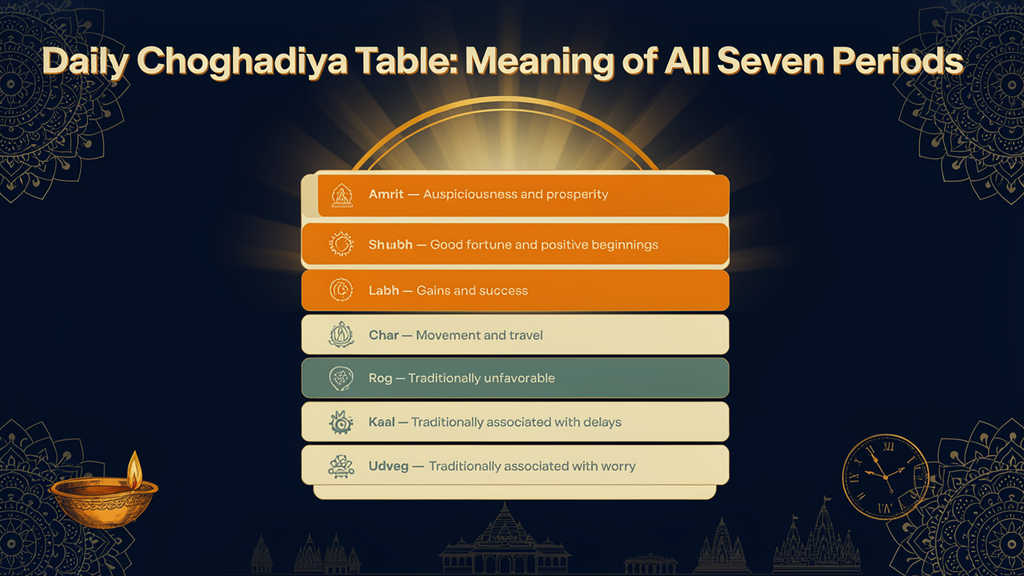
The following table explains the traditional interpretation of each Choghadiya type. These meanings describe customary astrological beliefs; individual traditions may interpret them somewhat differently.
| Choghadiya | Traditional meaning | Common traditional use |
| Amrit | Highly auspicious | Religious activities and important beginnings |
| Shubh | Auspicious | Ceremonies, puja, and new undertakings |
| Labh | Associated with gain | Business, trade, and financial activities |
| Char or Chal | Associated with movement | Travel and activities involving movement |
| Udveg | Traditionally considered unfavorable | Often avoided for major new beginnings |
| Kaal | Traditionally considered unfavorable | Often avoided for important auspicious starts |
| Rog | Traditionally considered unfavorable | Often avoided for major new undertakings |
Amrit, Shubh, and Labh are generally treated as favorable periods. Char is commonly considered suitable for travel, although its interpretation differs across traditions. Udveg, Kaal, and Rog are generally avoided when choosing a time for a major auspicious beginning.
This classification is a guide to traditional practice, not a prediction of real-world outcomes.
Daytime Choghadiya: Eight Periods from Sunrise to Sunset
Daytime Choghadiya begins at local sunrise and ends at local sunset. The interval between these two events is divided into eight equal periods.
For example, if the time between sunrise and sunset is 12 hours, each daytime period would last 90 minutes. On a day with shorter daylight, each period would be shorter; on a day with longer daylight, each period would be longer.
A daytime table generally includes:
- The name of each Choghadiya period.
- The local start time.
- The local end time.
- A traditional description of whether the period is favorable, neutral, or unfavorable.
The weekday affects the order of the periods. For instance, Monday traditionally begins its daytime sequence with Amrit, while Sunday begins with Udveg.
When reading a daytime table, check whether the first period starts at the displayed local sunrise. Do not assume that the first period always starts at 6:00 AM, because sunrise varies by season and location.
Image Caption: A daily Hindu Panchang showing sunrise, sunset, and the eight daytime Choghadiya periods.
Night Choghadiya: Auspicious Timings After Sunset
Night Choghadiya covers the interval from sunset to the following sunrise. Like the daytime schedule, the night is divided into eight equal periods, with each period assigned a traditional Choghadiya name.
Nighttime periods can be useful for people planning evening religious activities, late journeys, or other activities for which they follow traditional Muhurat guidance. Their duration depends on the length of the night, so the timings can differ from daytime periods.
When checking a night table, pay attention to the date shown beside each time. A period may begin before midnight and finish after midnight. The Panchang may display the ending time with the following calendar date.
For example, a period that begins at 11:30 PM and ends at 1:00 AM crosses into the next civil date. Always follow the date and location displayed by the calculator rather than assuming that every nighttime period belongs to the same calendar date.
The sequence of nighttime periods is not necessarily identical to the daytime sequence. Use the actual nighttime table rather than copying the daytime names into a separate schedule.
Choghadiya Order by Weekday
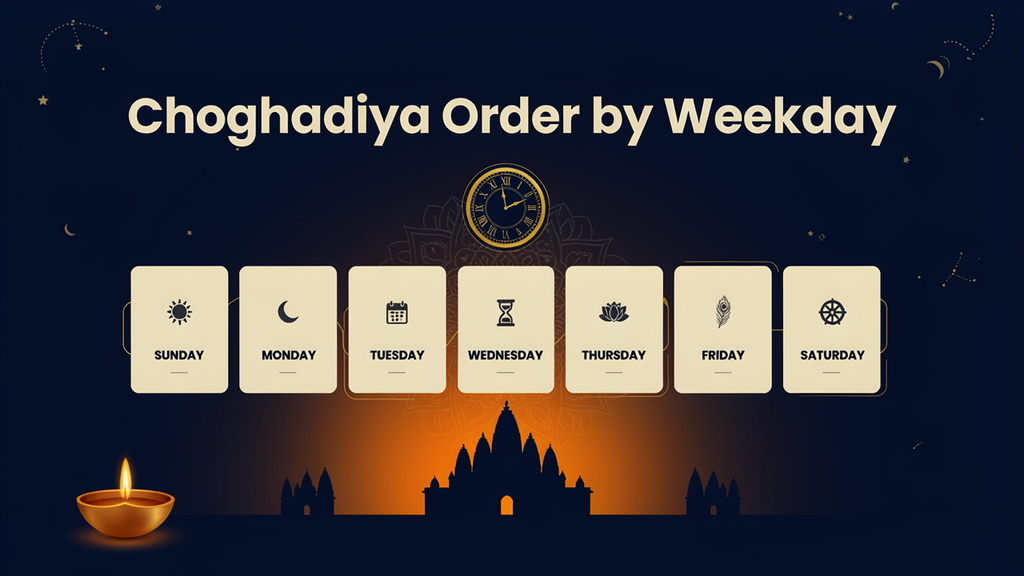
The weekday determines which Choghadiya begins the daytime sequence. The traditional starting periods are shown below.
| Weekday | First daytime Choghadiya |
| Sunday | Udveg |
| Monday | Amrit |
| Tuesday | Rog |
| Wednesday | Labh |
| Thursday | Shubh |
| Friday | Char |
| Saturday | Kaal |
After the first period, the names follow a traditional repeating sequence. The eighth period repeats the first name because there are eight periods but seven Choghadiya types.
This table is a reference for the starting name, not a complete timetable. It does not tell you the exact clock time when a favorable period begins. To find those times, you must also know the local sunrise and sunset for the chosen date.
For nighttime Choghadiya, consult the nighttime sequence supplied by a reliable Panchang. The daytime starting-name table should not be used as a substitute for the night schedule.
Which Choghadiya Is Best for Different Activities?
People who follow Choghadiya often select a period according to the type of activity they want to begin. The following table summarizes common traditional preferences.
| Activity | Traditionally preferred period | Practical note |
| Starting a new project | Amrit or Shubh | Check any additional Muhurat requirements for major events |
| Business or trade | Labh or Shubh | Review practical business conditions as well |
| Puja or a religious activity | Amrit or Shubh | Follow the requirements of the specific ritual |
| Beginning a journey | Char or Amrit | Check transport schedules and actual travel conditions |
| A purchase or transaction | Labh or Shubh | Compare prices and review the terms before paying |
| A major family ceremony | A suitable Muhurat chosen with the relevant Panchang | A complete Muhurat may consider more than Choghadiya |
These are customary associations, not strict universal rules. Different families and regional traditions may use additional considerations when choosing a time.
For a major ceremony such as a wedding, housewarming, or formal religious ritual, Choghadiya alone may not be considered sufficient. Consult the relevant Panchang or a qualified practitioner if your family follows a more detailed Muhurat system.
Choghadiya and Rahu Kaal: What Is the Difference?
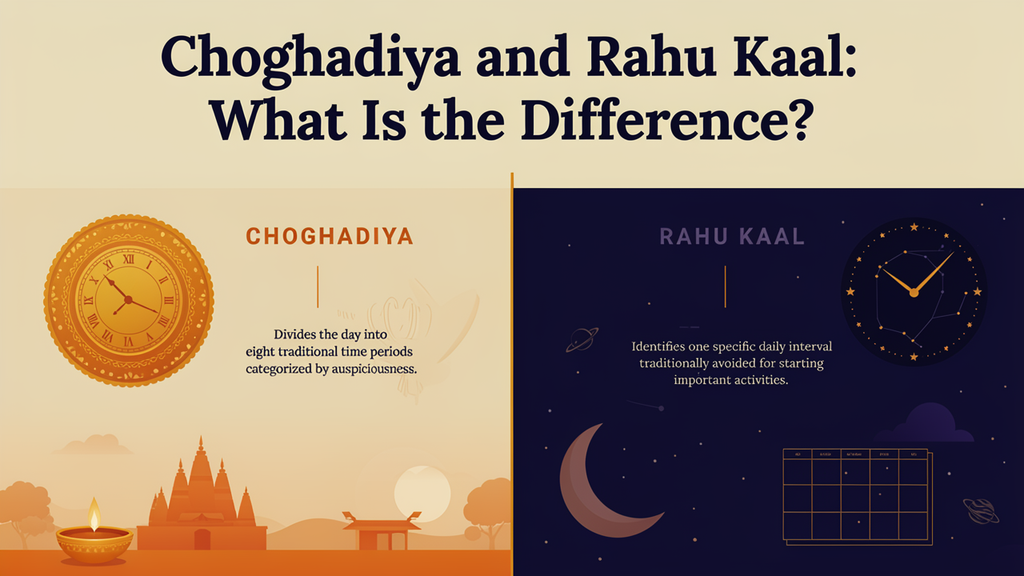
Choghadiya and Rahu Kaal are separate components of traditional Hindu time selection. Both are commonly checked when planning auspicious activities, but they do not represent the same calculation.
Choghadiya divides daylight and nighttime into eight periods each. Rahu Kaal is a separate daily interval calculated using the weekday and local daylight period.
| Feature | Choghadiya | Rahu Kaal |
| Main purpose | Classifies periods according to traditional auspiciousness | Identifies a traditionally avoided interval |
| Calculation | Eight parts of daylight and eight parts of nighttime | A weekday-based division of the daylight period |
| Changes by location | Yes | Yes |
| Changes by date | Yes | Yes |
| Used for | Selecting a traditionally suitable time for an activity | Often checked before beginning important auspicious work |
Some Panchang systems also provide Yamaganda, Gulika Kaal, Abhijit Muhurat, and other timing information. These should be checked separately when relevant.
An apparently favorable Choghadiya period does not automatically mean that every other Muhurat consideration is favorable. People who follow several Panchang rules generally review the relevant timings together.
How Are Choghadiya Timings Calculated?
The basic calculation uses local sunrise, local sunset, and the traditional weekday sequence.
Calculate the length of daylight
Find the interval between local sunrise and sunset. The length of this interval changes throughout the year.
Divide daylight into eight equal parts
Divide the total daylight duration by eight. This gives the duration of each daytime Choghadiya period.
Assign the names
Use the traditional weekday sequence to identify the name assigned to each period. The first daytime name depends on the weekday.
Calculate the nighttime periods
Find the interval from sunset to the following sunrise and divide it into eight equal parts. Use the appropriate nighttime sequence for the weekday.
Display local clock times
Convert the calculated periods into the local time zone for the selected city and date. A reliable Panchang performs these calculations and presents the resulting table.
Example using hypothetical times: Suppose sunrise occurs at 6:00 AM and sunset at 6:00 PM. Daylight lasts 12 hours, so each of the eight daytime periods lasts 90 minutes. This is only an illustration of the arithmetic, not a claim about actual sunrise or sunset on a particular date.
Because real sunrise and sunset times vary, do not use this hypothetical example as a daily Choghadiya timetable.
How to Use a Choghadiya Table Correctly
A Choghadiya table is most useful when you understand what it shows and what it does not show.
- Confirm the location: Choose the city where the activity will occur.
- Confirm the date: Make sure the date matches your plan.
- Use local time: Avoid mixing times from different time zones.
- Check both day and night: Use the appropriate table for the planned activity.
- Read the full time range: Confirm that your intended start time falls inside the selected period.
- Check other Panchang details: Consider Rahu Kaal or additional Muhurat rules if your tradition requires them.
- Plan practical matters first: Confirm bookings, transport, weather, and opening hours independently.
Do not assume that a time listed for one city will be accurate in another. Even cities in the same country can have different sunrise and sunset times, and seasonal changes affect the length of each Choghadiya.
Choghadiya Today 2026 for Travel Planning

Choghadiya is traditionally used by some travelers to select a preferred time to begin a journey. For example, a family may check the table before leaving home for a pilgrimage, visiting relatives, or beginning a long-distance trip.
If you use Choghadiya for travel, treat it as one part of your planning rather than a replacement for practical checks.
Before leaving, confirm:
- Your train, bus, or flight departure time.
- Road and weather conditions.
- The estimated journey duration.
- Local transport availability at your destination.
- Accommodation check-in requirements.
- Any opening hours or entry rules for the place you plan to visit.
A favorable traditional period cannot guarantee safe roads, punctual transport, or a successful journey. Never delay urgent travel or ignore a safety concern solely to wait for a preferred Choghadiya period.
For a pilgrimage or religious visit, you may also need to check temple opening hours and the schedule of the specific ritual you want to attend.
Regional Differences in Choghadiya Timings
Choghadiya tables are location-sensitive because they rely on local sunrise and sunset. A timetable prepared for one city should not automatically be applied to another.
The differences can be especially noticeable when comparing cities that are far apart, places at different latitudes, or locations in different time zones. Seasonal daylight changes also affect the duration of each period.
When using an online calculator, check the following details:
| Detail to verify | Why it matters |
| City or coordinates | Determines the relevant local solar timings |
| Date | Sunrise and sunset change from day to day |
| Time zone | Ensures the displayed clock time is local |
| Day or night table | Each covers a different part of the day |
| Calculation method | Different Panchang providers may apply different conventions |
If two sources show slightly different results, check whether they use the same city, date, time zone, and calculation conventions before comparing their tables.
For readers outside India, choose the actual location where the activity will take place. Do not simply use an Indian city’s timetable because the tradition originated in India.
Where to Find a Reliable Daily Choghadiya Table
A dependable daily table should show the selected date, location, local sunrise and sunset, and the start and end of each period.
You can begin with Select the relevant location and date, then review the displayed daytime and nighttime periods.
When checking any Panchang website or calendar, use this checklist:
- The selected city is correct.
- The displayed date is correct.
- The times are shown in the intended local time zone.
- Daytime and nighttime periods are clearly distinguished.
- The table identifies each Choghadiya by name.
- Any additional Muhurat details are clearly labeled.
Avoid relying on an undated screenshot or an old timetable shared on social media. A table from a previous day or a different location may not match your needs.
If you are planning a major ceremony, compare the daily table with the Panchang or guidance traditionally used by your family.
Common Mistakes to Avoid When Checking Choghadiya
A few simple mistakes can lead to choosing the wrong period.
Using the same timings every day
Choghadiya periods are calculated from sunrise and sunset, which vary by date. A fixed timetable may not be accurate for the day you need.
Using another city’s table
Even if the weekday is the same, the clock timings can differ by location. Always select the relevant city.
Confusing the daytime and nighttime sequences
Night Choghadiya has its own sequence. Do not assume that the daytime sequence continues unchanged after sunset.
Ignoring the date after midnight
Some nighttime periods extend beyond midnight. Read the displayed ending date carefully to avoid confusing one period with another.
Treating Choghadiya as a guarantee
Choghadiya reflects a traditional astrological framework. It does not establish that an activity will succeed or that an unfavorable outcome will occur.
Forgetting practical requirements
A favorable period does not replace checking transport availability, opening hours, financial terms, weather, or safety conditions.
Useful Tips for Following Choghadiya in 2026
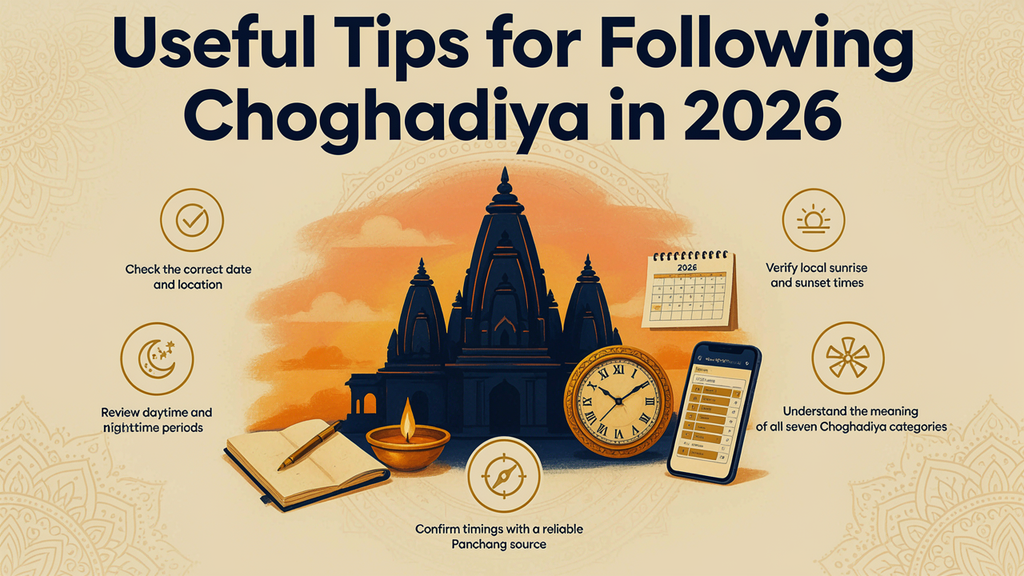
If you regularly consult Choghadiya, a simple routine can make the process easier.
- Check the daily table in the morning or before planning the activity.
- Select the correct date and city rather than relying on a generic timetable.
- Note the start and end of the preferred period.
- If the activity is important, check the other Panchang timings relevant to your tradition.
- Keep a small time buffer for travel, preparation, or arranging the activity.
- Confirm real-world arrangements independently.
- Recheck the table if your date, location, or plan changes.
For everyday tasks, this process can provide a convenient way to follow a traditional timing preference. For weddings, housewarmings, and other major ceremonies, families may want a more detailed Muhurat assessment.
FAQs
What is Choghadiya Today 2026, and why is it important?
Choghadiya Today 2026 is a traditional Hindu astrology timetable that divides the day and night into specific periods. People use it to identify times considered favorable or unfavorable for daily activities.
How can I check Choghadiya Today 2026 timings?
You can check a reliable Hindu Panchang website and select your current date and city. The timetable typically shows daytime and nighttime Choghadiya periods based on local sunrise and sunset.
Which is the most auspicious time in Choghadiya Today 2026?
Amrit, Shubh, and Labh are generally considered favorable periods in traditional Choghadiya. The most suitable time depends on your planned activity and personal customs.
What are the seven types of Choghadiya Today 2026?
The seven types are Amrit, Shubh, Labh, Char, Rog, Kaal, and Udveg. Each period has a traditional meaning that helps people choose timings according to their beliefs.
Does Choghadiya Today 2026 change every day?
Yes, the exact timings change daily because they depend on local sunrise and sunset. Always check the timetable for your chosen date and location.
How many periods are included in Choghadiya Today 2026?
The traditional system divides daytime into eight periods and nighttime into eight periods. Their durations vary according to the length of daylight and nighttime.
Can I use Choghadiya Today 2026 for starting a new business?
Yes, many people consult Choghadiya when opening a shop, launching a business, or starting a new project. They often prefer periods traditionally associated with positive results.
Is Choghadiya Today 2026 useful for planning travel?
Some travelers consult Choghadiya to choose a traditionally favorable departure time. However, transportation schedules, weather, traffic, and safety should always come first.
How is daytime calculated in Choghadiya Today 2026?
Daytime Choghadiya starts at local sunrise and ends at sunset. This interval is divided into eight parts, with each period lasting a different amount of time throughout the year.
How can I check nighttime Choghadiya Today 2026?
Choose a date-specific timetable that includes nighttime periods. These periods run from sunset to the next sunrise and are divided into eight parts.
Can Choghadiya Today 2026 help me plan puja?
Yes, people often consult the timetable when planning daily worship and religious activities. For major ceremonies, they may also consider a specific muhurat and other traditional guidelines.
What does Amrit mean in Choghadiya Today 2026?
Amrit is traditionally considered one of the most auspicious periods. People often choose it for worship, important beginnings, and other meaningful activities.
Why is Labh considered favorable in Choghadiya Today 2026?
Labh is associated with gain, benefit, and progress in traditional astrology. People may prefer this period for business activities and starting new projects.
What is the meaning of Shubh in Choghadiya Today 2026?
Shubh means favorable or auspicious. This period is traditionally preferred for positive beginnings, religious ceremonies, and important personal activities.
Should I avoid Rog and Kaal in Choghadiya Today 2026?
Traditional astrology generally considers Rog and Kaal unfavorable for auspicious beginnings. These interpretations reflect cultural beliefs and are not scientifically established predictions.
Can I use Choghadiya Today 2026 before buying a new vehicle?
Yes, some people consult Choghadiya before purchasing or taking delivery of a vehicle. They may choose a period traditionally considered favorable for new beginnings.
What is the difference between Choghadiya Today 2026 and Shubh Muhurat?
Choghadiya divides the day into traditional time periods, while a Shubh Muhurat is a selected favorable time for a particular activity. Some ceremonies require additional astrological considerations.
How accurate is the Choghadiya Today 2026 timetable?
The calculated timings depend on the correct date, location, sunrise and sunset data, and calculation method. Use a reliable Panchang that matches your local time zone.
Can Choghadiya Today 2026 be used for wedding planning?
Yes, some families consult Choghadiya for wedding-related activities. For the main marriage ceremony, they may seek a specific marriage muhurat from a knowledgeable astrologer.
Where can I find a complete Choghadiya Today 2026 table?
You can visit a reliable Hindu Panchang website that provides date-wise daytime and nighttime timings. Select your city to get timings based on the correct local sunrise and sunset.
Conclusion
Choghadiya Today 2026 is a useful traditional reference for people who want to understand auspicious and inauspicious periods throughout the day. It can help you explore favorable timings for puja, travel, business activities, and important beginnings. By learning the seven Choghadiya types, you can understand the daily timetable more easily. Always check the correct date and location before relying on specific timings. Use this guide to explore traditional Hindu timekeeping with greater confidence.
Whether you are planning a religious ceremony or checking daily auspicious periods, Choghadiya Today 2026 makes it easier to understand the traditional calendar system. Remember that the timings change with local sunrise and sunset, so yesterday’s schedule may not apply today. For major events such as weddings and housewarming ceremonies, consider consulting a qualified astrologer for specific guidance. Balance traditional beliefs with practical needs when making decisions. Keep a reliable Panchang handy to check daily timings whenever necessary.
Read More: Aaj Ka Choghadiya 2026: Complete Day and Night Muhurat Guide for Spiritual Travel
