

The Hindu Panchang is a traditional calendar that helps people understand important daily details such as Tithi, Nakshatra, Yoga, Karana, sunrise, sunset, fasting days, and auspicious timings. Aaj Ka Panchang is especially useful for devotees who want to plan prayers, puja, temple visits, religious ceremonies, or other spiritual activities according to the Hindu calendar. Since many Panchang timings depend on the location, checking the details for your city can provide more accurate information.
For many families, the Panchang is also a simple way to stay connected with Hindu traditions and important festivals throughout the year. Aaj Ka Panchang can help you find today’s lunar date, observe vrat and festival timings, and understand periods such as Rahu Kaal and Abhijit Muhurat. In this guide, you will learn how to read the daily Panchang and understand the key information it provides.
What Is Aaj Ka Panchang?
Aaj Ka Panchang means “today’s Panchang” or “today’s Hindu almanac.” It provides astronomical and calendrical information used in the Hindu tradition to understand the qualities and divisions of a particular day.
The word Panchang comes from two Sanskrit words: Pancha, meaning five, and Anga, meaning limbs or parts. The five primary components are:
Tithi – Lunar day
Nakshatra – Lunar constellation
Yoga – A particular Sun-Moon combination
Karana – Half of a Tithi
Vara – Day of the week
A daily Panchang may also include sunrise, sunset, moonrise, moonset, Rahu Kaal, Gulika Kaal, Yamaganda, auspicious Muhurat, fasting information, and festival details.
Why Do People Check the Daily Panchang?
People consult the Panchang for both religious observances and traditional timekeeping. Its use varies among families, regions, communities, and traditions.
Common reasons include:
- Checking today’s Tithi and Nakshatra
- Finding fasting and festival dates
- Planning puja and religious ceremonies
- Checking auspicious Muhurat
- Identifying Rahu Kaal
- Understanding the lunar phase
- Planning temple visits
- Selecting traditional times for important activities
- Following regional Hindu calendar traditions
- Planning spiritual journeys and pilgrimages
Panchang information can be especially useful during major festivals because Hindu festivals are generally calculated according to lunar and solar movements rather than simply using a fixed Gregorian calendar date.
The Five Angas of Panchang Explained
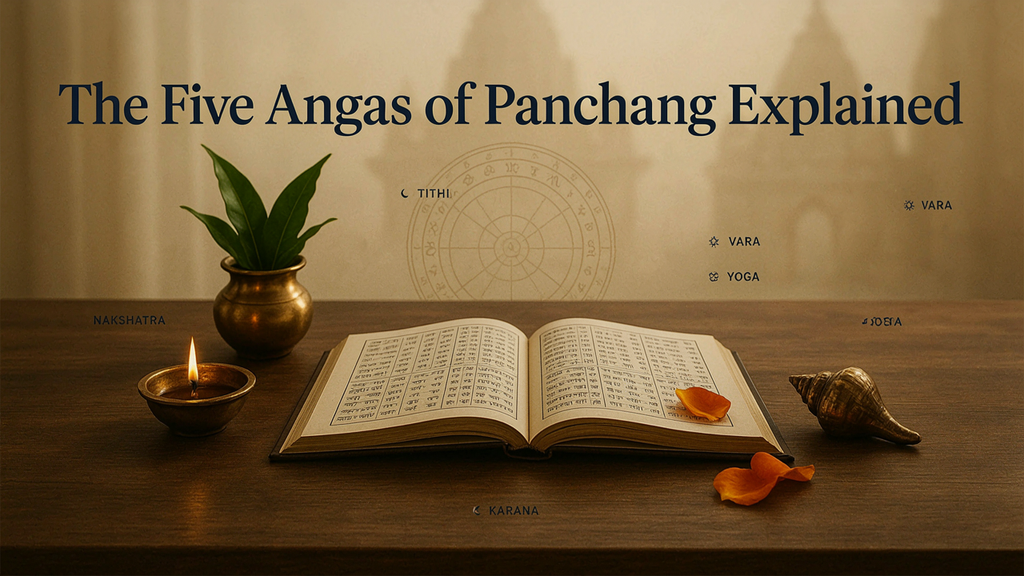
The five traditional elements form the foundation of a Panchang.
| Panchang Element | Simple Meaning | Why It Matters |
| Vara | Day of the week | Connects the day with its traditional planetary association |
| Tithi | Lunar day | Important for festivals, fasting, and religious observances |
| Nakshatra | Lunar constellation | Used in many traditional Muhurat calculations |
| Yoga | Sun-Moon angular relationship | Helps classify the quality of a period |
| Karana | Half of a Tithi | Used in traditional calendrical calculations |
These five elements are calculated using astronomical positions. Different Panchang systems can sometimes show differences because of calculation methods, regional traditions, or location.
Aaj Ki Tithi: Understanding the Hindu Lunar Day
Tithi is one of the most important parts of the Hindu calendar. It represents a lunar day based on the angular relationship between the Sun and Moon.
There are 30 Tithis in a lunar month. They are divided into two groups:
Shukla Paksha
Shukla Paksha is the waxing phase of the Moon, beginning after Amavasya and leading toward the full Moon.
Krishna Paksha
Krishna Paksha is the waning phase, beginning after Purnima and continuing toward Amavasya.
Tithis include names such as:
- Pratipada
- Dwitiya
- Tritiya
- Chaturthi
- Panchami
- Shashthi
- Saptami
- Ashtami
- Navami
- Dashami
- Ekadashi
- Dwadashi
- Trayodashi
- Chaturdashi
- Purnima or Amavasya
Because a Tithi does not necessarily match a midnight-to-midnight day, its start and end time can occur during different parts of a civil day.
Image Caption: The Moon’s changing phases illustrate the lunar cycle used in the Hindu Panchang.
Today’s Nakshatra and Its Traditional Significance
Nakshatra refers to one of the 27 divisions of the zodiac used in traditional Indian astronomy and astrology. The Moon’s position determines the Nakshatra associated with a particular time.
The 27 Nakshatras include:
- Ashwini
- Bharani
- Krittika
- Rohini
- Mrigashira
- Ardra
- Punarvasu
- Pushya
- Ashlesha
- Magha
- Purva Phalguni
- Uttara Phalguni
- Hasta
- Chitra
- Swati
- Vishakha
- Anuradha
- Jyeshtha
- Mula
- Purva Ashadha
- Uttara Ashadha
- Shravana
- Dhanishtha
- Shatabhisha
- Purva Bhadrapada
- Uttara Bhadrapada
- Revati
Nakshatra information is traditionally considered when determining certain Muhurat and religious activities.
What Are Yoga and Karana in Panchang?
Yoga
In Panchang calculations, Yoga is determined from the combined longitudinal positions of the Sun and Moon. There are 27 traditional Yogas.
Some commonly known names include:
- Vishkambha
- Priti
- Ayushman
- Saubhagya
- Shobhana
- Atiganda
- Sukarma
- Dhriti
- Shoola
- Ganda
Yoga is one of the five main Panchang components and is used in traditional calendrical calculations.
Karana
A Karana represents half of a Tithi. There are 11 traditional Karanas, including both movable and fixed Karanas.
Karana information is generally more technical than Tithi or Nakshatra, but it forms an important part of the complete Panchang calculation.
Sunrise, Sunset, Moonrise and Moonset
Daily Panchang information commonly begins with astronomical timings such as:
- Sunrise
- Sunset
- Moonrise
- Moonset
- Day duration
- Night duration
These times are not universal. A person checking the Panchang in Delhi can receive different timings from someone checking it in Mumbai, New York, London, or another location.
For this reason, anyone searching for Aaj Ka Panchang should select the correct city or geographic location when using a Panchang calendar.
This is particularly important when checking a Tithi or Muhurat that changes during the day.
Rahu Kaal, Gulika Kaal and Yamaganda
Many daily Panchang pages include three traditional time periods:
Rahu Kaal
Rahu Kaal is a period traditionally regarded as unsuitable for beginning certain important activities. Its timing changes according to the weekday and the local sunrise and sunset.
Gulika Kaal
Gulika Kaal is another traditional time division calculated from the day’s planetary time periods.
Yamaganda
Yamaganda is also traditionally considered when selecting times for certain activities.
These periods are location-dependent, so a fixed time should not be used for every city.
Abhijit Muhurat and Other Auspicious Timings
A Muhurat is a selected period considered suitable for a particular activity according to traditional Hindu calendrical practices.
One commonly listed period is Abhijit Muhurat, generally associated with the middle portion of the daytime. However, its exact timing depends on local sunrise and sunset.
Depending on the Panchang system, a daily page may also provide:
- Brahma Muhurat
- Amrit Kaal
- Vijaya Muhurat
- Godhuli Muhurat
- Nishita Kaal
- Rahu Kaal
- Yamaganda
- Gulika Kaal
The suitability of a particular Muhurat can depend on the activity being planned and the regional tradition being followed.
Aaj Ka Panchang and Hindu Festivals
The Panchang is particularly important for determining Hindu festivals and fasting observances.
Dates for events such as:
- Ekadashi
- Purnima
- Amavasya
- Pradosh Vrat
- Sankashti Chaturthi
- Shivaratri
- Navratri
- Janmashtami
- Ganesh Chaturthi
- Diwali
- Holi
- Dussehra
are traditionally determined using specific calendrical rules.
A festival can sometimes fall on different civil-calendar dates in different locations because the relevant Tithi may begin or end at different local times.
For major religious events, check a location-specific Panchang and follow the tradition used by your family, temple, or community.
How to Read Aaj Ka Panchang Correctly
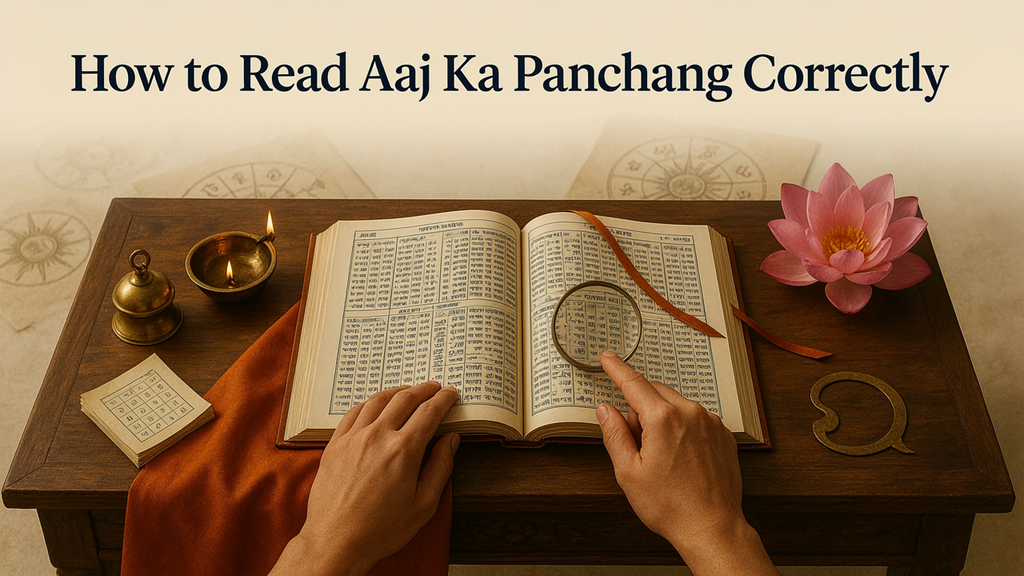
A daily Panchang can initially look complicated because it contains several Sanskrit terms and astronomical timings.
A simple approach is to read it in this order:
- Check the date and location.
- Look at sunrise and sunset.
- Check the current Tithi.
- Note when the Tithi begins or ends.
- Check the Nakshatra and its transition time.
- Review Yoga and Karana.
- Check Rahu Kaal and other traditionally avoided periods.
- Look for today’s fasting or festival information.
- Review Muhurat if you are planning a religious or important activity.
This makes the daily Panchang much easier to understand.
Aaj Ka Panchang for Travel and Pilgrimage Planning
Although Panchang is primarily a traditional calendar, some travelers use it when organizing spiritual journeys, temple visits, and pilgrimages.
For example, a traveler may consider:
- Festival dates
- Ekadashi or other fasting days
- Temple celebrations
- Sunrise and sunset
- Local religious events
- Traditional Muhurat
- Lunar dates associated with a particular temple or pilgrimage
If you are traveling for a festival, remember that transportation and accommodation can become busy around major religious occasions. Check official temple announcements and transportation providers before making arrangements.
Image Caption: Devotees visiting a Hindu temple during a traditional religious celebration.
Regional Differences in Hindu Panchang Calendars
One of the most important things to understand is that there is not always one universal Panchang calculation used by every Hindu community.
Regional calendars may follow different conventions, including:
- Amanta or Purnimanta lunar months
- Different regional festival traditions
- Different astronomical calculation methods
- Local sunrise and sunset
- Different rules for determining festival observance
For example, the naming and timing of lunar months can differ between northern and southern Indian calendar traditions.
This does not necessarily mean that one calendar is “wrong.” It can reflect differences in regional calendrical systems and religious traditions.
Is Aaj Ka Panchang the Same in India and the USA?
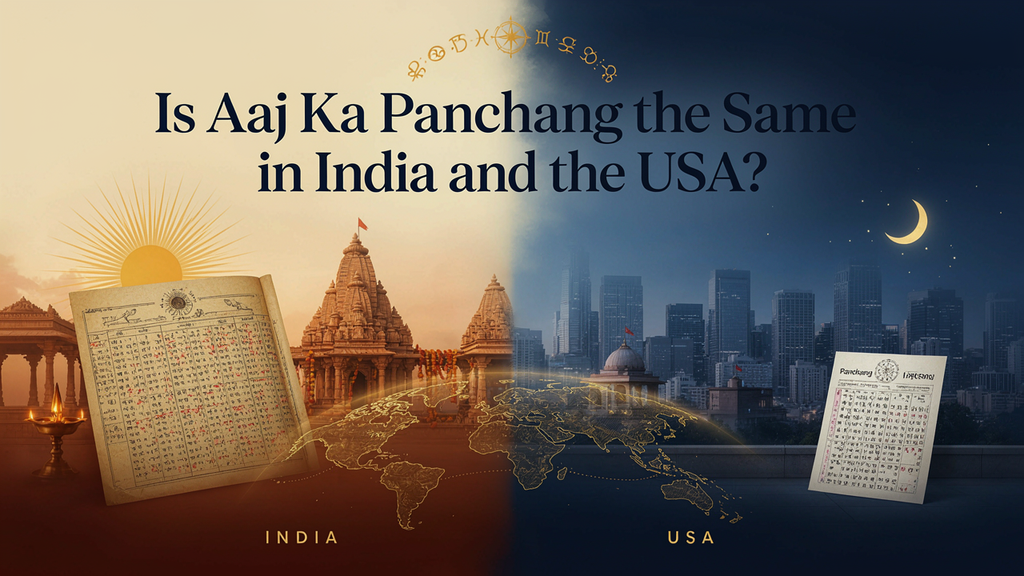
No. The basic astronomical system is the same, but the displayed timings can differ by location.
A Panchang calculated for:
- Delhi
- Mumbai
- Chennai
- Hyderabad
- Kathmandu
- New York
- Chicago
- Los Angeles
may show different sunrise, sunset, Tithi-transition, and Muhurat timings.
This is why users living outside India should choose their actual city when checking the daily Panchang.
For religious ceremonies, it is also useful to confirm the applicable tradition with the temple or priest conducting the ceremony.
Panchang, Hindu Calendar and Gregorian Calendar
The Gregorian calendar is primarily a solar calendar, while traditional Hindu calendars combine solar and lunar calculations.
| Calendar Information | Gregorian Calendar | Hindu Panchang |
| Main basis | Solar year | Solar and lunar movements |
| Months | January–December | Lunar/solar regional systems |
| Day | Midnight-based civil day | Includes astronomical divisions |
| Festivals | Usually fixed or rule-based dates | Often determined by Tithi and other factors |
| Location effect | Usually limited for date | Important for astronomical timings |
This is why a festival that appears to have a particular date on one calendar may require more detailed calculation to determine the exact observance period.
How to Use Panchang for Daily Spiritual Practice
You do not need to understand every technical calculation to benefit from a Panchang.
A simple daily routine could include:
- Checking today’s Tithi
- Noting any fasting observance
- Checking the day’s Nakshatra
- Reviewing sunrise and sunset
- Identifying important festival information
- Setting aside time for prayer or meditation
- Checking temple schedules separately
- Using a location-specific Muhurat when required
Panchang can therefore serve as a traditional planning tool as well as a calendar reference.
Important Tips Before Using Today’s Panchang
Keep these points in mind when checking a daily Panchang:
- Always select your city or location.
- Do not assume Indian timings apply to another country.
- Check whether the calendar follows your preferred regional tradition.
- Confirm festival observance rules for your community.
- For temple visits, verify the temple’s official schedule separately.
- For major ceremonies, consult the priest or qualified Panchang expert responsible for the event.
- Remember that astronomical timings can change from one date to another.
- Do not rely on an old screenshot or yesterday’s Panchang for today’s timings.
For September 25, 2026, for example, the exact Panchang should be calculated for the user’s location rather than presenting one universal set of timings.
A Simple Daily Panchang Checklist
If you only have a few minutes each morning, use this checklist:
| Check | What to Look For |
| Date | Today’s Gregorian and Hindu calendar date |
| Vara | Day of the week |
| Tithi | Current lunar day |
| Nakshatra | Moon’s current Nakshatra |
| Yoga | Current Yoga |
| Karana | Current Karana |
| Sunrise | Local sunrise |
| Sunset | Local sunset |
| Rahu Kaal | Traditional time period |
| Muhurat | Relevant auspicious periods |
| Vrat | Fasting observances |
| Festival | Religious events for the day |
FAQs
What is Aaj Ka Panchang and what does it include?
Aaj Ka Panchang provides daily Hindu calendar details such as Tithi, Nakshatra, Yoga, Karana, sunrise, sunset, and auspicious timings. It may also include festivals and fasting information.
How can Aaj Ka Panchang help with daily पूजा and rituals?
It helps devotees identify important Tithis, fasting days, Muhurat, and other traditional timings. This information can be used when planning prayers, puja, and religious observances.
Why does Aaj Ka Panchang vary from one city to another?
Panchang timings depend on local astronomical conditions, especially sunrise and sunset. Therefore, Tithi, Rahu Kaal, and Muhurat timings can differ between cities.
How does Aaj Ka Panchang show the current Tithi?
The Panchang calculates Tithi from the changing angular relationship between the Sun and Moon. A Tithi can begin or end at different times during a calendar day.
Can Aaj Ka Panchang be used to check Hindu fasting days?
Yes, it can provide information about fasting observances such as Ekadashi, Purnima, Amavasya, and Pradosh Vrat. Exact observance rules may vary by region and tradition.
Does Aaj Ka Panchang include Rahu Kaal timings?
Most daily Panchang calendars include Rahu Kaal along with other traditional time periods. The exact timing changes according to the weekday and local sunrise and sunset.
How can Aaj Ka Panchang help when planning temple visits?
It can help you identify festivals, Tithis, and spiritually significant days. However, always check the temple’s official opening hours and special darshan schedule separately.
Is Aaj Ka Panchang useful for people living outside India?
Yes, but the Panchang should be calculated for the user’s actual city. Sunrise, sunset, lunar transitions, and other timings can differ significantly by location.
What are the five main parts of Aaj Ka Panchang?
The five main parts are Vara, Tithi, Nakshatra, Yoga, and Karana. Together, these are traditionally known as the five limbs of the Panchang.
Where can I check accurate Aaj Ka Panchang timings?
Choose a reliable Panchang source that allows you to select your city and date. For important ceremonies, it is also helpful to confirm timings with a trusted priest or temple.
Conclusion
Aaj Ka Panchang is a useful traditional guide for understanding the Hindu calendar and daily religious timings.
It brings together Tithi, Nakshatra, Yoga, Karana, and Vara in one place.
It can also provide information about festivals, fasting days, sunrise, sunset, and Muhurat.
These details can help devotees plan their spiritual activities more carefully.
For the most accurate results, always check Panchang timings for your location.
Aaj Ka Panchang can be especially helpful when preparing for festivals, temple visits, puja, or traditional ceremonies.
Remember that timings may change according to your city and the Panchang tradition being followed.
Regional calendars can also use different methods for determining certain festival observances.
For important religious events, compare the information with a trusted local source.
Used correctly, the Panchang can make daily Hindu calendar information easier to understand and follow.
Read More: 2026 Hindu Festivals Calendar, Hindu Tyohar Calendar for Gujranwala, Punjab, Pakistan
