


Planning a spiritual journey, temple visit, or special outing can become more meaningful when traditional muhurat is included in the travel plan. Aaj Ka Choghadiya helps travelers understand the favorable and less favorable periods of the day and night, making it easier to choose a suitable time to begin a journey.
Choghadiya is especially useful for travelers who follow Hindu Panchang traditions and want to combine cultural beliefs with practical trip planning. Aaj Ka Choghadiya timings vary according to the date, location, sunrise, and sunset, so checking the correct city before traveling is important for an accurate and useful schedule.
Quick Travel & Choghadiya Planning Overview
| Information | Details |
| Topic | Choghadiya-based travel and muhurat planning |
| Geographic Scope | Commonly associated with Hindu Panchang traditions, especially North India; related timing systems are also used elsewhere |
| Calculation Basis | Local sunrise, sunset, date, and weekday |
| Day Periods | 8 Choghadiya divisions between sunrise and sunset |
| Night Periods | 8 Choghadiya divisions between sunset and next sunrise |
| Best-Known Favorable Periods | Amrit, Shubh, Labh, and Char |
| Travel-Focused Period | Char/Chara is traditionally associated with movement and travel |
| Important Cross-Check | Rahu Kala and other Vela periods may also be considered |
| Recommended Trip Length | Flexible: a few hours, one day, weekend, or a longer pilgrimage |
| Exact Timings | Must be checked for the chosen city and date |
The four commonly classified favorable Choghadiya are Amrit, Shubh, Labh, and Char, while Rog, Kaal, and Udveg are generally classified as unfavorable. Chara is especially associated with travel because of its moving nature.
What Is Choghadiya and Why Does It Matter for Travel?
Choghadiya, also written as Choghadia or Chaughadia, is a traditional muhurat system used to identify different periods of the day. It is especially popular in North India and is traditionally used as a simple way of selecting an appropriate time for activities without needing a detailed astrological consultation for every routine decision.
The system divides the period between sunrise and sunset into eight equal sections. The period between sunset and the next sunrise is similarly divided into eight sections. This produces eight daytime and eight nighttime Choghadiya periods.
For travelers, the important idea is simple: the start of a journey can be matched with a traditionally favorable period. For example, someone leaving for a temple town might prefer to depart during Char, Amrit, Shubh, or another period considered suitable for the particular purpose.
However, Choghadiya should not be used mechanically. A good travel plan still needs realistic departure time, road conditions, rest breaks, public transport schedules, hotel check-in rules, weather information, and daylight considerations.
How Aaj Ka Choghadiya Is Calculated
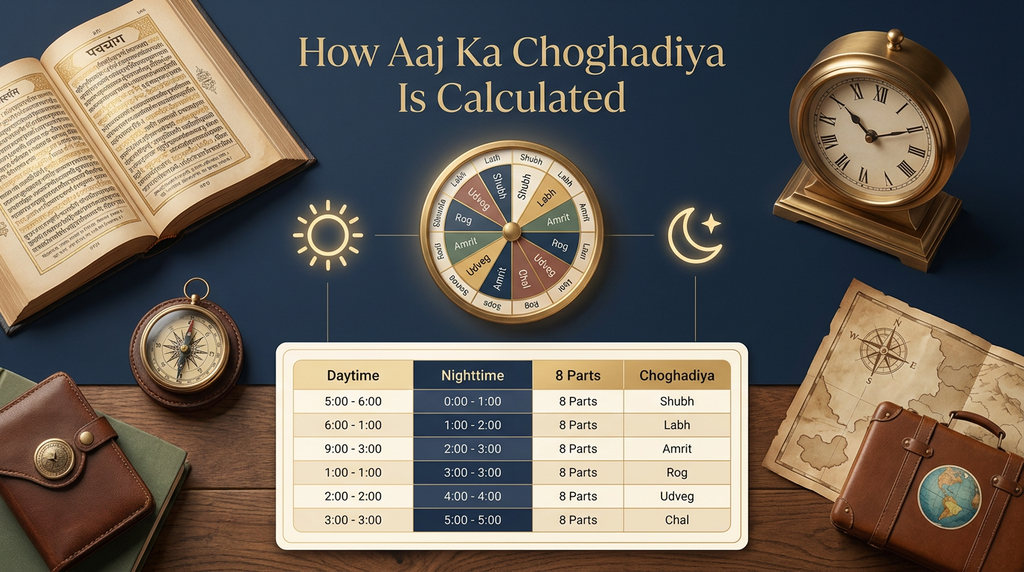
A Choghadiya calculator normally starts with two astronomical reference points: local sunrise and local sunset.
The daytime interval is divided into eight equal parts. The nighttime interval is also divided into eight equal parts. Since sunrise and sunset vary by location and throughout the year, each Choghadiya segment can have a different duration from one place or season to another.
The order of the periods is also connected with the weekday. For example, on Sunday, the daytime sequence begins with the influence associated with the Sun, followed by Venus, Mercury, Moon, Saturn, Jupiter, and Mars, before the cycle returns to the day lord.
That is why copying a Choghadiya table from another city can give misleading results. A traveler should always select the actual city or locality where the journey begins.
A Simple Choghadiya Calculation Formula
For practical understanding:
Day Choghadiya duration = (Sunset − Sunrise) ÷ 8
Night Choghadiya duration = (Next Sunrise − Sunset) ÷ 8
The resulting periods are then assigned their traditional Choghadiya names according to the weekday sequence.
Today’s Choghadiya Example: 4 October 2026
Because “today” changes with both date and location, there is no single universal table. For Sunday, October 4, 2026, published city calculations demonstrate how much the clock changes from place to place.
New Delhi Example
For New Delhi on October 4, 2026, sunrise is listed at 6:15 AM and sunset at 6:04 PM. The daytime sequence includes Chara, Labh, Amrit, Shubh, and the traditionally unfavorable periods.
| Day Choghadiya | Time | Traditional Classification |
| Udveg | 6:15–7:44 AM | Unfavorable |
| Chara | 7:44–9:13 AM | Travel-friendly/neutral |
| Labh | 9:13–10:41 AM | Favorable |
| Amrit | 10:41 AM–12:10 PM | Highly favorable |
| Kaal | 12:10–1:38 PM | Unfavorable |
| Shubh | 1:38–3:07 PM | Favorable |
| Rog | 3:07–4:35 PM | Unfavorable |
| Udveg | 4:35–6:04 PM | Unfavorable |
The New Delhi nighttime periods continue after sunset and extend into the following morning.
Lahore Example
The same date produces different times in Lahore. On October 4, 2026, sunrise is listed at 5:58 AM and sunset at 5:44 PM.
| Day Choghadiya | Time | Traditional Classification |
| Udveg | 5:58–7:26 AM | Unfavorable |
| Chara | 7:26–8:55 AM | Travel-friendly/neutral |
| Labh | 8:55–10:23 AM | Favorable |
| Amrit | 10:23–11:51 AM | Highly favorable |
| Kaal | 11:51 AM–1:19 PM | Unfavorable |
| Shubh | 1:19–2:48 PM | Favorable |
| Rog | 2:48–4:16 PM | Unfavorable |
| Udveg | 4:16–5:44 PM | Unfavorable |
Lahore’s nighttime sequence then begins with Shubh and Amrit before moving through the remaining periods.
Travel lesson: never assume that a Choghadiya time shown for Delhi, Lahore, Karachi, Jaipur, or another city will work for your departure location.
Understanding the Seven Main Choghadiya Periods
There are seven named Choghadiya categories in the standard cycle. Some repeat during the day and night.
| Choghadiya | Traditional Meaning | Travel Planning Use |
| Amrit | Nectar; highly favorable | Suitable for important beginnings |
| Shubh | Auspicious | Traditionally favorable for many activities |
| Labh | Gain | Favored for productive or beneficial activities |
| Chara/Char | Movement | Particularly suitable for travel |
| Udveg | Anxiety/agitation | Generally avoided for auspicious beginnings |
| Kaal | Loss | Generally avoided for auspicious beginnings |
| Rog | Illness/problem | Generally avoided for auspicious beginnings |
Drik Panchang classifies Amrit, Shubh, Labh, and Char as good periods and Rog, Kaal, and Udveg as periods generally avoided for auspicious work. It specifically describes Chara as suitable for travel because of its association with movement.
Should Travelers Always Choose Char?
Not necessarily. Char is particularly associated with travel, but Amrit or Shubh may also be attractive choices when they fit the travel purpose. A traveler should also check whether the selected interval overlaps with another period that their Panchang tradition recommends avoiding.
How to Use a Choghadiya Calculator Before a Trip
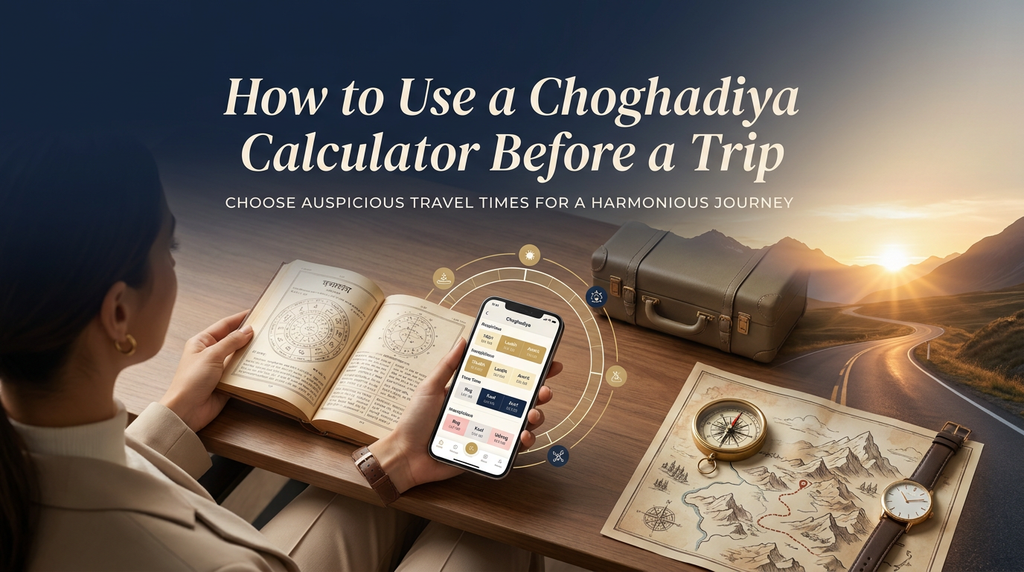
A Choghadiya calculator is most useful when used as part of a practical checklist.
First, select the exact date of travel. Next, select the city where the journey begins, not simply the destination. The calculator can then determine local sunrise and sunset and generate the eight daytime and eight nighttime periods.
For a spiritual journey, travelers can then compare the available periods with their planned departure. If the trip begins with a short drive to a railway station or airport, the relevant time may be the moment you actually begin the journey rather than the moment you board the train or flight.
A practical sequence is:
- Check sunrise and sunset for your location.
- Open the date-specific Choghadiya table.
- Identify favorable periods such as Char, Amrit, Shubh, or Labh.
- Check Rahu Kala and other Vela periods as required by your tradition.
- Compare the selected time with the real transport schedule.
- Choose a safe and realistic departure rather than delaying a trip unnecessarily.
This approach keeps traditional planning and real-world travel needs in balance.
Choghadiya, Rahu Kala and Other Muhurat Checks
Choghadiya is only one timing system used in traditional Panchang-based planning. Travelers may also check Rahu Kala, Vaar Vela, Kaal Vela, and Kaal Ratri, depending on their practice.
A particularly important issue is an overlap between a favorable Choghadiya and an unfavorable period. Drik Panchang notes that an auspicious Choghadiya can overlap with Rahu Kala and states that such an interval may be rejected when selecting a muhurat. It likewise advises considering Vaar Vela, Kaal Vela, and Kaal Ratri when choosing a favorable period.
This means a green or favorable label on one calendar should not automatically be treated as the only factor.
For a major religious ceremony or important life event, travelers may prefer to use their family tradition, local Panchang, or guidance from a knowledgeable priest alongside Choghadiya.
Best Travel Experiences to Plan Around Choghadiya
Choghadiya becomes especially useful when travel has a clear starting point or a meaningful activity attached to it.
Temple and Pilgrimage Visits
A traveler can select a favorable departure window before beginning a journey to a temple town or pilgrimage center. For longer journeys, the Choghadiya time can serve as the preferred departure goal while transport and safety remain the deciding practical factors.
Spiritual Day Trips
A day trip can be organized around a morning departure, temple visit, peaceful meal, cultural sightseeing, and return journey. A favorable morning period can be used to begin the outing.
Religious Ceremonies
When travel is connected with puja, darshan, a family ceremony, or another religious event, Choghadiya can be consulted alongside the specific muhurat prescribed for the ceremony.
Family Cultural Travel
Families can use the system as a cultural experience for children, helping them understand how traditional calendars influence travel and daily routines.
Best Destinations for a Choghadiya-Based Spiritual Trip
There is no single “Choghadiya destination.” Instead, the system can be applied to many types of spiritual and cultural journeys.
Well-known Indian pilgrimage and spiritual travel regions include destinations such as Varanasi, Haridwar, Ujjain, Mathura-Vrindavan, Ayodhya, Nashik, Pushkar, Puri, Rameswaram, and Madurai. The most suitable choice depends on the purpose of the trip, available transport, season, and the traveler’s preferred religious or cultural experience.
Rather than selecting a destination simply because a certain Choghadiya appears favorable, first choose the destination and travel dates. Then calculate the exact muhurat for the city and starting point.
What to Look for in a Choghadiya-Friendly Destination
Choose places that offer:
- Temples or pilgrimage sites
- Cultural and historical attractions
- Easy access to food and accommodation
- Family-friendly public spaces
- Reasonable transport connections
- Enough activities to match the length of the trip
How to Reach Your Chosen Spiritual Destination
Because Choghadiya is location-specific, transportation also needs to be planned around the actual destination.
By Air
For a long-distance trip, identify the nearest suitable commercial airport serving the chosen city or region. After checking the flight schedule, work backward from your preferred Choghadiya departure window.
Avoid choosing an auspicious time that makes you rush through airport security or arrive too late for check-in.
By Train
Train travel can be a good option for pilgrimage and cultural trips because departure times are usually predetermined. In this situation, Choghadiya can be used when planning the journey from home to the station or when beginning a local leg of the trip.
Do not postpone a confirmed train solely for a preferred period unless you have a flexible ticket and a practical alternative.
By Road
For road trips, Choghadiya can be easier to apply because the departure time is more flexible. Family travelers can prepare luggage in advance and leave during a preferred period without changing an entire public-transport schedule.
By Local Transport
Depending on the destination, local travel may involve:
- City buses
- Auto-rickshaws
- Taxis
- Ride-hailing services
- Rental cars
- Walking
- Hotel transfers
- Local pilgrimage transport
Always verify the latest availability, fares, operating hours, and route conditions before leaving.
Distance & Travel-Time Planning
Since the article does not specify an origin or destination city, a fixed distance table would be misleading. A better approach is to calculate your actual route before selecting the departure Choghadiya.
| Journey Stage | What to Check | Planning Advice |
| Home to station | Live road conditions | Add a safety buffer |
| Home to airport | Check-in and security requirements | Do not cut the timing too close |
| City-to-city road trip | Route distance and traffic | Allow rest and fuel stops |
| Railway journey | Confirmed train schedule | Treat train timing as fixed |
| Local temple transfer | Current transport availability | Check traffic around popular religious sites |
For long-distance travel, actual journey time should take priority over a narrowly selected muhurat. Traditional timing can guide your departure goal, but safety must come first.
Where to Stay During a Choghadiya-Based Journey
Because Choghadiya can be used in many cities, there is no single hotel or accommodation area that suits every trip. The most practical choice depends on the destination and purpose.
Near a Temple or Pilgrimage Area
Staying close to the main religious site can reduce daily travel and make early-morning visits easier.
Near a Railway Station
This can be convenient for travelers with an early train, particularly when the preferred Choghadiya falls close to the start of the day.
Near a Transport Hub
For short trips, accommodation near major transport connections can save valuable time.
Family-Friendly Areas
Families may prefer a quieter neighborhood with convenient access to restaurants, pharmacies, transport, and basic services.
| Accommodation Type | Best For |
| Budget guesthouse | Solo travelers and short stays |
| Dharamshala or pilgrimage lodging | Religious and budget-focused travel where available |
| Mid-range hotel | Families and couples |
| Serviced accommodation | Longer stays or families needing extra space |
| Luxury hotel | Comfort-focused travelers |
Hotel rates vary substantially according to location, season, room type, holidays, and booking date. Check current prices and cancellation conditions before reserving.
Food and Local Dining During a Spiritual Trip
Food is another part of the travel experience that varies by destination. Spiritual and pilgrimage centers often have vegetarian restaurants, traditional regional meals, sweets, snacks, and simple South Asian dining options.
Travelers can look for:
| Food Type | Why Try It |
| Regional vegetarian dishes | Reflect local culinary traditions |
| Temple-associated foods | Connect the journey with local religious culture where appropriate |
| Breakfast snacks | Useful before early departures |
| Fresh fruit and light meals | Convenient during sightseeing |
| Regional sweets | Popular cultural and food experience |
During a Choghadiya-based trip, do not let the preferred travel period force you to skip hydration or meals. Carry water and plan food stops around the actual journey.
Spiritual Travel Budget Guide
Because this article covers multiple possible destinations, publishing one fixed rupee price would not be accurate. Accommodation, meals, transport, entrance fees, and seasonal demand can differ significantly between cities.
A useful planning model is to divide your budget into major categories:
| Expense | Budget Traveler | Mid-Range Traveler | Luxury Traveler |
| Accommodation | Basic lodging or guesthouse | Comfortable private room | Premium hotel/resort |
| Food | Local eateries | Mix of local and established restaurants | Higher-end dining |
| Transport | Public transport | Taxi + public transport | Private transfers |
| Activities | Mostly free/low-cost sites | Paid attractions as needed | Premium experiences |
| Shopping | Minimal | Moderate | Flexible |
| Emergency reserve | Essential | Essential | Strongly recommended |
Check the latest prices in the specific city before booking, especially around religious festivals and major holidays.
A Practical One-Day Choghadiya Travel Itinerary
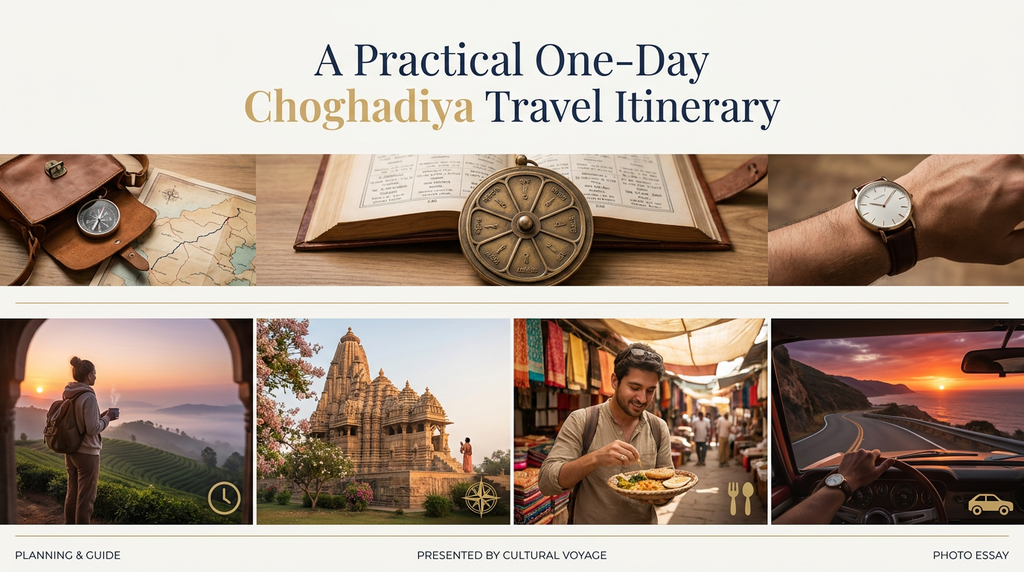
A Choghadiya-focused day trip works best when the timetable is flexible.
| Time Block | Suggested Activity |
| Early Morning | Prepare, breakfast, check weather and route |
| Preferred Choghadiya | Begin the journey when practical |
| Late Morning | Reach destination and visit main spiritual site |
| Afternoon | Lunch, cultural sightseeing, rest |
| Late Afternoon | Photography, market or secondary attraction |
| Evening | Return journey or overnight stay |
| Night | Final checks for next day’s travel |
The exact departure period should be selected from the city’s date-specific Choghadiya table rather than copied from this generic itinerary.
Picnic and Family-Friendly Travel Ideas
Choghadiya does not identify individual picnic places. Instead, it can help families choose a comfortable time to start an outing.
Look for destinations with:
- Public parks and gardens
- Riverside or lakeside areas where permitted
- Temple gardens or surrounding open spaces
- Scenic viewpoints
- Family museums
- Cultural markets
- Nature areas with safe visitor access
For children and older travelers, avoid building a schedule that requires rushing between multiple locations just to match several muhurat periods. One well-planned spiritual visit is often more enjoyable than an overloaded itinerary.
Best Photography and Scenic Opportunities
A Choghadiya-based trip can also become a photography journey. Plan visual stops separately from the muhurat calculation.
Good opportunities may include:
Sunrise: Early morning temple architecture, quiet streets, and natural scenery.
Golden Hour: Warm light on heritage buildings, riverfronts, or historic streets.
Sunset: City skylines, pilgrimage landscapes, and cultural neighborhoods.
Candid Cultural Photography: Markets, traditional crafts, food preparation, and everyday local life.
Always follow photography rules at temples and religious sites. Some sacred areas may restrict cameras or photography.
Image Caption: Travelers exploring a spiritual destination while balancing traditional timing with practical sightseeing.
Local Culture, Customs and Spiritual Etiquette
Choghadiya is part of a wider cultural tradition, so travelers should approach it respectfully.
When visiting religious places, modest clothing is often the safest choice. Remove footwear where required, follow signs and staff instructions, and avoid loud behavior in prayer areas.
Photography should be discreet. Do not photograph people, ceremonies, or private religious activities without appropriate permission.
Travelers should also remember that different families, regions, temples, and traditions may interpret muhurat differently. What one person considers an ideal period may not be treated identically by another community.
The best approach is to use the calendar as a guide while remaining respectful of local customs.
Safety Tips for Choghadiya-Based Travel
Traditional timing should never override basic travel safety.
Before leaving:
- Check current weather and road conditions.
- Confirm train, flight, or bus schedules.
- Keep identification and travel documents secure.
- Carry sufficient water and necessary medicines.
- Charge your phone and keep useful contacts available.
- Use reputable transport services.
- Avoid rushing simply to catch a preferred Choghadiya.
- Keep an emergency time buffer in your itinerary.
For international travel, verify passport, visa, immigration, insurance, and entry requirements using official sources before departure.
For domestic trips, check current transport advisories and local conditions, particularly when traveling during major festivals.
What to Pack for a Choghadiya-Based Spiritual Trip
Your packing list should depend more on the destination and season than on Choghadiya itself.
- Comfortable walking shoes
- Weather-appropriate clothing
- Modest clothing for religious sites
- Reusable water bottle
- Phone and power bank
- Identification and required travel documents
- Personal medicines
- Small day bag
- Sunglasses or rain protection depending on season
- Basic toiletries
- Cash plus a reliable digital-payment option
- Light snacks for travel
- A small scarf or covering where culturally appropriate
For longer pilgrimages, add comfortable clothing for multiple days and any gear required for hiking, outdoor walking, or changing weather.
Common Choghadiya Travel Mistakes to Avoid
Using Another City’s Timings
This is one of the easiest mistakes to make. Sunrise and sunset differ by location, so a table prepared for one city should not automatically be used for another.
Treating All Favorable Periods as Identical
Amrit, Shubh, Labh, and Char are generally favorable, but traditional interpretations can differ depending on the activity. Chara is particularly associated with travel.
Ignoring Rahu Kala or Other Vela Periods
Some travelers check several Panchang elements rather than relying on Choghadiya alone. Overlapping periods can change the preferred choice.
Sacrificing Practical Safety
Missing a train, driving while tired, traveling through dangerous weather, or rushing on a busy road is not a sensible trade-off for a few minutes of preferred timing.
Planning Every Activity Around Muhurat
Choghadiya works best as one planning layer. Leave enough time for meals, traffic, rest, queues, weather, and unexpected delays.
Best Time to Use Choghadiya for Travel
Choghadiya is most useful when a traveler has some flexibility around the beginning of an activity.
| Travel Situation | How Choghadiya Can Help |
| Private-car pilgrimage | Choose a preferred departure window |
| Local day trip | Adjust departure time around favorable periods |
| Temple visit | Plan the start of the outing around a suitable period |
| Family spiritual trip | Create a relaxed departure target |
| Fixed train journey | Use Choghadiya for the journey to the station |
| Fixed flight | Use it as a supplementary planning tool |
| Multi-day road trip | Check the start of each major travel leg |
For fixed transport, the booking should generally come first. Choghadiya can then be incorporated around the unavoidable schedule.
Why Choghadiya Is Useful for Modern Travelers
One reason Choghadiya remains practical is its simplicity. Instead of requiring travelers to understand every part of a complete Panchang, it provides clearly divided periods with traditional classifications.
Digital calculators make this even easier because users can select a date and city and see the corresponding day and night periods. Contemporary Choghadiya services commonly allow travelers to change the location and date instead of relying on a fixed table.
For modern travel, the strongest approach is a combination of traditional preference + accurate local calculation + practical preparation.
That balance lets travelers respect cultural traditions without turning the journey into an unnecessarily rigid schedule.
FAQs
What is Aaj Ka Choghadiya and how is it used?
Aaj Ka Choghadiya divides the day and night into traditional time periods.
Travelers use it to choose a preferred time for starting journeys or important activities.
How is Aaj Ka Choghadiya calculated for today?
The calculation uses local sunrise and sunset for the selected date and place.
Because these times change by location, the exact Choghadiya schedule is not the same everywhere.
Which Aaj Ka Choghadiya is considered best for travel?
Char or Chara is traditionally linked with movement and travel.
Amrit, Shubh, and Labh are also generally considered favorable periods for many activities.
Does Aaj Ka Choghadiya change from city to city?
Yes, the timings can change between cities because sunrise and sunset are different.
Always choose the correct location when checking a Choghadiya calendar or calculator.
Can Aaj Ka Choghadiya be used for a road trip?
Yes, it can help travelers select a preferred departure window for a flexible road journey.
Still, road safety, traffic, weather, and driver rest should remain the top priorities.
Is Aaj Ka Choghadiya the same during day and night?
No, the daytime and nighttime are divided separately into eight periods each.
The duration of each period depends on the local length of day and night.
Should I check Rahu Kala with Aaj Ka Choghadiya?
Many travelers who follow Panchang traditions also check Rahu Kala and other timing periods.
This can help them make a more complete muhurat decision for an important journey.
Can Aaj Ka Choghadiya help with temple or pilgrimage travel?
Yes, it can be used to select a traditional departure time before visiting a temple or pilgrimage site.
It works best as one part of a broader itinerary that includes transport and visiting schedules.
Is Aaj Ka Choghadiya useful for family trips?
Yes, families can use it to choose a convenient and traditionally preferred time to begin their outing.
The schedule should remain flexible enough for children, older travelers, meals, and rest.
Where can I check Aaj Ka Choghadiya for the correct location?
Use a reliable Panchang or Choghadiya calculator that allows you to select the exact date and city.
Check the latest calculation before traveling because the timings change by location and date.
Conclusion
Aaj Ka Choghadiya offers a simple way to include traditional muhurat planning in modern travel.
It can be especially useful for temple visits, pilgrimages, cultural outings, and road journeys.
The most important point is to check the correct date and local location before choosing a period.
Traditional timing should support your travel plan, not make it rushed or difficult.
Always balance cultural preferences with weather, transport schedules, safety, and personal comfort.
A thoughtful journey begins with good preparation as well as meaningful traditions.
Aaj Ka Choghadiya can help travelers choose a preferred starting period with greater confidence.
For fixed trains or flights, practical schedules should always take priority over a narrow time window.
For flexible trips, travelers can build their itinerary around favorable periods while keeping enough extra time.
Used wisely, Choghadiya can add a meaningful cultural element to a well-organized travel experience.
Read More: Rahu Kalam Yamagandam Timings 2026: Today, Monday, Wednesday, Friday & Saturday Travel Guide
