

Planning a temple visit, pilgrimage, or spiritual journey in 2026 can be easier when you understand the traditional Panchang time periods. Rahu Kalam Yamagandam Timings are commonly checked by travelers who prefer to choose suitable times for beginning important activities or journeys. Because these periods depend on the local sunrise and sunset, the exact timings can change from one city to another.
For spiritual travelers, using Panchang traditions can add another thoughtful layer to trip planning while exploring India’s temples, historic towns, sacred rivers, and cultural landmarks. Rahu Kalam Yamagandam Timings can be checked alongside temple schedules, transport times, weather, and other practical details to create a smoother travel plan. This guide explains the 2026 weekday patterns and how to use them during your journey.
Quick Travel Overview
| Information | Details |
| Destination | India-wide spiritual and pilgrimage travel |
| Country | India |
| Travel Theme | Hindu pilgrimage, temple visits, Panchang-based travel planning |
| Exact Rahu Kalam | Depends on local sunrise, sunset, date, and weekday |
| Main Days Covered | Monday, Wednesday, Friday, Saturday |
| Main Experiences | Temple visits, pilgrimage, heritage, ghats, local markets, spiritual activities |
| Currency | Indian Rupee (INR) |
| Languages | Hindi plus regional languages; English is widely useful for tourism |
| Transportation | Domestic flights, trains, buses, taxis, metro systems in selected cities, walking |
| Recommended Duration | 1–3 days for one city; longer for multi-city pilgrimage routes |
| Budget | Highly location-dependent; accommodation and transport create the biggest variations |
| Important Planning Tip | Check a city-specific Panchang before starting a journey or booking a time-sensitive activity |
What Are Rahu Kalam, Yamagandam and Kuligai Kalam?
Rahu Kalam, Yamagandam, and Gulika Kalam are traditional Panchang time periods observed by many Hindu families and communities. They are generally associated with choosing suitable times for beginnings rather than stopping every ordinary activity during the entire period.
Rahu Kalam is traditionally associated with Rahu. It occupies one of eight divisions of the daylight period, and its position changes according to the weekday. Drik Panchang notes that it is commonly considered when deciding whether to begin new work, ceremonies, purchases, or journeys.
Yamagandam, also known as Yama Gandam or Yamaganda, is another traditionally avoided period for certain new beginnings. In travel traditions, it receives particular attention when someone is deciding when to start a journey.
Gulika Kalam, often called Gulikai or Kuligai Kalam in South Indian usage, is the third period. It follows the same daylight-segment calculation but has a different weekday position.
These are matters of religious and cultural tradition, not scientifically established causes of travel outcomes. Travelers who follow Panchang practices can use them as part of their personal planning while still considering practical factors such as weather, traffic, transport schedules, temple opening hours, and safety.
Rahu Kalam Yamagandam Timings Today: Saturday, October 3, 2026
The current date is Saturday, October 3, 2026. Because these timings depend on location, there is no single India-wide clock time for today.
For Saturday, the traditional segment positions are:
- Rahu Kalam: 3rd daylight segment
- Yamagandam: 6th daylight segment
- Kuligai/Gulika Kalam: 1st daylight segment
For example, published Panchang-style calculations for October 3, 2026 show the following local times:
| City | Sunrise | Sunset | Rahu Kalam | Yamagandam | Kuligai/Gulika |
| Chennai | 5:58 AM | 5:57 PM | 8:58–10:28 AM | 1:27/1:28–2:57 PM | 5:58–7:28 AM |
| Delhi | 6:15 AM | 6:05 PM | 9:12–10:41 AM | 1:38–3:07 PM | 6:15–7:43 AM |
| Mumbai | 6:29 AM | 6:25 PM | 9:28–10:57 AM | 1:56–3:26 PM | 6:29–7:59 AM |
| Hyderabad | 6:06 AM | 6:03 PM | 9:05–10:35 AM | 1:34–3:04 PM | 6:06–7:36 AM |
These examples demonstrate why travelers should never copy one city’s “today” time for another city. Current city-based calculators show slightly different results because sunrise and sunset differ by location; minor one-minute differences can also occur between calculation conventions.
Image Caption: A traditional Hindu Panchang travel-planning concept showing sunrise, sunset and daily time divisions.
Rahu Kalam Yamagandam Timings for Monday, Wednesday, Friday and Saturday
For travelers specifically searching for Monday, Wednesday, Friday, and Saturday 2026 timings, the weekday pattern is more useful than a fixed clock schedule.
The following table assumes an illustrative 6:00 AM sunrise and 6:00 PM sunset. These are examples only; real times must be recalculated using local sunrise and sunset.
| Day | Rahu Kalam | Yamagandam | Kuligai/Gulika Kalam |
| Monday | 2nd segment — 7:30–9:00 AM | 4th segment — 10:30 AM–12:00 PM | 6th segment — 1:30–3:00 PM |
| Wednesday | 5th segment — 12:00–1:30 PM | 2nd segment — 7:30–9:00 AM | 4th segment — 10:30 AM–12:00 PM |
| Friday | 4th segment — 10:30 AM–12:00 PM | 7th segment — 3:00–4:30 PM | 2nd segment — 7:30–9:00 AM |
| Saturday | 3rd segment — 9:00–10:30 AM | 6th segment — 1:30–3:00 PM | 1st segment — 6:00–7:30 AM |
The weekday assignments are traditionally fixed by segment, while the actual length of each segment changes with daylight duration.
A useful rule to remember is that 12-hour daylight creates 90-minute segments, but a longer or shorter day produces longer or shorter segments. This is why statements such as “Monday Rahu Kalam is always 7:30–9:00 AM” should be treated as examples rather than universal 2026 times.
How a Rahu Kalam Calculator Works
A Rahu Kalam Yamagandam Timings calculator is essentially a daylight-segment calculator.
The process is:
- Find the local sunrise.
- Find the local sunset.
- Calculate the total daylight duration.
- Divide daylight by eight.
- Identify the weekday.
- Select the appropriate segment for Rahu Kalam, Yamagandam, or Gulika.
For example, assume a destination has a 6:00 AM sunrise and 6:00 PM sunset.
Total daylight: 12 hours
12 hours ÷ 8: 1 hour 30 minutes per segment
Saturday assigns Rahu Kalam to the third segment. Therefore:
- Segment 1: 6:00–7:30 AM
- Segment 2: 7:30–9:00 AM
- Segment 3: 9:00–10:30 AM
So the illustrative Saturday Rahu Kalam is 9:00–10:30 AM.
The same method produces the Yamagandam and Kuligai periods using their respective segment numbers.
Simple Formula
Segment length = (Sunset − Sunrise) ÷ 8
Then:
Period start = Sunrise + [(Segment number − 1) × Segment length]
Period end = Period start + Segment length
This makes a location-specific calculator much more reliable than copying a standard table from another city.
How to Use These Timings When Planning a Spiritual Journey
For travelers, the most practical use is to plan the beginning of a journey or important activity around the traditional periods.
Suppose you are traveling to a temple town by train. Your train may depart at 8:30 AM, while the next suitable traditional window begins later. In that situation, practical transport availability may matter more than an idealized schedule, especially when tickets are fixed.
A more flexible road trip is easier to coordinate. You can finish breakfast, pack the vehicle, leave the hotel, and begin the journey outside the period your tradition recommends avoiding.
The important distinction is between starting something new and continuing an activity that has already begun. Drik Panchang notes that Rahu Kaal is commonly considered for new work, while already-started work may continue.
For travel planning, check the following in order:
| Planning Question | Why It Matters |
| Where does the journey begin? | Determines local sunrise and sunset |
| What day is it? | Determines the assigned segment |
| Is the departure flexible? | Flexible travel is easier to align with Panchang traditions |
| Is transport ticketed? | Fixed departures may not be movable |
| Is the temple schedule fixed? | Temple entry and darshan rules may take priority |
| What is the weather? | Outdoor travel should remain comfortable and safe |
| Is the route long? | Road delays can change the actual departure or arrival |
Traditional timing can be one planning layer, but it should not replace practical travel judgment.
Best Time for Panchang-Based Spiritual Travel in India
There is no single “best month” for all spiritual destinations in India. The country covers very different climates, and pilgrimage towns range from Himalayan regions to tropical southern coasts.
A broad planning framework looks like this:
| Period | General Travel Consideration |
| October–February | Often comfortable for many northern and central destinations, but regional conditions vary |
| March–June | Summer heat can affect outdoor sightseeing, particularly in hotter inland areas |
| July–September | Monsoon conditions can influence road travel, outdoor plans, and some mountain routes |
| Festival periods | Can provide powerful cultural experiences but may bring larger crowds and higher demand |
The official Incredible India portal lists spiritual destinations and experiences across many regions, from Haridwar and Varanasi to Tirupati and Rameswaram, demonstrating the geographic variety involved in planning a pilgrimage.
Matching Travel With Different Priorities
For temple-focused travelers: prioritize the temple’s official schedule and local festival calendar.
For families: choose periods with manageable weather and enough flexibility for rest breaks.
For photographers: sunrise and sunset can be excellent for outdoor scenes, but check temple photography rules.
For older travelers: avoid building a schedule that depends on long walks immediately after a flight, train journey, or overnight bus.
For road travelers: allow additional time for traffic, weather, breaks, and unexpected delays.
Spiritual Destinations to Pair With Panchang Travel Planning
Since the title is India-wide rather than tied to one city, several destinations can serve as examples of how this travel style works.
Varanasi
Varanasi combines temples, ghats, riverfront experiences, music, crafts, food, and living traditions. The official tourism portal describes experiences including morning boat rides, Kashi Vishwanath Temple, Ramnagar Fort, historic lanes, Banarasi silk, and Ganga Aarti.
A traveler can therefore use Panchang timings mainly to organize the beginning of a pilgrimage walk, temple-related activity, or departure, while leaving enough time for spontaneous exploration.
Haridwar
Haridwar is an important spiritual destination on the Ganges and is featured by India’s official tourism portal as a major destination associated with pilgrimage and wellness.
It can suit travelers looking for riverfront experiences, temples, spiritual ceremonies, and a slower cultural itinerary.
Tirupati
Tirupati is home to the Sri Venkateswara Swamy Temple in the Tirumala Hills. The official tourism portal identifies Tirupati International Airport and Tirupati Railway Station among the relevant transport points and describes the temple’s extensive pilgrimage infrastructure.
Because pilgrim numbers can be significant, travelers should check current darshan arrangements, booking requirements, and local instructions before finalizing a schedule.
Rameswaram
Rameswaram offers a particularly strong combination of pilgrimage and coastal scenery. The official tourism portal lists Ramanathaswamy Temple as the central attraction and identifies Madurai International Airport and Rameswaram Railway Station as major access points.
The temple’s currently published visiting schedule is 5:00 AM–1:00 PM and 3:00 PM–9:00 PM, but travelers should reconfirm before visiting because religious-site schedules can change for festivals or special observances.
Image Caption: Pilgrims and travelers exploring a historic Hindu temple destination as part of a Panchang-aware journey.
How to Reach Major Spiritual Destinations

Because there is no single destination in the title, transportation depends on the city chosen.
By Air
India has major airports serving cities such as Delhi, Mumbai, Chennai, Hyderabad, and other pilgrimage gateways. Some spiritual destinations have their own airports, while others require road or rail transfers.
For example, the official tourism page for Tirupati lists Tirupati International Airport along with Chennai, Hyderabad, and Bengaluru as possible airport gateways. Rameswaram’s official tourism page identifies Madurai International Airport as the nearest airport.
Always check the latest flight schedule and transfer arrangements before travel.
By Road
Road travel is useful for temple circuits and destinations with several nearby sites. Options can include:
- Intercity buses
- State transport services
- Private coaches
- Taxis
- Rental vehicles
- Private cars
Actual travel time can change substantially with traffic, road conditions, weather, and festival crowds.
By Train
Rail travel is particularly useful for major Indian pilgrimage cities. Rameswaram has a dedicated railway station, while Tirupati is served by Tirupati Railway Station.
Indian Railways’ official ticketing instructions allow travelers to search trains by origin and destination and check routes, timings, fares, and availability through IRCTC.
Local Transportation
Depending on the city, travelers may use:
- Metro rail
- City buses
- Auto-rickshaws
- App-based taxis
- Traditional taxis
- Rental cars
- Cycle-rickshaws in some areas
- Walking
Walking is especially practical around historic temple neighborhoods, but narrow streets, crowds, heat, and uneven surfaces should be considered.
Distance and Travel-Time Planning
There is no honest single distance table for an India-wide Rahu Kalam travel guide. The correct distance depends on your starting city and selected pilgrimage destination.
A better approach is to build the journey around segments.
| Starting Point | Destination Type | Transport | How to Plan |
| Major city | Nearby temple town | Train/road | Compare scheduled departure with the chosen Panchang window |
| Major city | Distant pilgrimage center | Air + road/rail | Use the airport arrival time as the next planning point |
| Pilgrimage hub | Nearby temple | Taxi/bus/private car | Allow traffic and temple-crowd buffers |
| Hotel | Local temple area | Walk/auto/taxi | Check local temple entry rules first |
A useful rule is to calculate the traditional time for the location where the journey begins, not simply for the destination shown on your itinerary.
For ticketed transport, safety and actual operating schedules should always remain part of the decision.
Where to Stay During a Spiritual Trip
Accommodation varies dramatically between major cities and smaller pilgrimage towns.
Budget Stays
Look for:
- Simple guesthouses
- Pilgrim accommodation where officially available
- Dormitory-style rooms
- Modest hotels
- Lodging near public transport
Mid-Range Accommodation
These can suit travelers who want a private room, easier transport access, and more comfort without choosing premium properties.
Luxury Stays
Large pilgrimage cities and major tourist centers may have premium hotels, especially near airports, business districts, and established tourism areas.
Choosing the Right Area
For Panchang-based travel, location is often more valuable than a small difference in room price. Staying close to your main temple or transport hub can reduce the risk of losing time in traffic.
| Stay Location | Best For | Potential Advantage |
| Near temple zone | Pilgrims | Easier early visits |
| Near railway station | Train travelers | Convenient arrival/departure |
| Near city center | First-time visitors | Access to food and sightseeing |
| Near airport | Short stays | Convenient for early flights |
| Quieter outer area | Longer retreats | More relaxed atmosphere |
Hotel rates vary by date, demand, festivals, room type, and booking conditions, so current prices should be checked before payment.
Food to Try During a Spiritual Journey
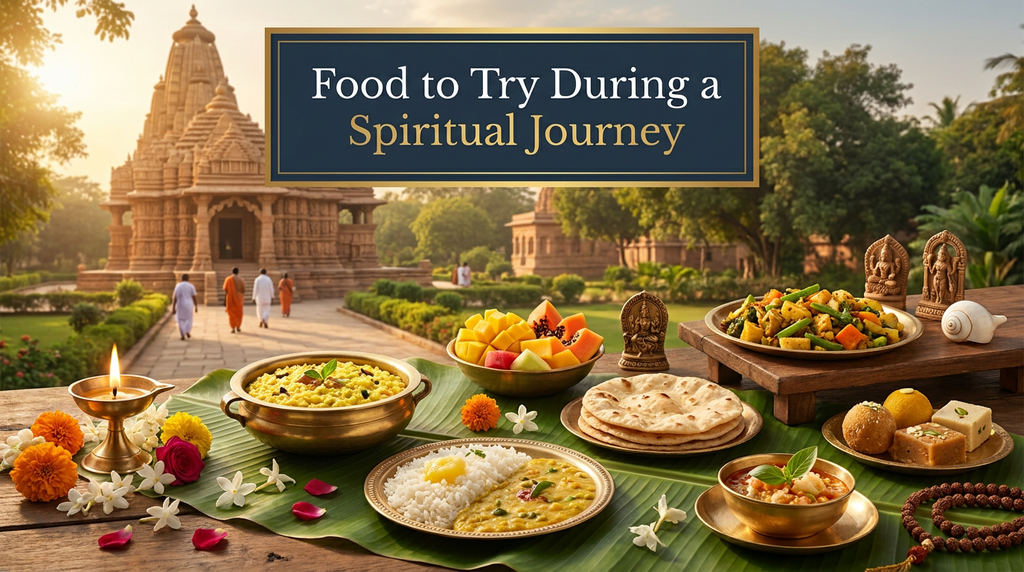
Food is part of the cultural experience, but cuisine changes from region to region.
In Varanasi, official tourism material highlights foods and drinks including kachori-sabzi, tamatar chaat, lassi, Banarasi sweets, and Banarasi paan.
In southern pilgrimage regions, travelers may encounter dishes based around rice, lentils, vegetables, dosa, idli, sambar, and regional thalis. Temple towns may also have specific prasadam traditions.
| Food Type | Good Choice For |
| Simple vegetarian meal | Early temple days |
| Idli/dosa-style breakfast | Quick morning meal |
| Regional thali | Travelers wanting variety |
| Street snacks | Cultural exploration |
| Fresh fruit and water | Hot-weather travel |
| Temple prasadam | Religious and cultural experience |
Dining Tips
Check whether a temple prohibits outside food in specific areas. Carry drinking water, but use reliable sources rather than assuming untreated local water is safe. When eating street food, choose busy establishments with high turnover and good visible hygiene.
Travel Cost and Budget Planning
Exact costs cannot responsibly be given for an India-wide guide because a one-day temple-town visit and a multi-city luxury pilgrimage can have completely different budgets.
Instead, use this planning model:
| Expense | Budget Traveler | Mid-Range Traveler | Luxury Traveler |
| Accommodation | Basic room/guesthouse | Comfortable hotel | Premium hotel |
| Food | Local meals | Restaurants + local food | Premium dining |
| Local transport | Bus/walking/auto | Taxi + public transit | Private car/taxi |
| Attractions | Mainly free/low-cost sites | Paid experiences as needed | Premium experiences where available |
| Intercity travel | Economy train/bus | Higher class/air as practical | Flights + private transfers |
| Buffer | Keep a small emergency margin | Larger flexibility | Generous contingency |
A useful personal budgeting split is to reserve the largest share for accommodation and intercity transport, then allocate for food, local travel, attraction fees, and a contingency amount.
Do not use an old online price as a 2026 promise. Hotel rates, flights, train fares, exchange rates, and local transport costs can change.
A Practical 3-Day Panchang-Aware Spiritual Itinerary
Because the article covers India rather than one city, this is a reusable structure rather than a fixed route.
| Day | Morning | Afternoon | Evening |
| Day 1 | Arrive and settle in; check local Panchang | Main temple or heritage attraction | Local market and regional dinner |
| Day 2 | Early temple visit or spiritual activity | Museum, historical site, or cultural neighborhood | Riverfront, cultural program, or relaxed meal |
| Day 3 | Sunrise experience or second temple | Local shopping, crafts, or nearby attraction | Depart or begin next leg |
How to Add Rahu Kalam to the Itinerary
Use the daily calculation before setting a start time. For a flexible road journey, you may schedule the departure outside the traditionally avoided period. For fixed trains and flights, book according to the operating schedule rather than attempting to force a ticket into a preferred traditional window.
The same principle applies to temple appointments and darshan bookings: check the institution’s actual rules first.
Family-Friendly, Picnic and Photography Ideas
Spiritual travel does not have to mean spending every hour inside a temple.
Family-Friendly Experiences
Families can mix religious visits with:
- Gardens and public parks
- Riverfront walks where appropriate
- Heritage sightseeing
- Local craft markets
- Short scenic excursions
- Cultural performances
- Family-friendly food stops
For example, Varanasi offers more than temples, including historic streets, crafts, river experiences, and cultural activities.
Photography
Good photography opportunities can include:
- Sunrise over a riverfront
- Temple architecture from permitted public areas
- Historic streets
- Traditional markets
- Local crafts
- Landscapes around pilgrimage towns
- Sunset views
Always follow photography restrictions. Some temples restrict cameras, phones, video, or photography near sacred areas.
Image Caption: Sunrise and heritage architecture creating a peaceful setting for spiritual travel photography.
Local Culture, Etiquette and Spiritual Experiences
A Panchang-based trip is also a chance to experience local culture respectfully.
Before entering a temple, observe posted dress requirements and footwear instructions. Avoid loud conversations in prayer areas, follow queue systems, and ask before photographing worshippers, priests, or ceremonies.
Some religious sites have customs that differ considerably between regions. A rule followed in one temple should not automatically be assumed to apply elsewhere.
Travelers can also explore:
- Traditional crafts
- Regional music
- Temple architecture
- Local festivals
- Vegetarian cuisine
- River ceremonies
- Historic neighborhoods
- Religious storytelling and cultural performances
India’s official tourism portal presents spiritual destinations alongside heritage, gastronomy, crafts, nature, and cultural experiences, which makes it possible to build a balanced itinerary rather than treating pilgrimage as a single-purpose visit.
Safety, Packing and Essential Travel Tips
Rahu Kalam and Yamagandam are traditional planning tools, but a safe journey still depends on normal travel precautions.
Safety Tips
Keep passports, identification, reservations, and essential medicines secure. Use official transport or reputable providers when possible, and keep emergency contacts available.
In India, the government-operated 112 emergency system provides a unified emergency number for police, fire, medical, and other urgent assistance across states and union territories.
Money and Connectivity
Carry a combination of payment methods rather than depending on only one. Keep some cash for small purchases, especially during visits to markets or smaller towns.
For international travelers, confirm current visa rules through India’s official visa channels before departure. Visa requirements depend on nationality and travel circumstances.
What to Pack
- Comfortable walking shoes
- Weather-appropriate clothing
- Modest clothing for temple visits
- A light layer for changing temperatures
- Reusable water bottle
- Sun protection
- Small umbrella or rain protection during wet seasons
- Phone and charging cable
- Power bank
- Copies of key travel documents
- Small day bag
- Any required prescription medicines
- Hand sanitizer and basic personal-care items
Before Starting the Day
A simple routine can prevent most planning mistakes:
Check sunrise → calculate the eight segments → check Rahu/Yamagandam/Kuligai → check temple timings → check transport → leave a practical buffer.
Never sacrifice safe driving, a confirmed train, a required temple booking, or an emergency response simply to follow a preferred traditional time window.
FAQs
What are Rahu Kalam Yamagandam Timings for today?
Rahu Kalam, Yamagandam, and Kuligai are traditional Panchang periods calculated from local sunrise and sunset. Exact times vary by city and date.
How are Rahu Kalam Yamagandam Timings calculated in 2026?
Daylight is divided into eight equal parts, and each weekday has assigned segments for Rahu Kalam, Yamagandam, and Kuligai. Local sunrise and sunset determine the clock time.
What are the Rahu Kalam Yamagandam Timings on Monday?
On Monday, Rahu Kalam falls in the second daylight segment, Yamagandam in the fourth, and Kuligai in the sixth. Exact times depend on the location.
What are the Rahu Kalam Yamagandam Timings on Wednesday?
Wednesday places Rahu Kalam in the fifth segment, Yamagandam in the second, and Kuligai in the fourth. Use local sunrise and sunset for accurate times.
What are the Rahu Kalam Yamagandam Timings on Friday?
On Friday, Rahu Kalam is in the fourth segment, Yamagandam in the seventh, and Kuligai in the second. City-specific calculations are needed for exact timing.
What are the Rahu Kalam Yamagandam Timings on Saturday?
Saturday assigns Rahu Kalam to the third segment, Yamagandam to the sixth, and Kuligai to the first. The actual hours change with daylight duration.
Can I plan a journey using Rahu Kalam Yamagandam Timings?
Yes. Travelers who follow Panchang traditions may use these periods when choosing when to begin a journey, while also considering transport schedules and safety.
Are Rahu Kalam Yamagandam Timings the same in every city?
No. The weekday pattern stays consistent, but the clock times change because every city has different sunrise and sunset times throughout the year.
Should temple visits be planned around Rahu Kalam Yamagandam Timings?
They can be considered as part of traditional planning. However, temple opening hours, darshan rules, bookings, and local instructions should also be checked.
Where can I check accurate Rahu Kalam Yamagandam Timings for my location?
Use a reliable Panchang or city-specific calculator that uses the local sunrise and sunset. Check it again for the exact travel date before starting your trip.
Conclusion
Rahu Kalam Yamagandam Timings can help travelers who follow Hindu Panchang traditions plan journeys with greater awareness.
The exact hours are not fixed across India because sunrise and sunset vary by location and date.
For this reason, a city-specific calculation is always more useful than a general timetable.
Travelers should also consider temple schedules, transport availability, weather, and local conditions.
Used alongside practical planning, these traditional time periods can fit smoothly into a spiritual journey.
A well-planned pilgrimage can combine religious visits with heritage, food, local culture, photography, and peaceful experiences.
Checking Rahu Kalam Yamagandam Timings before departure may help align the start of a journey with personal customs.
At the same time, fixed flights, trains, temple bookings, and safety needs should never be ignored.
Leave enough time for traffic, crowds, rest stops, and unexpected changes along the route.
With thoughtful preparation, your 2026 spiritual travel experience can remain comfortable, respectful, and enjoyable.
Read More: Today’s Nakshatra: Know the Current Nakshatra by Location on Friday, October 2, 2026
