

Choghadiya Muhurat 2026 is a traditional Hindu calendar guide that helps people identify auspicious and inauspicious times during the day and night. Many people use Choghadiya when planning religious ceremonies, starting new work, traveling, or making important decisions. It offers a simple way to understand traditional timings and choose a suitable period for different activities according to personal beliefs.
The Choghadiya Muhurat 2026 calendar includes seven traditional periods: Amrit, Shubh, Labh, Char, Rog, Kaal, and Udveg. Each period has a specific meaning in Hindu astrology, and some are considered more favorable than others. Amrit, Shubh, and Labh are generally preferred for positive beginnings, while Rog, Kaal, and Udveg are traditionally avoided for auspicious activities.
With the help of Choghadiya Muhurat 2026, you can explore daily Choghadiya timings for both daytime and nighttime. The daytime schedule runs from sunrise to sunset, while the nighttime schedule runs from sunset to the following sunrise. Since these periods depend on local sunrise and sunset, the exact timings change according to the date and location.
Many people check Choghadiya Muhurat 2026 before planning activities such as puja, business openings, shopping, vehicle purchases, and spiritual journeys. The calendar can help you understand which periods are traditionally considered favorable for these occasions. However, it is best to consider practical factors alongside traditional guidance, especially when making important personal or professional decisions.
In this complete guide to Choghadiya Muhurat 2026, you will learn about the seven Choghadiya periods, daily auspicious timings, day and night schedules, and the difference between Choghadiya and Rahu Kaal. You will also discover how to check accurate timings for your city and date. Whether you follow Hindu traditions regularly or simply want to learn about this ancient timekeeping system, this guide will help you understand the basics in simple English.
Quick Overview of Choghadiya Muhurat 2026
| Information | Details |
| Topic | Choghadiya and daily auspicious timings |
| Cultural background | Traditional Hindu astrology and Panchang |
| Relevant locations | India and communities worldwide that follow the Hindu calendar |
| Best time to check | Before the planned activity |
| Daytime periods | Eight divisions from local sunrise to sunset |
| Nighttime periods | Eight divisions from local sunset to the following sunrise |
| Main categories | Amrit, Shubh, Labh, Char, Rog, Kaal, and Udveg |
| Common uses | Travel, worship, business, and personal milestones |
| Languages | Hindi, English, Gujarati, and other regional languages |
| Timetable availability | Commonly available through online Panchang calendars and apps |
| Cost of checking | Often free online |
| Accuracy requirement | Correct date, location, sunrise, sunset, and local time zone |
What Is Choghadiya Muhurat and Why Is It Used?
Choghadiya is a traditional Hindu system for dividing the day and night into periods associated with different qualities. It is often consulted alongside a Panchang, the Hindu almanac that includes information about lunar days, Nakshatras, and other calendar or astrological elements.
The term is commonly associated with chau ghadi, or four traditional ghatis. In the modern timetable, daylight is divided into eight equal periods, and nighttime is divided into another eight. The length of each period changes with the duration of daylight or darkness.
People who follow Choghadiya may consult it before:
- Beginning a journey or pilgrimage.
- Opening a business or starting a new project.
- Performing religious worship or puja.
- Making significant purchases.
- Organizing family ceremonies.
- Choosing a preferred time for other important activities.
The practice is part of cultural and religious tradition. It is not a scientifically established way to predict whether an activity will succeed. Many people value it as a way to honor family customs and make personal decisions in keeping with their beliefs.
The Seven Choghadiya Categories and Their Meanings
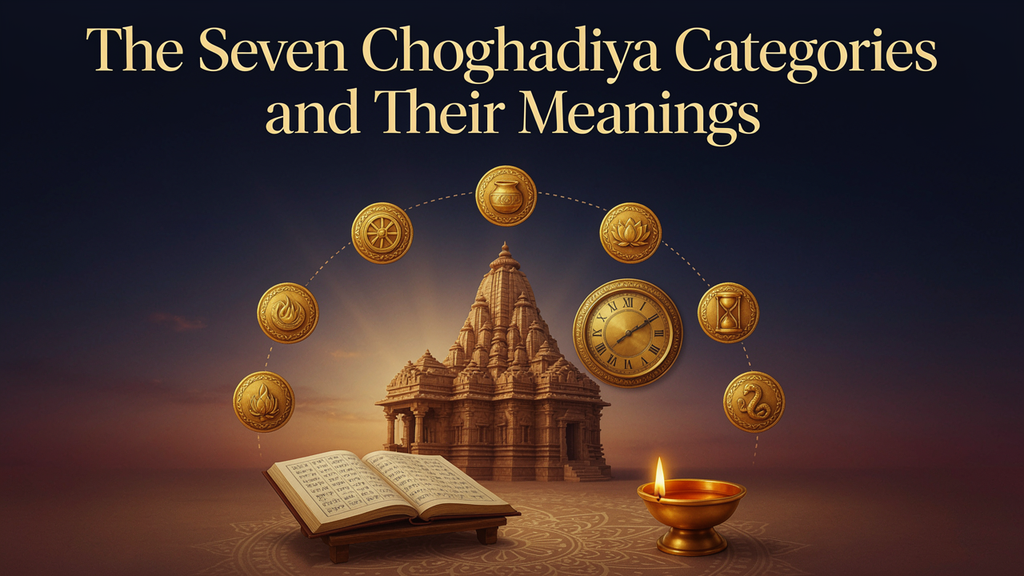
Choghadiya uses seven named categories, but each daytime or nighttime sequence contains eight periods. One category therefore appears twice in the sequence.
| Category | Traditional meaning | Commonly preferred activities |
| Amrit (अमृत) | Highly favorable | Worship and general auspicious beginnings |
| Shubh (शुभ) | Favorable | Ceremonies and new beginnings |
| Labh (लाभ) | Favorable | Business, education, and activities associated with gain |
| Char (चर) | Associated with movement | Travel and journeys |
| Udveg (उद्वेग) | Generally considered unfavorable | Often avoided for auspicious beginnings |
| Kaal (काल) | Generally considered unfavorable | Traditionally avoided for selected important activities |
| Rog (रोग) | Generally considered unfavorable | Commonly avoided for auspicious beginnings |
These descriptions reflect common interpretations, and recommendations can vary between regional customs and Panchang services.
Which Choghadiya Is Traditionally Considered Most Auspicious?
Amrit is widely regarded as a highly favorable period for general auspicious activities. Shubh is associated with ceremonies and positive beginnings, while Labh is commonly preferred for business-related activities. Char is associated with movement, making it relevant to people who wish to choose a traditional time to begin a journey.
The most suitable category depends on the activity and the tradition being followed. For a major ceremony, marriage, or important religious event, a detailed muhurat may involve additional Panchang considerations.
Choghadiya Muhurat 2026: Daytime Timing Table
The daytime schedule begins at local sunrise and ends at local sunset. The duration between these two points is divided into eight equal sections, with each section assigned a category according to the traditional weekday sequence.
| Period | Start time | End time |
| First | Local sunrise | Sunrise plus one-eighth of daylight |
| Second | End of first period | Sunrise plus two-eighths of daylight |
| Third | End of second period | Sunrise plus three-eighths of daylight |
| Fourth | End of third period | Sunrise plus four-eighths of daylight |
| Fifth | End of fourth period | Sunrise plus five-eighths of daylight |
| Sixth | End of fifth period | Sunrise plus six-eighths of daylight |
| Seventh | End of sixth period | Sunrise plus seven-eighths of daylight |
| Eighth | End of seventh period | Local sunset |
This table explains the calculation method rather than giving unverified clock times. To obtain the exact schedule for a particular day in 2026, check the local sunrise and sunset and apply the correct weekday sequence.
For example, if the daylight period lasts exactly 12 hours, each daytime Choghadiya lasts 90 minutes. This is a mathematical example, not a forecast for a particular city.
Image Caption: A Hindu Panchang showing the eight daytime Choghadiya periods between local sunrise and sunset.
Choghadiya Muhurat 2026: Nighttime Timing Table
Nighttime Choghadiya begins at local sunset and continues until the following sunrise. Like daytime, nighttime is divided into eight equal periods.
The nighttime schedule should be checked separately. Do not assume that the last daytime category continues into the evening or that nighttime periods have the same duration as daytime periods.
| Period | Start time | End time |
| First night period | Local sunset | Sunset plus one-eighth of nighttime |
| Second night period | End of first period | Sunset plus two-eighths of nighttime |
| Third night period | End of second period | Sunset plus three-eighths of nighttime |
| Fourth night period | End of third period | Sunset plus four-eighths of nighttime |
| Fifth night period | End of fourth period | Sunset plus five-eighths of nighttime |
| Sixth night period | End of fifth period | Sunset plus six-eighths of nighttime |
| Seventh night period | End of sixth period | Sunset plus seven-eighths of nighttime |
| Eighth night period | End of seventh period | Following sunrise |
How to Read Nighttime Muhurat After Midnight
Some nighttime periods continue past midnight. For example, a period may begin late in the evening and finish in the early hours of the following calendar day.
This is normal when a timetable follows the sunset-to-sunrise nighttime cycle. Check the date shown beside the ending time, the local time zone, and the calendar convention used by the Panchang. This is particularly important if you are planning an overnight journey or a ceremony shortly after midnight.
How Choghadiya Changes by Weekday in 2026
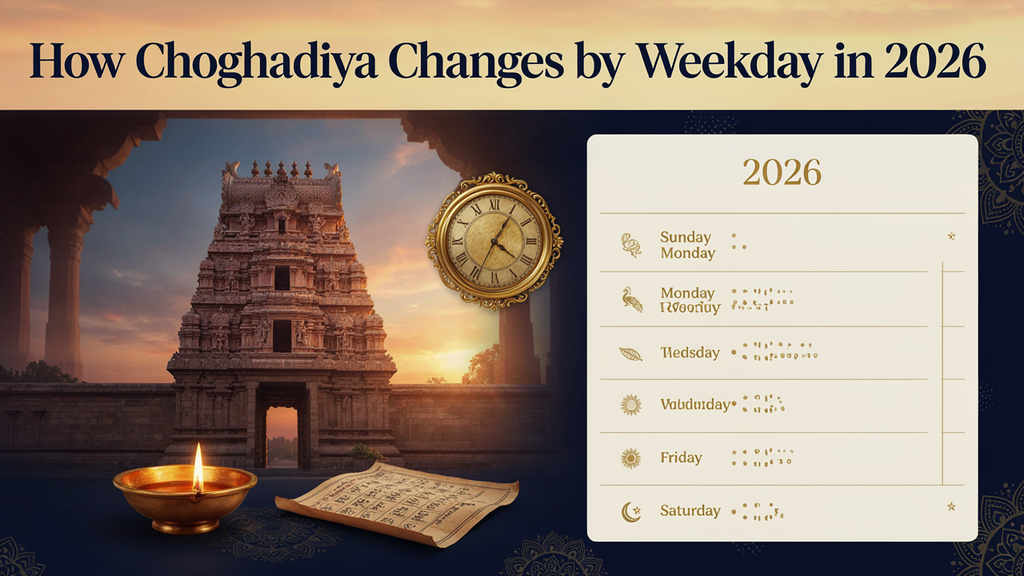
The weekday determines the starting category in the commonly followed daytime sequence. The remaining categories follow the traditional order, so the first period changes throughout the week.
| Weekday | First daytime category |
| Sunday | Udveg |
| Monday | Amrit |
| Tuesday | Rog |
| Wednesday | Labh |
| Thursday | Shubh |
| Friday | Char |
| Saturday | Kaal |
This table shows the starting category, not a complete timetable. The exact start and end times still depend on local sunrise and sunset, and the nighttime sequence must be checked separately.
Why Do Choghadiya Timings Change Every Day?
Two factors influence the daily schedule. First, the duration of daylight and darkness changes over the year, affecting the length of each period. Second, the weekday determines the starting category in the traditional sequence.
A timetable prepared for one date should therefore not automatically be reused on another date. Select the correct day and city before using the timings for an activity.
How to Calculate Choghadiya for Your City
A reliable Panchang calculator is the easiest option for most people, but the underlying calculation is straightforward.
- Select the date: Choose the exact day you need in 2026.
- Choose the location: Enter the city where your activity will take place or where your journey will begin.
- Check local sunrise and sunset: Use a reliable Panchang or astronomical calendar.
- Calculate daylight duration: Subtract sunrise from sunset.
- Divide daylight by eight: This gives the length of each daytime period.
- Apply the weekday sequence: Identify the starting category and follow the traditional order.
- Calculate nighttime separately: Measure from sunset to the following sunrise and divide that interval into eight periods.
- Verify the final timetable: Confirm the city, date, time zone, and category labels.
For example, if daylight lasts 11 hours and 20 minutes, each daytime period lasts 85 minutes. This example illustrates the arithmetic; it is not a verified timing for any specific city.
Image Caption: An explanatory diagram showing how sunrise-to-sunset daylight is divided into eight equal Choghadiya periods.
Best Choghadiya for Travel, Business, and Religious Activities
People who follow Choghadiya may select different periods depending on the activity they want to begin. These traditional associations can help with personal planning, but they do not guarantee a particular result.
| Activity | Traditionally preferred period | Practical advice |
| Starting a journey | Char, Amrit, Shubh, or Labh | Check weather, transport schedules, and road safety |
| Business opening | Labh or Shubh | Prepare documents, staff, and supplies in advance |
| Religious worship | Amrit or Shubh | Confirm the temple’s ritual and visiting hours |
| Beginning a new project | Amrit, Shubh, or Labh | Make a practical plan and set realistic goals |
| Important shopping | Amrit, Shubh, or Labh | Compare prices and check product quality |
| Family outings | A convenient period that suits your tradition | Consider opening hours and family needs |
Is Char Choghadiya Good for Starting a Journey?
Char is traditionally associated with movement, making it a commonly preferred period for beginning a journey. People may consult it before a road trip, pilgrimage, or other departure.
However, you should not postpone essential travel or ignore safe transport arrangements simply to wait for a preferred period. Weather, road conditions, transport availability, and adequate rest are more important practical considerations.
Best Time to Check Choghadiya Muhurat in 2026
There is no single clock time that is best for every date in 2026. The schedule changes with the weekday, local sunrise, and sunset.
The most useful approach is to check the timetable before you need it. If you are leaving early in the morning, review the schedule the previous evening. If you are organizing a major ceremony, confirm the date and location well in advance.
| Situation | When to check |
| Early-morning departure | The previous evening |
| Daytime business activity | Before the working day begins |
| Evening temple visit | Before leaving home |
| Overnight journey | Before departure, including periods after midnight |
| Major religious ceremony | Well in advance, with detailed muhurat guidance if needed |
Can You Use One Choghadiya Timetable Throughout 2026?
No. A single day’s timetable should not be treated as valid for the whole year. The duration of daylight changes seasonally, and the weekday sequence changes from day to day.
Even if you use a yearly calendar, verify that it corresponds to your city and local time zone. For an important activity, check the specific date rather than relying on an old screenshot or a general timetable.
Choghadiya vs. Rahu Kaal and Other Hindu Muhurat Timings
Choghadiya is one of several traditional systems used when selecting auspicious times. Some people also consider Rahu Kaal, Yamaganda, Gulika Kaal, Tithi, and Nakshatra.
| System | What it represents | Common traditional use |
| Choghadiya | Eight periods during daylight and eight during nighttime | General activity and departure planning |
| Rahu Kaal | A period traditionally avoided for certain new beginnings | Selecting times for particular activities |
| Yamaganda | Another period considered in Hindu time selection | Muhurat planning |
| Gulika Kaal | A separate traditional astrological timing element | Additional timing considerations |
| Detailed muhurat | A time selected using several Panchang factors | Major ceremonies and important events |
A period considered favorable in Choghadiya may overlap with a period that a particular Panchang advises avoiding. Different traditions may also assign different importance to these factors.
For weddings, housewarming ceremonies, or major religious events, consider consulting a knowledgeable Panchang practitioner rather than combining different timing tables without understanding their methods.
Planning a Temple Visit Around Choghadiya
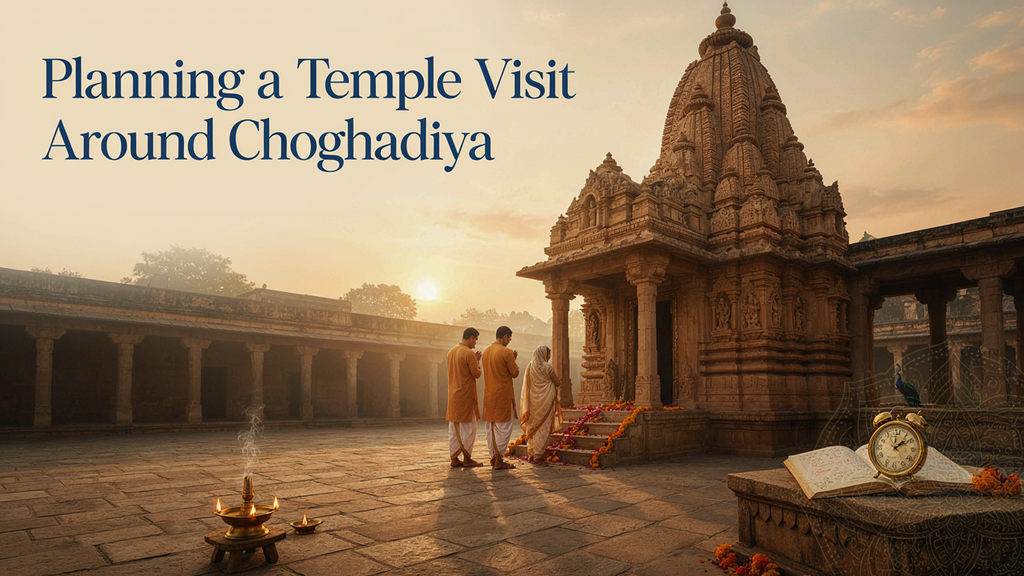
For pilgrims and religious travelers, Choghadiya can be one part of planning a visit. However, it does not determine a temple’s opening hours, darshan availability, or ritual schedule.
Before setting out, check:
- Official opening and closing times.
- Darshan hours and special puja schedules.
- Whether advance booking or identification is required.
- Festival-day arrangements and expected queues.
- Local transportation and return options.
- Dress requirements and rules about footwear or photography.
If you prefer to begin your journey during a favorable period, choose your departure time first and then confirm that it allows enough time to reach the temple during its published visiting hours.
Image Caption: A pilgrim checking a Hindu Panchang before beginning a temple visit.
Accommodation Guide for a Choghadiya-Based Trip
Choghadiya is followed in different regions, so there is no single accommodation area that suits everyone. Your lodging choice should depend on the destination, your budget, and the purpose of your journey.
If you are planning a pilgrimage, consider staying near the temple or a convenient public transport connection. For a longer holiday, choose accommodation that makes it easy to visit the places on your itinerary.
| Accommodation type | Suitable for | What to check |
| Budget guesthouse | Short visits and cost-conscious travelers | Cleanliness, location, and recent reviews |
| Mid-range hotel | Families and independent travelers | Transport connections and included facilities |
| Premium hotel | Travelers seeking additional comfort | Total price and cancellation policy |
| Family accommodation | Groups with children or older relatives | Room capacity and suitable facilities |
| Lodging near a temple | Pilgrims and religious travelers | Local access, walking distance, and visitor arrangements |
Hotel prices depend on the city, season, demand, and booking date. Compare the total price, taxes, and cancellation terms before reserving a room.
Food and Local Dining During Your Journey
There is no single cuisine associated with Choghadiya because the tradition is followed across different regions and communities. If you are traveling, your food options will depend on the destination and its local culinary traditions.
Useful dining tips include:
- Try regional dishes from reputable restaurants or food stalls.
- Ask about ingredients if you have allergies or dietary restrictions.
- Confirm food preparation practices if you follow a vegetarian diet for religious reasons.
- Carry water and suitable snacks for long journeys.
- Check restaurant opening hours before planning a meal around a particular muhurat.
- Keep time for meals and rest even when following a preferred schedule.
Choghadiya can help you choose a departure time, but it should not lead you to skip meals or ignore your health needs during a journey.
Travel Budget and Expenses
Checking a Choghadiya timetable is often free, but the cost of a trip depends on the destination and the way you travel. Without a specified city or attraction, reliable hotel rates, transport fares, and ticket prices cannot be provided.
| Expense | Budget traveler | Mid-range traveler | Luxury traveler |
| Choghadiya timetable | Usually free online | Usually free online | Usually free online |
| Accommodation | Basic lodging | Comfortable hotel | Premium accommodation |
| Transportation | Public transport where available | Reserved transport or taxis | Private or premium transport |
| Food | Local eateries | Restaurants and cafés | Premium dining |
| Activities | Free attractions and simple outings | A mix of free and paid activities | Private experiences where available |
These are general budget categories, not quoted prices. Actual expenses vary by location, dates, availability, and exchange rates. Verify current prices before making reservations.
A One-Day Itinerary Using Choghadiya
If you want to include Choghadiya in your daily routine or travel planning, the following schedule combines traditional time selection with practical preparation.
| Time | Suggested activity | Planning advice |
| Previous evening | Check the next day’s timetable | Confirm the date and location |
| Early morning | Prepare for the day’s activities | Check weather and transport |
| Morning | Begin planned activities if convenient | Use your selected local timetable |
| Afternoon | Continue sightseeing, work, or errands | Allow time for breaks and delays |
| Evening | Visit a temple or return from a day trip | Check closing times and safe transport |
| Night | Review nighttime periods if needed | Confirm any date change after midnight |
This is a flexible example rather than a fixed itinerary for a specific city. Adapt it to your actual destination, transportation, and personal requirements.
Family-Friendly Outings, Picnics, and Photography
Choghadiya does not provide a list of parks, picnic spots, lakes, or scenic viewpoints. Those recommendations depend on the destination you choose. However, families can use a local timetable alongside ordinary travel planning.
Tips for a Family Day Out
- Choose a park, garden, religious site, or attraction suitable for everyone in your group.
- Check opening hours, entry requirements, and the weather forecast.
- Carry drinking water, snacks, necessary medicines, and sun protection.
- Allow extra time for children, older relatives, and rest breaks.
- Select a convenient departure time if following Choghadiya.
- Plan your return journey before setting out.
Best Photography Times
Sunrise and sunset often provide attractive natural light for travel photography. The actual conditions depend on weather, season, and the direction of the landscape.
If you are visiting a temple or religious site, check its photography rules before taking pictures. Respect other visitors and ask permission when necessary.
Image Caption: A family preparing for a day trip while checking a traditional calendar and local travel arrangements.
Local Culture and the Tradition of Auspicious Timing
Choosing an auspicious time is part of a broader cultural tradition in many Hindu communities. A Panchang may be consulted for puja, weddings, housewarming ceremonies, business openings, and pilgrimages.
The importance given to Choghadiya differs among families, regions, and religious practitioners. Some people use it as a simple reference, while others consider several Panchang elements before selecting a muhurat.
Visitors attending a ceremony should follow the host’s guidance about clothing, footwear, photography, and participation. Respectful questions can be a helpful way to learn about local customs.
It is also important to distinguish between religious observance and practical requirements. A chosen time may hold spiritual meaning for someone, but it does not guarantee a particular outcome or replace careful decision-making.
Safety Tips When Using a Choghadiya Timetable
A timetable should support your planning rather than replace common sense. Keep these precautions in mind:
- Confirm the city: Sunrise and sunset differ by location.
- Verify the date: Do not reuse an old timetable without checking it.
- Check the time zone: This matters when planning activities abroad.
- Review nighttime periods: Some timings extend into the following calendar day.
- Use a consistent source: Different services may follow different conventions.
- Confirm major muhurats: Seek qualified guidance for important ceremonies.
- Prioritize safety: Do not delay medical care or essential travel to wait for a preferred period.
- Check travel arrangements: Verify tickets, transport schedules, and accommodation independently.
- Protect your belongings: Keep identification, money, and booking confirmations secure.
- Monitor local conditions: Check the weather and relevant travel advisories.
For exact daily timings, use a location-specific Panchang such as Confirm that the selected date, city, and time zone are correct.
Packing Checklist for a Choghadiya-Based Journey
Your packing needs will depend on your destination, weather, trip duration, and planned activities. This general checklist covers the essentials.
- Identification and required travel documents.
- Phone, charger, and power bank.
- Saved copy of the correct Choghadiya timetable.
- Transport tickets and accommodation confirmations.
- Cash and a suitable payment method.
- Comfortable footwear and weather-appropriate clothing.
- Water bottle and suitable snacks.
- Personal medicines and essential toiletries.
- Sun protection or rain protection, depending on the forecast.
- Appropriate clothing for religious places.
- Emergency contact information.
- Offline maps or downloaded travel details when useful.
For overnight journeys, plan rest breaks and choose safe, reliable transportation. For temple visits, check whether advance booking or special visitor arrangements are required.
FAQs
What is Choghadiya Muhurat 2026, and why is it important?
Choghadiya Muhurat 2026 is a traditional Hindu timekeeping guide used to identify favorable and unfavorable periods during the day and night. Many people consult it when planning religious rituals, travel, and important activities.
How can I check Choghadiya Muhurat 2026 for today?
You can check a daily Choghadiya table based on your location and date. It usually lists daytime and nighttime periods with their start and end times.
Which Choghadiya periods are considered auspicious in 2026?
Amrit, Shubh, and Labh are generally considered favorable periods in traditional Choghadiya. People often prefer these times for new beginnings, worship, and important work.
How is Choghadiya Muhurat 2026 calculated?
Choghadiya divides the time between sunrise and sunset into eight daytime periods and sunset to the next sunrise into eight nighttime periods. The duration of each period depends on the length of daylight or nighttime.
What is the difference between day and night Choghadiya Muhurat 2026?
Daytime Choghadiya runs from sunrise to sunset, while nighttime Choghadiya runs from sunset to sunrise. Both have eight periods, and their timings vary according to the date and location.
Is Choghadiya Muhurat 2026 suitable for starting a new business?
Many people consult Choghadiya before opening a shop, launching a business, or beginning a new project. They traditionally prefer favorable periods such as Labh, Shubh, or Amrit.
Can Choghadiya Muhurat 2026 help me choose a travel time?
Yes, some travelers use Choghadiya to select a traditionally auspicious departure time. Always prioritize road safety, weather conditions, transport schedules, and other practical travel needs.
What does Amrit mean in Choghadiya Muhurat 2026?
Amrit is traditionally considered one of the most auspicious Choghadiya periods. People often choose it for religious ceremonies, important beginnings, and other activities they consider significant.
Why is Labh important in Choghadiya Muhurat 2026?
Labh is associated with gain, benefit, and progress in traditional astrology. It is commonly preferred for business activities, financial planning, and starting new projects.
What does Shubh mean in Choghadiya Muhurat 2026?
Shubh means favorable or auspicious. This period is traditionally considered suitable for ceremonies, positive beginnings, and important personal activities.
What are Rog, Kaal, and Udveg in Choghadiya Muhurat 2026?
Rog, Kaal, and Udveg are traditionally classified as unfavorable periods for auspicious beginnings. Their meanings are associated with difficulties, time-related concerns, and anxiety in traditional astrology.
Can I use Choghadiya Muhurat 2026 for buying a vehicle?
Yes, some people check Choghadiya before purchasing or taking delivery of a vehicle. They may select an Amrit, Shubh, or Labh period according to their traditional beliefs.
Is Choghadiya Muhurat 2026 the same as Rahu Kaal?
No, Choghadiya and Rahu Kaal are different traditional timekeeping systems. Choghadiya divides daytime and nighttime into periods, while Rahu Kaal identifies a specific daily interval traditionally avoided for auspicious beginnings.
Can Choghadiya Muhurat 2026 be used for puja and religious ceremonies?
Many people consult Choghadiya when planning daily puja and religious activities. For major ceremonies, they may also consider a specific muhurat based on other traditional astrological factors.
Does Choghadiya Muhurat 2026 change every day?
Yes, the exact timings can change daily because they depend on local sunrise and sunset. Always check a date-specific timetable for your city rather than relying on a schedule from another day.
Can I follow Choghadiya Muhurat 2026 for marriage planning?
Choghadiya may help with selecting a time for certain wedding-related activities. However, families following Hindu astrological traditions often consult a qualified astrologer for the main marriage muhurat.
How many periods are included in Choghadiya Muhurat 2026?
There are seven traditional Choghadiya types: Amrit, Shubh, Labh, Char, Rog, Kaal, and Udveg. These types appear across eight daytime and eight nighttime periods, with some types repeating.
Does Choghadiya Muhurat 2026 depend on my city?
Yes, accurate timings depend on the local sunrise and sunset for your location. A timetable for Delhi, Karachi, or New York may show different timings for the same date.
Where can I find the Choghadiya Muhurat 2026 calendar?
You can look for a reliable Panchang or Choghadiya calendar that provides daily daytime and nighttime timings. Choose a date-specific schedule for your location and verify its time zone.
Is Choghadiya Muhurat 2026 scientifically proven?
Choghadiya is based on traditional Hindu astrological beliefs and cultural practices. There is no established scientific evidence that choosing a particular period guarantees success or changes the outcome of an activity.
Conclusion
Choghadiya Muhurat 2026 is a useful traditional guide for people who want to understand auspicious timings for daily activities, religious rituals, travel, and new beginnings. By learning about Amrit, Shubh, Labh, and the other Choghadiya periods, you can understand the daily timetable more easily. Always check the correct date and local sunrise and sunset times before planning an important activity. This helps you follow traditional practices with greater clarity and confidence. Use the calendar as a reference that supports your personal beliefs and planning needs.
Whether you are preparing for a spiritual journey, opening a business, or organizing a family ceremony, Choghadiya Muhurat 2026 can help you explore traditionally favorable time periods. Remember that the timings differ by location and date, so a reliable local Panchang is important. For major religious ceremonies, consider seeking guidance from a knowledgeable astrologer. Combine traditional customs with practical judgment when making important decisions. With the right information, you can plan your activities in a way that respects your beliefs and daily schedule.
Read More: Aaj Ka Choghadiya 2026: आज का चौघड़िया, दिन-रात के शुभ मुहूर्त और चौघड़िया समय
