


The Hindu calendar is much more than a list of dates. It connects time with the Moon, Sun, festivals, fasting days, religious observances, and traditional practices. That is why people searching for आज की तिथि | तिथि कैलेंडर सितम्बर, 2026 | Aaj Ki Tithi are often looking for more than just a date. They may want to know which lunar day is active, whether a religious observance falls on that day, and how they can plan their spiritual activities.
For travelers in the United States, the Hindu tithi calendar can be especially useful. Many American cities now have Hindu temples, cultural centers, community events, and spiritual destinations. Whether you live in New York, Texas, California, Florida, Illinois, New Jersey, or another state, understanding the tithi can help you plan a thoughtful temple visit or cultural experience.
This guide explains Aaj Ki Tithi, the September 2026 tithi calendar, important lunar days, temple travel tips, common mistakes, and practical ways to combine Hindu calendar planning with spiritual travel in the USA.
Quick Answer
Aaj Ki Tithi means “today’s lunar day” in the Hindu calendar. Unlike the regular Gregorian calendar, which follows the solar year, a Hindu tithi is calculated from the changing angular relationship between the Sun and Moon.
For September 13, 2026, the tithi at New York sunrise falls in Shukla Tritiya based on astronomical calculation. However, tithi timings can change by location because Hindu calendars use local sunrise and exact astronomical positions. Travelers in other parts of the USA should therefore check a location-specific Panchang before planning a temple visit, fast, puja, or religious event.
For visitors interested in Hindu culture, knowing today’s tithi can also make a spiritual trip more meaningful. A tithi may help you choose when to visit a temple, attend a special puja, explore a Hindu cultural center, or learn about traditional lunar observances.
What Is a Tithi in the Hindu Calendar?

A tithi is a lunar day used in the traditional Hindu calendar. It is not exactly the same as a 24-hour day.
A tithi is based on the angular distance between the Sun and Moon. As the Moon moves around Earth, this angle changes continuously. Each 12-degree segment represents one tithi.
There are 30 tithis in a complete lunar cycle:
- 15 tithis in Shukla Paksha, the waxing Moon
- 15 tithis in Krishna Paksha, the waning Moon
The lunar days include:
| Tithi | Common Sanskrit Name |
| 1 | Pratipada |
| 2 | Dvitiya |
| 3 | Tritiya |
| 4 | Chaturthi |
| 5 | Panchami |
| 6 | Shashthi |
| 7 | Saptami |
| 8 | Ashtami |
| 9 | Navami |
| 10 | Dashami |
| 11 | Ekadashi |
| 12 | Dwadashi |
| 13 | Trayodashi |
| 14 | Chaturdashi |
| 15 | Purnima or Amavasya |
The remaining 15 tithis repeat during the opposite lunar phase.
Why Does a Tithi Matter for Travelers?
A tithi can be important when your trip includes religious activities. Certain lunar days are traditionally associated with particular deities, fasting practices, prayers, or festivals.
For example:
- Ekadashi is widely associated with fasting and Lord Vishnu.
- Chaturthi is associated with Lord Ganesha, especially during major Chaturthi observances.
- Ashtami has significance in several Hindu traditions.
- Purnima is the full-moon tithi.
- Amavasya is the new-moon tithi.
The importance and exact observance can vary by regional and family tradition.
September 2026 Tithi Calendar: A Practical USA Reference

A tithi can begin or end at any time of the day. Therefore, a simple date-to-tithi table should not be treated as a universal Panchang for every American city.
The following is a New York City sunrise-based planning reference for September 2026. It is useful for understanding the lunar sequence, but travelers should verify exact timings for their own location before observing a religious fast or time-sensitive ritual.
| Date | Tithi at New York Sunrise* |
| September 1 | Panchami |
| September 2 | Shashthi |
| September 3 | Saptami |
| September 4 | Ashtami |
| September 5 | Navami |
| September 6 | Dashami |
| September 7 | Ekadashi |
| September 8 | Trayodashi |
| September 9 | Chaturdashi |
| September 10 | Amavasya |
| September 11 | Shukla Pratipada |
| September 12 | Shukla Dvitiya |
| September 13 | Shukla Tritiya |
| September 14 | Shukla Chaturthi |
| September 15 | Shukla Panchami |
| September 16 | Shukla Shashthi |
| September 17 | Shukla Saptami |
| September 18 | Shukla Ashtami |
| September 19 | Shukla Navami |
| September 20 | Shukla Navami |
| September 21 | Shukla Dashami |
| September 22 | Shukla Ekadashi |
| September 23 | Shukla Dwadashi |
| September 24 | Shukla Trayodashi |
| September 25 | Shukla Chaturdashi |
| September 26 | Purnima |
| September 27 | Krishna Pratipada |
| September 28 | Krishna Dvitiya |
| September 29 | Krishna Tritiya |
| September 30 | Krishna Panchami |
*This is a planning reference calculated around New York sunrise. Exact tithi start/end times can differ by U.S. location and by the Panchang calculation method.
Why Can Two Cities Show Different Tithi Timings?
The tithi itself is an astronomical measurement, but Hindu observances often depend on local sunrise and the time when a tithi prevails.
For this reason, a person in:
- New York
- Los Angeles
- Chicago
- Houston
- Dallas
- Seattle
may see different local tithi timings compared with another city.
This is one reason travelers should avoid copying an India-based Panchang without checking the local U.S. time zone.
Important Tithis to Know in September 2026

Some tithis are particularly useful when planning a spiritual or cultural trip.
Ekadashi
Ekadashi is the 11th lunar day. Many devotees observe a fast or follow special dietary practices on Ekadashi.
If your trip includes a temple visit on Ekadashi, check whether the temple has a special puja, kirtan, lecture, or community gathering.
Amavasya
Amavasya represents the new-moon day. It has different meanings and practices across Hindu traditions.
Travelers should ask the temple or religious center about its specific observances rather than assuming every temple follows the same program.
Purnima
Purnima is the full-moon tithi. Full-moon days have religious and cultural importance in many Hindu traditions.
A temple may organize special prayers, bhajans, satsang, or community activities around Purnima.
Chaturthi
Chaturthi is the fourth lunar day. It has a particularly strong association with Ganesha worship in Hindu tradition.
If you are interested in Ganesha temples or cultural celebrations, check the temple’s official calendar before traveling.
How to Use Aaj Ki Tithi for Spiritual Travel in the USA
Checking Aaj Ki Tithi can become part of your travel planning routine.
Instead of choosing a destination only because it is nearby, you can combine three factors:
- Your destination
- The local tithi
- The temple or community schedule
For example, suppose you are visiting the New York area and want a spiritual experience. You can first check the tithi, then search for Hindu temples or cultural organizations nearby, and finally confirm their public visiting hours.
A Simple Planning Method
Check the local tithi.
Identify any religious observance associated with that day.
Find a Hindu temple or cultural center.
Check its official website for opening hours.
Confirm whether visitors are welcome during the planned time.
Review dress and photography policies.
Plan transportation and parking.
This approach makes a temple visit more respectful and less stressful.
Best USA Destinations for Hindu Spiritual Travel

The United States has a growing Hindu community, and several regions are known for their temples and cultural organizations.
New York and New Jersey
The New York metropolitan area and neighboring New Jersey have large South Asian communities and numerous Hindu temples.
Travelers can combine a temple visit with:
- Indian restaurants
- cultural districts
- community events
- museums
- local sightseeing
Always verify temple schedules before making a special trip.
Texas
Texas has several Hindu temples and cultural organizations, particularly around major metropolitan areas such as Houston, Dallas, and Austin.
A spiritual trip here can easily be combined with a broader Texas vacation.
California
California is another major destination for Hindu and Indian-American cultural experiences.
Visitors can combine temple visits with California’s beaches, national parks, cities, and food destinations.
Illinois
The Chicago metropolitan area offers Hindu temples and cultural centers that can be included in a weekend itinerary.
Florida
Florida’s Hindu community and temples provide another option for travelers looking to combine religious tourism with beaches and family vacations.
Temple Visit vs. General Sightseeing: Which Is Better?
A spiritual travel itinerary can look very different from a standard sightseeing trip.
| Travel Style | Best For | Advantages | Considerations |
| Temple Visit | Spiritual and cultural travelers | Meaningful cultural experience | Follow temple rules |
| Festival Visit | Travelers interested in celebrations | Music, food and community | Crowds may be larger |
| Cultural Center | Families and beginners | Educational experience | Schedule varies |
| General Sightseeing | First-time visitors | Flexible itinerary | Less focused on religious culture |
| Spiritual Weekend | Dedicated pilgrims | Deeper experience | Requires advance planning |
There is no single best option. The right choice depends on your travel purpose, available time, and comfort level.
Pros and Cons of Planning Travel Around Aaj Ki Tithi
| Pros | Cons |
| Adds cultural meaning to a trip | Tithi timings can be complicated |
| Helps identify important observances | Timings vary by location |
| Can help plan temple visits | Not every temple follows the same schedule |
| Supports cultural learning | Some events require advance confirmation |
| Creates a more intentional itinerary | Religious practices differ by tradition |
The best approach is to use the Hindu calendar as a planning tool, while confirming important details directly with the temple or organization.
How to Check Today’s Tithi Correctly in the USA
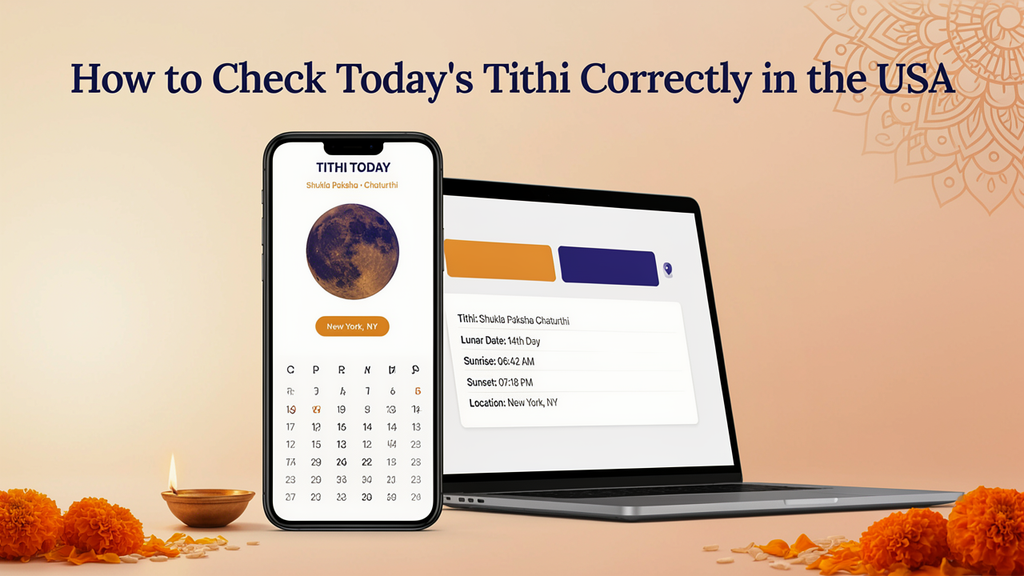
If you search for Aaj Ki Tithi, you may find several calendars showing slightly different information.
Here is a better method.
Check Your City First
Do not immediately use a calendar set to India.
Choose your actual U.S. city or nearest location whenever the calendar provides that option.
Check Sunrise and Sunset
Many Hindu observances depend on local sunrise, sunset, or another specific period.
Check the Tithi End Time
Knowing only the tithi name is sometimes not enough. You may also need to know when that tithi ends.
Check the Temple Calendar
If your purpose is travel, the temple’s own event schedule is often more useful than a general calendar.
Confirm Before a Major Religious Observance
For fasting, puja, or festival-related travel, verify the date and timing shortly before your trip.
Aaj Ki Tithi and Hindu Festivals: What’s the Connection?
A tithi often forms the basis for determining Hindu festivals and religious observances.
This is one major difference between the Hindu lunar calendar and a standard Gregorian calendar.
A festival may not occur on the same Gregorian date every year because the lunar calendar follows astronomical cycles.
Lunar Calendar vs. Gregorian Calendar
| Feature | Hindu Lunar Calendar | Gregorian Calendar |
| Main basis | Lunar and solar movements | Solar year |
| Daily unit | Tithi | 24-hour day |
| Festival dates | Often vary yearly | Usually fixed or rule-based |
| Sunrise relevance | Often important | Usually less central |
| Regional variations | Common | Limited |
| Religious use | Very important | Mainly civil use |
This explains why searching for today’s Hindu tithi is useful when planning religious activities.
Common Mistakes When Using a Tithi Calendar
Treating a Tithi Like a Normal 24-Hour Day
A tithi does not necessarily begin at midnight and end at midnight.
It can change during the day.
Using Indian Timings in the USA
This is one of the biggest problems for U.S.-based readers.
An India-based calendar may display times that do not apply to your city.
Ignoring Daylight Saving Time
Local U.S. time zones and daylight-saving rules can affect displayed timings.
Assuming Every Hindu Tradition Is Identical
Hindu traditions vary by region, sampradaya, family, and temple.
A festival or fast may be observed differently by different communities.
Planning a Temple Trip Without Checking Opening Hours
A temple may have different hours on weekends, festival days, or special puja days.
Assuming Every Temple Allows Photography
Some temples restrict photography inside sanctums or during ceremonies.
Always follow posted instructions.
Expert Tips for Spiritual Travel Based on the Hindu Calendar
Choose the Experience Before the Date
First decide whether you want:
- temple worship
- cultural learning
- a festival
- meditation
- community activities
- architecture and sightseeing
Then choose the date.
Verify the Local Calendar
Use a location-specific Panchang whenever exact timing matters.
Contact the Temple
For an important pilgrimage, call or check the temple’s official website.
Ask about:
- opening hours
- special puja
- visitor access
- dress code
- parking
- photography
- food or prasad
- festival crowds
Leave Extra Travel Time
Major religious events can attract large crowds.
Respect Local Customs
You do not need to know every Hindu custom before visiting. Being respectful, observant, and willing to follow instructions goes a long way.
Keep Your Itinerary Flexible
Tithi-based travel works best when you leave some room for schedule changes.
A Simple Spiritual Travel Checklist
Before leaving for a temple or Hindu cultural destination, use this checklist:
- Check Aaj Ki Tithi
- Select your U.S. city
- Check local sunrise and tithi timing
- Confirm the temple’s opening hours
- Check for special events
- Review dress expectations
- Check parking and transportation
- Allow extra time for crowds
- Carry water and basic travel items
- Respect photography rules
- Follow temple instructions
- Reconfirm important timings before departure
How Families Can Plan a Tithi-Based Trip
A spiritual trip does not have to be complicated.
Families can choose a nearby temple and combine the visit with a simple day trip.
For example:
Morning: Visit the temple and attend a prayer or cultural program.
Afternoon: Have lunch at a nearby Indian restaurant.
Evening: Explore a local attraction or return home.
Parents can also use the experience as a way to teach children about:
- Hindu festivals
- lunar calendars
- Indian traditions
- temple architecture
- Indian languages
- religious diversity
This makes the journey educational as well as enjoyable.
Aaj Ki Tithi for USA Travelers: What Should You Remember?
The most important point is simple: a tithi is location-sensitive when used for religious timing.
If you only want to understand the general lunar day, a standard tithi calendar can provide useful information.
If you are planning:
- Ekadashi fasting
- a temple ceremony
- a festival trip
- a special puja
- a pilgrimage
- a religious event
then check the exact local timing.
For a USA audience, this distinction is particularly important because the United States covers multiple time zones and has a wide geographical range.
FAQs
What is Aaj Ki Tithi?
Aaj Ki Tithi means today’s lunar day according to the Hindu calendar. It is calculated using the relative positions of the Sun and Moon.
What is the tithi on September 13, 2026?
At New York sunrise, September 13, 2026 falls under Shukla Tritiya in the astronomical calculation used for this guide. Exact observance timings can differ across the USA.
Why does today’s tithi change from one location to another?
Tithi calculations are astronomical, but religious observances often use local sunrise and local time. Therefore, the applicable tithi timing can differ between cities.
Is Aaj Ki Tithi the same as today’s date?
No. A Gregorian date is a civil calendar date, while a tithi is a lunar day. One tithi can begin or end at a time that does not match midnight.
What is Ekadashi?
Ekadashi is the 11th lunar day of each lunar fortnight. Many Hindus observe fasting or special devotional practices on Ekadashi.
What is Purnima?
Purnima is the full-moon tithi in the Hindu lunar calendar. Many Hindu traditions associate Purnima with special prayers, festivals, or religious activities.
What is Amavasya?
Amavasya is the new-moon tithi. Its religious significance and associated practices vary across Hindu traditions.
Can I use an Indian Panchang while traveling in the USA?
You can use it for general information, but it may not provide the correct local timing for a U.S. city. For important observances, use a location-specific Panchang.
Can Aaj Ki Tithi help me plan a temple visit?
Yes. Checking the tithi can help you identify potentially meaningful religious days. However, you should also check the individual temple’s schedule before traveling.
Is a tithi the same in every Hindu tradition?
The basic astronomical concept is shared, but calendar systems, regional customs, and festival-observance rules can vary. For an important religious event, follow the tradition and calendar used by the relevant temple or community.
Conclusion
Aaj Ki Tithi is a useful way to understand the Hindu lunar calendar and connect dates with traditional religious and cultural practices. For September 2026, the tithi sequence provides many opportunities for travelers to explore Hindu temples, cultural centers, festivals, and spiritual destinations across the United States.
The key is to remember that a tithi is not simply another name for a calendar date. Its timing can change during the day, and local sunrise and time zone differences matter when planning religious observances. For a casual cultural experience, a general tithi calendar can be a helpful starting point. For fasting, puja, festivals, or an important temple visit, always verify the exact local timing and event schedule.
If you are planning a spiritual trip in the USA, use the September 2026 Tithi Calendar as your starting point, choose a temple or cultural destination, and confirm the local details before you travel. This simple approach can turn an ordinary day trip into a more meaningful cultural experience.
Read More:Father’s Day 2026: Sunday, June 21 Date, History, Celebrations & Travel Ideas
