

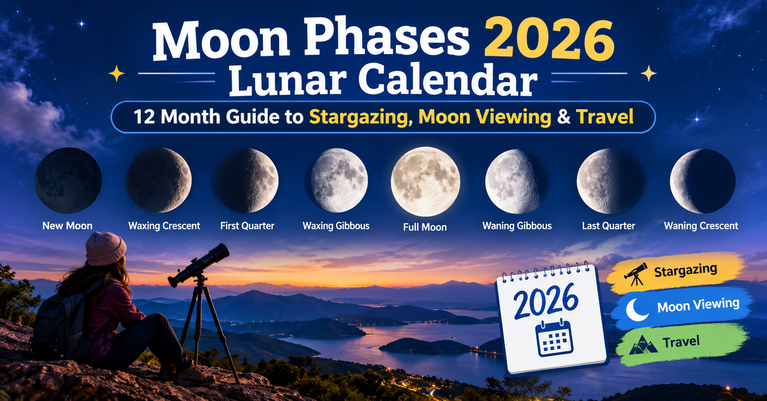
The Moon is one of the easiest objects to enjoy while traveling. You do not need a powerful telescope, special training, or an expensive observatory visit. A clear evening, a comfortable viewing spot, and a little planning can turn an ordinary trip into a memorable night-sky experience.
The Moon Phases 2026 Lunar Calendar can help travelers choose the right nights for moon watching, landscape photography, dark-sky adventures, and astronomy-focused vacations. The Moon looks different throughout its roughly monthly cycle, and each phase creates a different travel experience.
For USA travelers, lunar planning becomes even more useful when combined with weather, moonrise and moonset times, light pollution, and the location of a destination. A full Moon over a national park can create a dramatic landscape, while a new Moon can provide darker skies for stargazing.
Quick Answer:
The Moon Phases 2026 Lunar Calendar tracks four primary phases: New Moon, First Quarter, Full Moon, and Last Quarter.
According to the U.S. Naval Observatory, the major 2026 dates include:
| Month | New Moon | First Quarter | Full Moon | Last Quarter |
| January | Jan. 18 | Jan. 26 | Jan. 3 | Jan. 10 |
| February | Feb. 17 | Feb. 24 | Feb. 1 | Feb. 9 |
| March | Mar. 19 | Mar. 25 | Mar. 3 | Mar. 11 |
| April | Apr. 17 | Apr. 24 | Apr. 2 | Apr. 10 |
| May | May 16 | May 23 | May 31 | May 9 |
| June | Jun. 15 | Jun. 21 | Jun. 29 | Jun. 8 |
| July | Jul. 14 | Jul. 21 | Jul. 29 | Jul. 7 |
| August | Aug. 12 | Aug. 20 | Aug. 28 | Aug. 6 |
| September | Sep. 11 | Sep. 18 | Sep. 26 | Sep. 4 |
| October | Oct. 10 | Oct. 18 | Oct. 26 | Oct. 3 |
| November | Nov. 9 | Nov. 17 | Nov. 24 | Nov. 1 |
| December | Dec. 9 | Dec. 17 | Dec. 24 | Dec. 30 |
The dates above are based on U.S. Naval Observatory calculations. The listed times are in Universal Time (UT), so the calendar date or time can differ for travelers in the United States depending on their time zone.
For travel planning, the most important rule is simple: full Moon nights are excellent for seeing the Moon itself, while nights close to a new Moon are usually better for seeing faint stars and the Milky Way.
What Are Moon Phases?
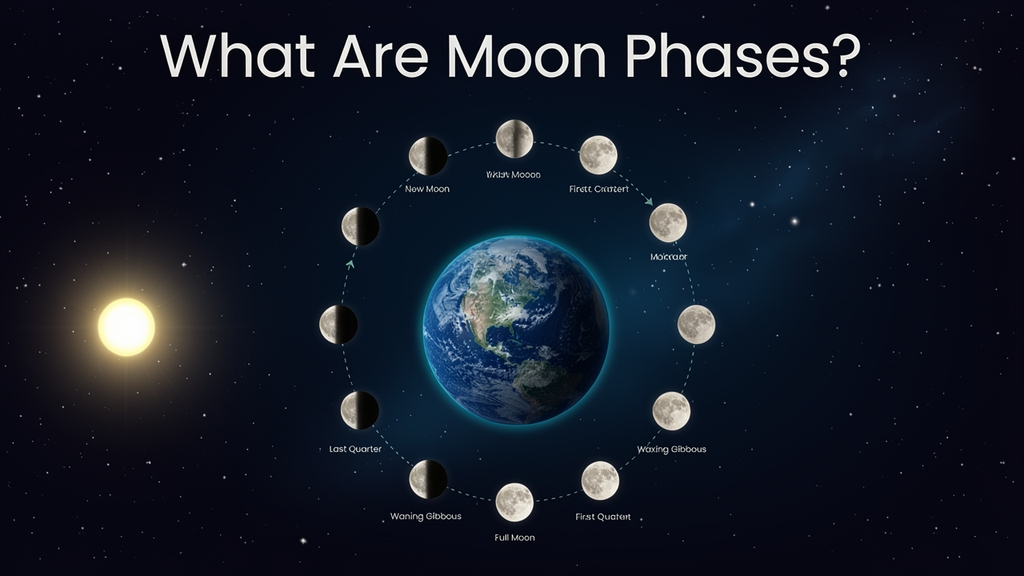
Moon phases describe the changing appearance of the Moon as viewed from Earth.
The Moon does not produce its own visible light. Sunlight illuminates different portions of the Moon as the Moon travels around Earth. From Earth, we see different amounts of that illuminated portion.
There are four primary Moon phases:
- New Moon
- First Quarter
- Full Moon
- Last Quarter
Between these major phases are intermediate stages such as the waxing crescent, waxing gibbous, waning gibbous, and waning crescent.
Understanding these phases makes it much easier to plan a lunar photography trip or choose the best night for stargazing.
New Moon
During a new Moon, the illuminated side is generally facing away from Earth. The Moon is therefore difficult or impossible to see with the unaided eye under normal conditions.
For travelers, however, this can be a major advantage.
A new Moon usually means a darker night sky, which can make faint stars and the Milky Way easier to see when local conditions are good.
First Quarter
The first quarter Moon appears approximately half illuminated from Earth.
It is a popular phase for casual Moon watching because the Moon can be visible during the afternoon and evening. The changing shadows along the lunar surface can also make the craters and mountains interesting through binoculars or a telescope.
Full Moon
A full Moon occurs when the Moon’s Earth-facing side is fully illuminated.
This is one of the most popular lunar events for travelers and photographers.
A bright full Moon can illuminate landscapes, mountains, coastlines, deserts, and historic sites. It can also make some faint stars harder to see because the night sky is brighter.
Last Quarter
The last quarter Moon also appears approximately half illuminated.
It is particularly useful for early-morning Moon watching because it is often visible during the late night and morning hours.
Moon Phases 2026 Lunar Calendar
The following calendar gives the primary Moon phases for the full year.
January 2026
- Full Moon: January 3
- Last Quarter: January 10
- New Moon: January 18
- First Quarter: January 26
January can be a good month for combining winter travel with nighttime photography. Cold, clear conditions can sometimes provide crisp views, although weather and cloud cover remain important.
February 2026
- Full Moon: February 1
- Last Quarter: February 9
- New Moon: February 17
- First Quarter: February 24
Travelers visiting darker rural areas can use the February new Moon period for stargazing, provided the weather cooperates.
March 2026
- Full Moon: March 3
- Last Quarter: March 11
- New Moon: March 19
- First Quarter: March 25
March offers a useful balance between Moon viewing and darker-sky opportunities.
April 2026
- Full Moon: April 2
- Last Quarter: April 10
- New Moon: April 17
- First Quarter: April 24
Spring travel can be an excellent opportunity for landscape photography involving the Moon, especially in scenic outdoor destinations.
May 2026
- Last Quarter: May 9
- New Moon: May 16
- First Quarter: May 23
- Full Moon: May 31
The late-May full Moon can be especially interesting for travelers planning evening outdoor activities.
June 2026
- Last Quarter: June 8
- New Moon: June 15
- First Quarter: June 21
- Full Moon: June 29
Summer travel offers longer daylight hours in many parts of the USA, so travelers should check local moonrise and sunset times before planning a photography session.
July 2026
- Last Quarter: July 7
- New Moon: July 14
- First Quarter: July 21
- Full Moon: July 29
NASA’s July 2026 skywatching guidance highlighted the July 14 new Moon as a useful dark-sky window for observing objects such as the Milky Way, while July 29 brings the full Moon.
August 2026
- Last Quarter: August 6
- New Moon: August 12
- First Quarter: August 20
- Full Moon: August 28
August is a strong month for outdoor astronomy trips. A new Moon period can be particularly appealing when paired with a dark-sky destination.
September 2026
- Last Quarter: September 4
- New Moon: September 11
- First Quarter: September 18
- Full Moon: September 26
September can be an excellent transition month for travelers who want cooler weather and nighttime photography.
October 2026
- Last Quarter: October 3
- New Moon: October 10
- First Quarter: October 18
- Full Moon: October 26
October is especially attractive for scenic travel because many destinations have fall colors. A Moon-lit landscape can add another photographic element.
November 2026
- Last Quarter: November 1
- New Moon: November 9
- First Quarter: November 17
- Full Moon: November 24
November’s longer nights can give travelers more time for astronomy and night photography.
December 2026
- Last Quarter: December 1
- New Moon: December 9
- First Quarter: December 17
- Full Moon: December 24
- Last Quarter: December 30
December’s full Moon falls on Christmas Eve, making the night potentially interesting for holiday landscape photography and evening sky watching.
The complete 2026 phase schedule is calculated by the U.S. Naval Observatory.
Best Moon Phases for Stargazing Trips
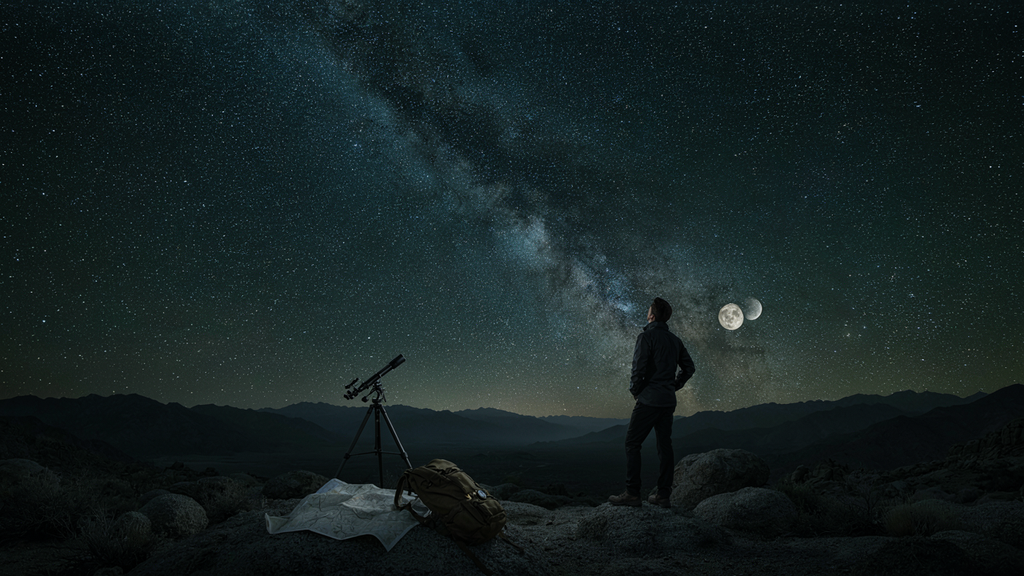
Not every Moon phase is equally useful for stargazing.
If your main goal is to see faint stars, the new Moon is generally the best phase because there is less moonlight in the sky.
If your goal is to photograph the Moon itself, a first quarter or full Moon may be more useful.
| Travel Goal | Best Moon Phase | Why |
| Milky Way viewing | New Moon | Darker sky |
| Moon photography | Full Moon | Fully illuminated Moon |
| Lunar surface details | First/Last Quarter | Strong shadows reveal surface features |
| Moonrise landscape photos | Full Moon | Bright Moon can illuminate scenery |
| Casual Moon watching | First Quarter | Convenient evening visibility |
| Early-morning Moon viewing | Last Quarter | Often visible before sunrise |
Why New Moon Nights Are Great for Dark-Sky Travel
A dark sky allows more stars to become visible.
That makes new Moon periods attractive for travelers visiting places away from major cities.
Examples of suitable destinations can include:
- Remote desert areas
- High-elevation locations
- Rural mountain regions
- Designated dark-sky areas
- National park areas with limited artificial lighting
Always check local park rules, weather conditions, road conditions, and opening hours before traveling.
Best Places for Moon Viewing and Stargazing in the USA
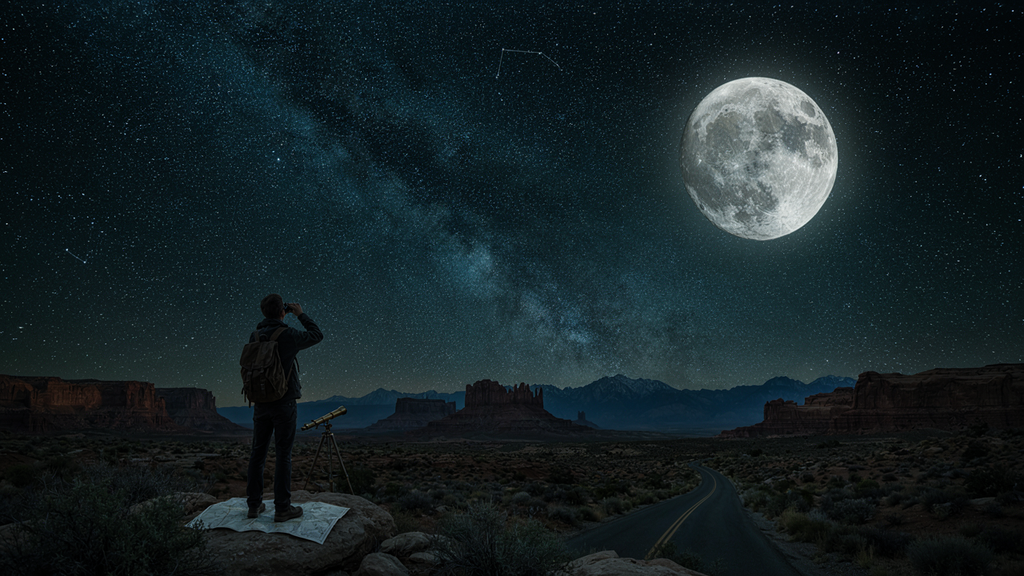
The United States has many excellent astronomy and dark-sky destinations.
Utah
Utah is a strong choice for combining dramatic landscapes with night-sky photography.
Red-rock formations, desert landscapes, and wide-open horizons can create impressive Moon photographs.
Arizona
Arizona’s dry climate and desert landscapes make it a popular destination for astronomy-focused travel.
Areas away from major urban centers can offer darker skies.
Nevada
Nevada has large areas with relatively low population density outside major cities. Travelers can combine scenic road trips with nighttime sky watching.
California
California offers diverse landscapes, from deserts and mountains to coastal areas. Travelers should move away from heavily light-polluted urban zones when planning serious stargazing.
New Mexico
New Mexico is well known for astronomy-related travel and dark-sky locations.
Its dry climate, high elevations, and open landscapes can create favorable conditions for sky watching.
National Parks
National parks can offer spectacular night landscapes, but travelers should check individual park rules.
Some parks have designated astronomy programs, while others simply provide opportunities for visitors to experience darker skies.
How Moon Phases Affect Travel Photography
Moon phases can completely change the mood of a travel photograph.
A full Moon can work as a strong focal point, while a crescent Moon can add a subtle detail to a sunset or twilight scene.
Full Moon Photography
Full Moon photography works well with:
- Mountains
- Buildings
- Bridges
- Coastlines
- Desert formations
- Historic landmarks
- City skylines
The key is composition.
Instead of photographing only the Moon, place it near an interesting foreground or background object.
Crescent Moon Photography
A crescent Moon can look beautiful during twilight.
Try photographing it shortly after sunset or before sunrise when the sky still has some natural color.
Night Landscape Photography
A darker Moon phase can help photographers capture stars and landscape details together.
Use a stable tripod and plan the composition before it becomes completely dark.
Full Moon vs. New Moon for Travel
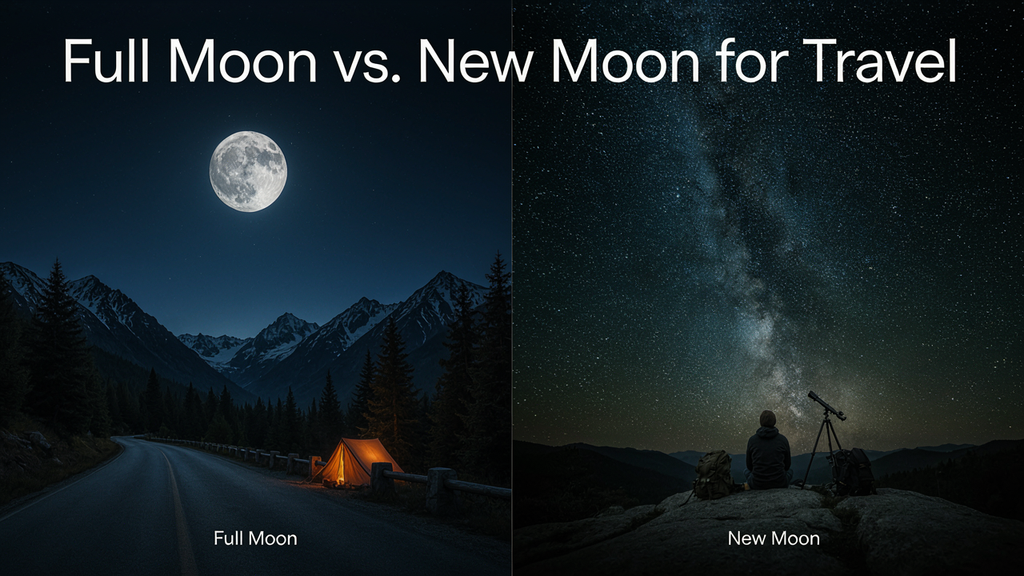
| Feature | Full Moon | New Moon |
| Moon visibility | Excellent | Very low |
| Star visibility | Lower | Better |
| Milky Way | Harder to see | Better conditions |
| Moon photography | Excellent | Poor |
| Landscape lighting | Natural moonlight | Very dark |
| Best for | Moon watching | Stargazing |
| Photography style | Moonlit landscapes | Starry landscapes |
Neither phase is universally “better.”
The best phase depends on what you want to experience.
Moon Phase Travel Planning Checklist
Use this checklist before booking a lunar-themed trip:
- Check the Moon phase.
- Check the exact local Moonrise and Moonset time.
- Check sunset and sunrise.
- Check the weather forecast.
- Look for low-light-pollution areas.
- Check park or attraction opening hours.
- Confirm road and trail conditions.
- Pack appropriate clothing.
- Bring a phone or camera.
- Carry a tripod for photography.
- Check battery levels.
- Download offline maps for remote areas.
- Tell someone about your travel plans.
- Follow all park and local safety rules.
The U.S. Naval Observatory provides location-specific Moonrise and Moonset calculations, showing why travelers should not rely on a generic national timetable when planning a precise viewing session.
Common Mistakes When Planning Moon Viewing Travel
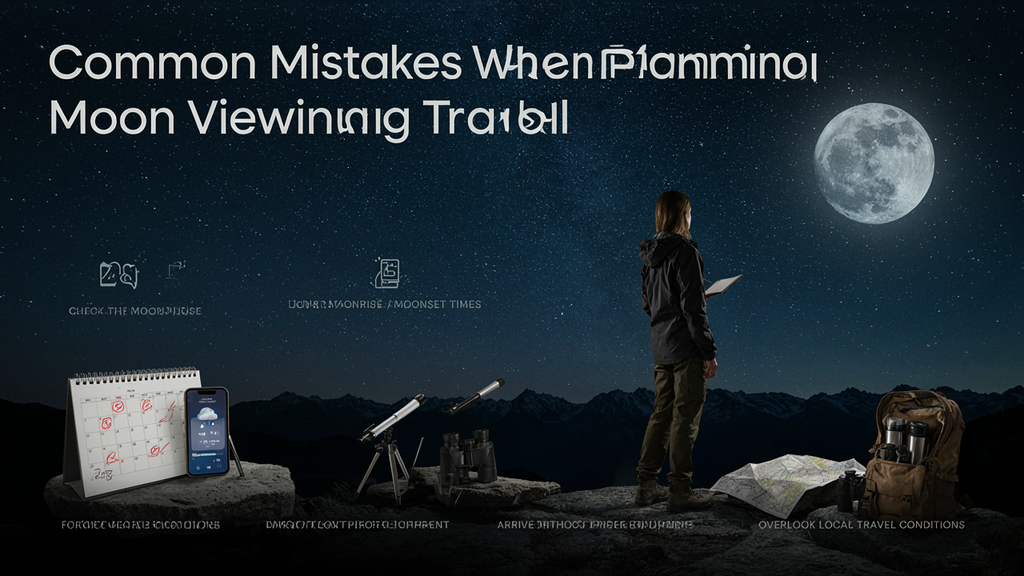
Assuming the Full Moon Is Best for Stargazing
A full Moon is bright. That brightness can make faint stars more difficult to see.
If stargazing is your main goal, consider planning around a new Moon.
Using Only the Moon Phase Date
Knowing that a full Moon occurs on a certain date is useful, but it is not enough for precise photography.
Moonrise and Moonset times vary by location.
Ignoring Weather
A perfect lunar date does not guarantee a perfect view.
Clouds, rain, smoke, haze, and atmospheric conditions can block the Moon.
Staying Near Bright City Lights
Light pollution can dramatically reduce the number of visible stars.
For serious stargazing, travel away from major urban centers when practical.
Forgetting Time Zones
Official lunar phase tables may use Universal Time.
The U.S. Naval Observatory specifically notes that its displayed phase times are in Universal Time and should be converted to local time.
Planning Too Much Around One Exact Minute
A Moon phase is an astronomical moment, but you do not need to be outside at that exact minute to enjoy the Moon.
For travel photography, the hours around the event can often be more useful than the exact phase time.
Pros and Cons of Using a Lunar Calendar for Travel
| Pros | Cons |
| Helps plan Moon photography | Weather can ruin plans |
| Helps identify dark-sky periods | Local times vary |
| Useful for astronomy trips | Moonrise differs by location |
| Makes travel planning more organized | Light pollution can reduce visibility |
| Great for photography planning | Exact viewing conditions cannot be guaranteed |
| Helps choose full Moon experiences | Some remote locations require extra planning |
Expert Tips for Moon-Phase Travel
Choose Your Goal First
Before selecting a date, decide what you want to photograph or observe.
Want the Moon?
Choose a bright phase.
Want the Milky Way?
Look around the new Moon.
Want lunar craters?
Try a quarter Moon when shadows make surface features easier to notice.
Check Location-Specific Data
A lunar calendar gives you the phase, but your destination determines when the Moon rises and sets.
For detailed planning, use a reputable astronomical data service for your exact destination.
Plan for the Landscape
Think beyond the Moon.
Ask yourself:
What should appear with the Moon in the photograph?
A mountain, lighthouse, desert arch, city skyline, or historic building can make the image much stronger.
Arrive Before Dark
Do not wait until the exact Moon event to reach your location.
Arriving early gives you time to:
- Find parking
- Set up your camera
- Choose a composition
- Check the horizon
- Adjust equipment
- Enjoy twilight
Keep Your Plans Flexible
Cloud cover can change quickly.
If your trip lasts several nights, you have a better chance of getting a clear sky.
A Simple 2026 Moon Travel Strategy
You can divide the year into three types of lunar trips.
Full Moon Getaway
Choose a destination with dramatic scenery.
Examples:
- Mountain overlook
- Desert landscape
- Coastal viewpoint
- Historic town
- Scenic national park area
The bright Moon can add natural illumination to the scene.
New Moon Stargazing Trip
Choose a location far from strong artificial light.
Stay for at least one or two nights if possible.
This gives you more flexibility if clouds appear.
Quarter Moon Photography Trip
Quarter phases are excellent for travelers interested in the Moon’s surface.
A telescope or binoculars can reveal more detail, while a camera with a suitable lens can capture the Moon against the surrounding sky.
How to Read the Moon Phases 2026 Lunar Calendar
The calendar is simple once you understand the four major terms.
New Moon → Waxing Crescent → First Quarter → Waxing Gibbous → Full Moon → Waning Gibbous → Last Quarter → Waning Crescent → New Moon
“Waxing” means the illuminated portion is increasing.
“Waning” means the illuminated portion is decreasing.
This cycle repeats approximately every month.
NASA provides educational resources for building a Moon phases calendar and recommends Moon-viewing resources for observing the Moon throughout the year.
Moon Phases and Night Travel: What Actually Matters?
Moon phases are useful, but they are only one part of the planning process.
For a successful night-sky trip, consider these five factors:
- Moon phase
- Moonrise and Moonset
- Weather
- Light pollution
- Location and visibility
For example, a new Moon does not automatically mean you will see the Milky Way. Clouds, haze, smoke, city lights, and the horizon can still affect the experience.
This is why experienced travelers combine a lunar calendar with local weather and astronomical information.
Best Months for Lunar Travel in 2026
There is no single “best” month for everyone.
Best for Dark-Sky Travel
July, August, and September can be attractive choices for travelers looking for summer or early-fall dark-sky adventures, depending on location and weather.
Best for Fall Landscape Photography
October can combine fall scenery with interesting Moon photography opportunities.
Best for Winter Night-Sky Experiences
December and January offer long nights in many parts of the USA, although winter weather can be challenging.
Best for Beginners
Any month can work.
Instead of chasing a specific event, beginners should choose a destination with easy access, a clear horizon, and low light pollution.
Moon Photography Tips for Travelers
You do not need expensive equipment to start.
A modern smartphone can capture the Moon, although dedicated cameras provide more control.
Basic Travel Photography Setup
Consider bringing:
- Smartphone or camera
- Tripod
- Extra battery
- Lens cloth
- Remote shutter or timer
- Headlamp with appropriate night-sky etiquette
- Offline map
For smartphone photography, tap on the Moon and adjust exposure carefully.
For a dedicated camera, experiment with shutter speed, ISO, and focus while keeping the camera stable.
Include Foreground Objects
A Moon by itself can look small in a photograph.
Including a recognizable foreground object can communicate scale and create a stronger travel image.
FAQs
What is the Moon Phases 2026 Lunar Calendar?
The Moon Phases 2026 Lunar Calendar is a yearly schedule showing the dates of the major Moon phases, including new Moon, first quarter, full Moon, and last quarter.
When is the first full Moon of 2026?
The first full Moon of 2026 occurs on January 3, according to U.S. Naval Observatory calculations.
When is the first new Moon in 2026?
The first new Moon of 2026 occurs on January 18 in the U.S. Naval Observatory’s Universal Time table.
What Moon phase is best for stargazing?
The new Moon is generally the best major phase for dark-sky stargazing because moonlight is minimal.
However, weather, light pollution, and location also matter.
What Moon phase is best for Moon photography?
A full Moon is ideal when you want a bright, recognizable Moon in your photograph. First and last quarter phases can be better for showing lunar surface shadows and texture.
Can I see the Moon during the day?
Yes. Depending on its phase and position, the Moon can be visible during daylight hours.
Does the Moon phase change every night?
The Moon’s appearance changes gradually throughout its lunar cycle. The four primary phases are separated by intermediate waxing and waning stages.
Are Moon phase dates the same everywhere?
The astronomical event occurs at a specific moment, but the local date and time can differ because of time zones. Moonrise and Moonset times also depend on location.
Is a full Moon good for seeing the Milky Way?
Usually, a full Moon is not ideal for faint-sky viewing because its brightness can wash out many stars. A new Moon generally provides darker conditions.
Where should I travel for Moon and stargazing experiences?
Good options include areas with low light pollution, clear horizons, and favorable weather. Desert, mountain, and designated dark-sky areas can be excellent choices, subject to local conditions and access rules.
Final Takeaway
The Moon Phases 2026 Lunar Calendar is more than an astronomy reference. For travelers, it can become a practical planning tool for moon photography, dark-sky adventures, national park visits, scenic road trips, and nighttime experiences.
The key is to match the Moon phase with your travel goal. Choose a full Moon when you want a bright lunar subject or moonlit landscape. Choose a new Moon when darker skies and stargazing are your priority. Quarter phases offer another excellent option for observing lunar surface details.
Remember that Moon phase dates alone do not guarantee a great view. Check your destination’s Moonrise and Moonset times, weather, light pollution, local regulations, and accessibility before heading out. Official astronomical data from the U.S. Naval Observatory can provide the precise phase information needed for better planning.
If you’re building a 2026 travel calendar, add the major lunar phases alongside your destination, weather, and photography plans. With a little preparation, the night sky can become one of the most memorable parts of your next USA adventure.
Read More:Login to Twinkl Teaching Resources – Twinkl 2026: Easy Sign-In Guide, Resources & Expert Tips
