


For many devotees, Shri Ram Raksha Stotram is more than a Sanskrit prayer it is a meaningful way to remember Lord Rama, strengthen devotion, and create a peaceful spiritual routine. But a common question for beginners is: When to read Shri Ram Raksha Stotram? Should it be recited in the morning, evening, on Tuesday, or before bedtime?
Traditionally, many devotees prefer early morning after bathing, when the mind and surroundings are calm. However, there is no single clock time that applies to every Hindu tradition. You can also recite Shri Ram Raksha Stotram during your regular puja, in the evening, before sleep, or at another quiet time when you can pray with concentration and sincerity.
In this beginner-friendly guide, you will discover the 7 best times to read Shri Ram Raksha Stotram, traditional practices, devotional benefits, simple recitation tips, common mistakes, and practical advice for creating a regular prayer routine. Whether you live in India or the USA, this guide will help you understand how to make Shri Ram Raksha Stotram a meaningful part of your daily spiritual practice.
Quick Answer:
The best time to read Shri Ram Raksha Stotram is generally a quiet time when you can recite it with concentration and devotion. Many devotees prefer early morning after bathing, while others recite it in the evening or before bedtime.
There is no single universal clock time that every Hindu tradition requires. Your family tradition, sampradaya, personal practice, and guidance from a qualified spiritual teacher may influence the preferred timing.
Quick timing guide

| Time | Why devotees may choose it |
| Early morning | Peaceful atmosphere and focused mind |
| After bathing | Supports a clean and devotional routine |
| Tuesday | Commonly chosen by devotees connected with Hanuman worship |
| Saturday | Often selected for devotional practice and prayer |
| Evening | Convenient after work or family responsibilities |
| Before bedtime | Can become a calm nightly prayer routine |
| During personal prayer | Useful whenever you have a quiet, respectful setting |
The most important principle is regular, sincere recitation rather than simply choosing a particular hour.
What Is Shri Ram Raksha Stotram?
Shri Ram Raksha Stotram is a traditional Hindu devotional hymn dedicated to Lord Rama. The Sanskrit word Raksha means protection, while Stotram refers to a hymn of praise.
The stotram is traditionally associated with Budha Kaushika Rishi and praises Lord Rama while invoking His protective presence. Devotees recite it as part of their spiritual practice and may associate the prayer with courage, inner strength, devotion, and a sense of divine protection.
For many Hindu families, the practice is not only about asking for protection. It can also be a way to remember the qualities associated with Lord Rama, such as dharma, courage, truthfulness, self-control, compassion, and responsibility.
For readers in the United States, Shri Ram Raksha Stotram can fit naturally into a home puja routine, temple visit, meditation practice, or family devotional time.
Why Does the Time of Recitation Matter?

The timing of a prayer can influence the quality of attention you bring to the practice.
A quiet morning may make it easier to concentrate before work, school, or daily responsibilities. An evening practice can help create a peaceful transition from a busy day to family or personal prayer.
However, the spiritual value of recitation should not be reduced to the clock.
A person who recites with sincere devotion at a convenient time may have a more meaningful practice than someone who chooses a traditionally preferred time but rushes through the verses without attention.
Three factors matter most
- Regularity Build a routine you can realistically maintain.
- Concentration Choose a time when distractions are limited.
- Devotion Approach the prayer respectfully and sincerely.
This is particularly useful for beginners. Instead of worrying about finding a “perfect” minute, focus on creating a sustainable devotional routine.
7 Best Times to Read Shri Ram Raksha Stotram
There is no need to make your practice complicated. Below are seven practical times devotees may choose for recitation.
Early Morning After Bathing
For many people, early morning is the most comfortable time to recite Shri Ram Raksha Stotram.
The house may be quieter, the mind may feel less crowded with daily tasks, and you can begin the day with prayer.
A simple morning routine could be:
- Wake up.
- Complete your normal hygiene routine.
- Bathe if that is part of your tradition.
- Sit in a clean, quiet place.
- Light a diya if appropriate and safe.
- Offer a short prayer.
- Recite Shri Ram Raksha Stotram.
- Spend a few moments in silent reflection.
You do not need an elaborate home temple. A clean and respectful space is enough for a simple personal practice.
Why morning works well
Morning recitation can help establish a devotional mindset before work, school, commuting, or other responsibilities.
For people living in the USA, this can be especially practical on weekends or days when the morning schedule is flexible.
During Your Regular Puja
If you already perform daily puja, Shri Ram Raksha Stotram can become part of that routine.
This may be easier than creating a completely separate prayer schedule.
For example:
Morning puja → short meditation → Shri Ram Raksha Stotram → personal prayer
The advantage is consistency. When the prayer becomes connected to an existing routine, you may find it easier to remember.
Families can also create a shared devotional routine where appropriate.
A simple family approach
Parents can introduce children to Lord Rama through stories, values, and short devotional practices without forcing them to memorize a long Sanskrit text immediately.
The goal should be understanding, respect, and gradual learning.
On Tuesday
Tuesday is commonly associated with Lord Hanuman, who is deeply connected with Lord Rama in the Ramayana tradition.
Because of this connection, some devotees choose Tuesday for reciting Shri Ram Raksha Stotram.
However, it is important not to confuse a popular devotional practice with a universal requirement.
If Tuesday is convenient for you, you can make it your weekly recitation day. If another day works better, maintaining a sincere routine may be more practical.
A Tuesday devotional routine
You could:
- Take a bath and wear clean clothes.
- Prepare your prayer space.
- Remember Lord Rama and Hanuman.
- Recite Shri Ram Raksha Stotram.
- Offer a simple prayer for strength, wisdom, and righteous conduct.
- End with gratitude.
On Saturday
Some devotees also choose Saturday for devotional recitation, particularly when their broader spiritual routine includes Hanuman worship.
Saturday practices vary significantly among families and traditions, so there is no need to assume that everyone must recite Shri Ram Raksha Stotram on this day.
If your family tradition recommends Saturday, follow it. Otherwise, choose a day that allows you to practice with attention.
In the Evening After Work
Morning schedules can be difficult.
For many USA readers, work, school, commuting, and family responsibilities make evening prayer more realistic.
There is nothing inherently wrong with creating an evening devotional routine if it helps you practice consistently.
Choose a quiet period after completing major responsibilities.
Example evening routine
7:00 PM: Finish dinner preparation or household tasks
7:30 PM: Take a few quiet minutes
7:35 PM: Sit in your prayer space
7:40 PM: Recite Shri Ram Raksha Stotram
7:50 PM: Silent prayer or meditation
The exact clock time is not the important part. The goal is to create a peaceful and repeatable routine.
Before Bedtime
Some devotees prefer prayer at night.
Reciting Shri Ram Raksha Stotram before bed can become part of a personal devotional routine. The quiet environment may help you slow down after a busy day.
If you choose this approach, avoid turning the recitation into something rushed simply because you are tired.
Better bedtime practice
Keep the routine simple:
- Put away distractions.
- Sit comfortably.
- Take several slow breaths.
- Remember Lord Rama.
- Recite the stotram attentively.
- End with gratitude.
The practice should feel devotional rather than like another task on a checklist.
Whenever You Have a Quiet, Respectful Time
This may be the most practical answer for beginners.
If you cannot follow a traditional morning routine, you can choose another time when you can pray with sincerity and concentration.
For example:
- During a quiet weekend morning
- After returning from a Hindu temple
- During personal meditation
- Before an important life event
- During a family prayer session
- During a personal period of reflection
The key is to avoid thinking that missing one specific time makes the prayer meaningless.
Best Time vs Convenient Time: Which Is Better?

This is a common question among beginners.
The answer is simple: a consistent, focused time is usually more useful than chasing a supposedly perfect time.
| Practice | Advantage | Possible challenge |
| Early morning | Quiet and peaceful | Difficult for late schedules |
| Morning puja | Easy to make habitual | Requires an established routine |
| Tuesday | Fits some devotional traditions | Not convenient for everyone |
| Saturday | Works with weekend routines | May conflict with family plans |
| Evening | Practical for working adults | More distractions |
| Before bed | Calm and reflective | Fatigue can reduce concentration |
| Flexible timing | Easy to maintain | Requires personal discipline |
For USA-based devotees, consistency and practical scheduling can be especially important because work and school routines differ widely.
How to Recite Shri Ram Raksha Stotram Correctly
Knowing when to read Shri Ram Raksha Stotram is only one part of the practice. Beginners should also focus on respectful pronunciation and understanding.
Choose a Clean Space
Select a quiet and reasonably clean area.
A dedicated puja room is helpful but not essential.
Prepare Yourself
Follow the cleanliness practices of your family or tradition.
Bathing before prayer may be customary in many households, but do not let the lack of a perfect setup prevent sincere prayer.
Settle Your Mind
Take a few moments before starting.
Avoid immediately opening the text and rushing through it.
Pronounce the Sanskrit Carefully
If you are new to Sanskrit, listen to a reliable traditional recitation and learn gradually.
Do not feel embarrassed about needing time to improve pronunciation.
Understand the Meaning
Learning the basic meaning of the verses can make recitation more meaningful.
You can study a few lines at a time rather than trying to understand everything in one sitting.
Recite With Attention
Quality matters more than speed.
Avoid racing through the stotram simply to complete it.
Finish With Gratitude
End your practice respectfully.
You may offer a personal prayer, sit silently for a moment, or simply express gratitude.
Shri Ram Raksha Stotram Benefits: What Devotees Traditionally Seek

Devotees may recite the stotram for different spiritual reasons.
Traditional devotional practice commonly connects the prayer with themes such as:
- Protection
- Courage
- Inner strength
- Faith
- Devotion to Lord Rama
- Mental focus
- Spiritual discipline
- Remembrance of dharma
- Peaceful prayer
It is important to distinguish religious belief from scientifically established medical claims.
A devotional practice may support a person’s sense of peace, discipline, or spiritual connection, but it should not be presented as a guaranteed treatment for illness, anxiety, financial problems, or other medical or personal difficulties.
The deeper value of the practice
The Ramayana presents Lord Rama as an important model of dharma and responsible conduct.
Therefore, recitation can also become an opportunity to reflect on questions such as:
- Am I acting honestly?
- Am I keeping my commitments?
- Am I treating others with respect?
- Am I responding to difficulties with courage?
- How can I practice self-control?
These reflections can make devotional practice more meaningful.
Traditional Practice vs Modern Beginner Routine
You do not have to choose between tradition and practicality.
A beginner can respect tradition while building a manageable modern routine.
| Traditional approach | Modern beginner approach |
| Follow family or guru guidance | Start with a realistic schedule |
| Dedicated puja setting | Clean quiet corner |
| Formal preparation | Simple respectful preparation |
| Regular devotional practice | Short, consistent routine |
| Sanskrit-focused learning | Sanskrit plus meaning |
| Family traditions | Adapt around work and school |
If you have access to a knowledgeable priest or teacher, ask about the practices followed by your specific tradition.
Pros and Cons of Different Recitation Times
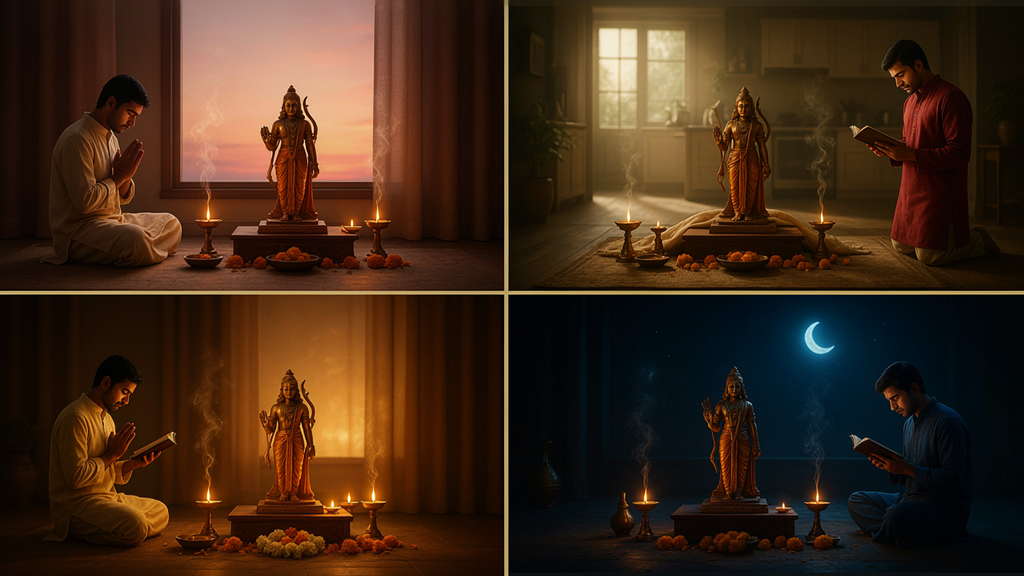
| Time | Pros | Cons |
| Morning | Quiet, focused, fresh start | May be hard with work schedules |
| Evening | Convenient for many families | Household distractions |
| Bedtime | Peaceful and reflective | Tiredness |
| Tuesday | Traditional devotional association | Weekly-only routine may reduce frequency |
| Saturday | Convenient for some families | Weekend commitments |
| Flexible | Highly practical | Requires self-discipline |
There is no need to treat this as a competition between times. The best routine is one that you can maintain respectfully.
Shri Ram Raksha Stotram Recitation Checklist
Use this simple checklist before beginning your practice.
- Choose a quiet and clean space.
- Follow your family or tradition’s cleanliness practices.
- Keep the prayer text ready.
- Put your phone and unnecessary distractions aside.
- Sit comfortably.
- Take a few moments to settle your mind.
- Remember Lord Rama with devotion.
- Recite at a comfortable pace.
- Pay attention to pronunciation.
- Learn the meaning gradually.
- Avoid rushing.
- End with gratitude.
- Maintain a regular schedule.
Common Mistakes to Avoid

Believing There Is Only One Correct Clock Time
Different traditions can follow different practices. Do not assume that one specific hour is mandatory for everyone.
Rushing Through the Stotram
Speed is not the goal.
Try to maintain clear pronunciation and attention.
Ignoring Pronunciation
If you are learning Sanskrit, take time to improve pronunciation using trustworthy traditional instruction.
Focusing Only on Material Results
Devotional practice is broader than asking for specific outcomes.
Use the prayer as an opportunity for remembrance, devotion, reflection, and spiritual discipline.
Stopping Because Your Routine Is Not Perfect
Missing a day does not mean you need to abandon your practice.
Simply return to your routine.
Treating Internet Advice as Your Family Tradition
Online articles can provide general information, but your family priest, guru, or established tradition may have specific guidance.
Making Medical Claims
Do not replace medical care with prayer. Devotion and professional healthcare can exist separately.
Expert Tips for a Better Recitation Practice
Start Small
If you are new to the practice, create a manageable routine rather than setting an unrealistic goal.
Pick a Repeatable Time
If mornings are chaotic, do not force yourself into a morning routine just because someone online calls it the “best.”
Choose a time you can maintain.
Learn the Meaning
Understanding the devotional message can deepen your connection with the prayer.
Improve Pronunciation Gradually
Do not expect perfect Sanskrit pronunciation on your first attempt.
Learn patiently.
Create a Distraction-Free Environment
Silence notifications and place your phone away from your prayer space.
Respect Your Tradition
If your household follows a particular Ramayana or devotional tradition, preserve those practices.
Combine Prayer With Reflection
After recitation, spend a few moments thinking about values associated with Lord Rama, such as dharma, courage, truth, and responsibility.
Keep the Practice Sustainable
A simple routine maintained consistently can be more practical than an elaborate routine that lasts only a few days.
Shri Ram Raksha Stotram in the USA: Creating a Home Practice
Hindu families in the United States often balance religious traditions with busy school, work, and family schedules.
A home devotional practice can be adapted without losing its spiritual character.
Simple USA-friendly routine
Weekdays:
Choose a consistent morning or evening time.
Tuesday or Saturday:
Add a longer devotional session if your family tradition follows it.
Weekend:
Use extra time to learn Sanskrit pronunciation, meaning, or stories from the Ramayana.
Temple visits:
Participate in community worship when convenient.
Many Hindu temples across the USA also organize Rama-related devotional events, Ramayana programs, bhajans, and other cultural activities at different times of the year.
Always check the individual temple’s current schedule rather than assuming an event occurs on a particular date.
How to Build a 7-Day Shri Ram Raksha Stotram Routine
Beginners can use a simple weekly plan.
| Day | Suggested focus |
| Monday | Learn or review pronunciation |
| Tuesday | Devotional recitation connected with Rama-Hanuman bhakti |
| Wednesday | Recitation with focus on meaning |
| Thursday | Quiet personal prayer |
| Friday | Family devotional session if convenient |
| Saturday | Longer prayer or temple visit |
| Sunday | Review and reflection |
This is not a universal religious prescription. It is simply an example of how a beginner might organize a sustainable practice.
You can modify it according to your family’s tradition and schedule.
What If You Cannot Read Sanskrit?
You can still begin learning.
Start with a reliable transliteration or guided pronunciation resource. However, avoid treating random online pronunciations as automatically authoritative.
A good learning process is:
Listen → Repeat → Compare → Practice → Understand
If possible, learn from a qualified Sanskrit teacher, priest, or trusted traditional source.
The goal is not perfection on day one.
Can You Read Shri Ram Raksha Stotram Without a Puja Setup?
Yes, a large or elaborate puja setup is not necessary for everyone.
A clean, respectful place and sincere intention are enough for a simple personal devotional practice.
Some families may have additional rituals, offerings, or procedures. Those should be understood within the relevant tradition rather than presented as requirements for every devotee.
FAQs
When to read Shri Ram Raksha Stotram?
You can read it during a quiet and respectful time that suits your devotional routine. Many devotees prefer morning after bathing, while evening and bedtime are also practical options.
Can I read Shri Ram Raksha Stotram at night?
Yes. Some devotees include it in an evening or bedtime prayer routine. Choose a time when you can recite without rushing.
What is the best time to recite Ram Raksha Stotram?
Early morning is a popular choice because the environment may be quiet and the mind more focused. However, there is no single universal clock time that applies to every tradition.
Can I read Ram Raksha Stotram on Tuesday?
Yes. Tuesday is commonly associated with Hanuman, who has a close devotional connection with Lord Rama. Some devotees therefore choose Tuesday for Rama-related prayers.
Can I read Shri Ram Raksha Stotram on Saturday?
Yes, some devotees include it in their Saturday devotional routine, especially alongside Hanuman worship. Practices vary by family and tradition.
How many times should I recite Shri Ram Raksha Stotram?
There is no need to assume that one number applies to every devotee. Follow your family tradition or teacher’s guidance. Beginners can focus on sincere, attentive recitation rather than quantity.
Can beginners read Shri Ram Raksha Stotram?
Yes. Beginners can learn gradually through transliteration, pronunciation guidance, and study of the meaning.
Do I need to take a bath before reading Ram Raksha Stotram?
Bathing before prayer is part of traditional cleanliness practice for many Hindus, but specific requirements vary. Follow your family or spiritual tradition.
Can I read Shri Ram Raksha Stotram without a temple?
Yes. Many people maintain personal devotional practices at home. A clean, respectful space can be sufficient for a simple prayer routine.
What are the benefits of Shri Ram Raksha Stotram?
Devotees traditionally associate the stotram with themes of divine protection, courage, devotion, inner strength, and remembrance of Lord Rama. These are spiritual and devotional beliefs, not guaranteed medical outcomes.
Conclusion
Knowing when to read Shri Ram Raksha Stotram can help beginners create a devotional routine that fits both traditional values and modern life. Early morning is a popular choice, but evening, bedtime, Tuesday, Saturday, or another peaceful time may also work depending on your tradition and schedule.
For readers in the USA, the most practical approach is to build a routine that you can maintain around work, school, family, and temple activities. Focus on pronunciation, attention, understanding, and devotion rather than worrying about an exact clock time.
If you are beginning your Shri Ram Raksha Stotram journey, start with a simple routine today, learn the meaning gradually, and seek guidance from a trusted priest, Sanskrit teacher, or your family tradition when you need more specific instructions.
Start your practice with sincerity—not pressure—and let consistency make it meaningful.
Read More:How to Recite Shri Ram Raksha Stotram Correctly: 7 Powerful Steps, Benefits & Beginner’s Guide
