

Mokshada Ekadashi Vrat 2026 is an important Hindu fasting occasion dedicated to Lord Vishnu and Lord Krishna. Devotees observe this sacred day with prayers, fasting, mantra chanting, and spiritual activities to seek blessings and inner peace. Mokshada Ekadashi is traditionally associated with liberation, known as moksha, from the cycle of birth and death. It is also closely connected with Gita Jayanti, which celebrates the divine teachings of the Bhagavad Gita.
The spiritual significance of Mokshada Ekadashi Vrat 2026 goes beyond fasting and religious rituals. It encourages devotees to practice self-discipline, strengthen their faith, and focus on spiritual growth. Many people spend the day chanting the Hare Krishna maha-mantra, worshipping Lord Vishnu, and reading sacred scriptures. These devotional practices help followers reflect on the importance of truth, compassion, and righteous living.
If you are planning to observe Mokshada Ekadashi Vrat 2026, understanding the correct date, fasting rules, and Parana time is essential. Devotees may follow different fasting methods depending on their family traditions and religious practices. Some observe a complete fast, while others consume fruits, milk, nuts, and other permitted foods. Always check a reliable Panchang or an ISKCON calendar for the correct observance date and local timings.
For followers of ISKCON, Mokshada Ekadashi Vrat 2026 offers a meaningful opportunity to deepen their devotion to Lord Krishna. Devotees may visit an ISKCON temple, participate in kirtan, listen to spiritual discourses, and study the Bhagavad Gita. Since Mokshada Ekadashi is associated with the appearance of the Bhagavad Gita’s teachings, reading Krishna’s message can be an important part of the day’s observance. These activities help devotees connect religious traditions with everyday life.
This complete guide to Mokshada Ekadashi Vrat 2026 will explain its significance, fasting guidelines, puja rituals, recommended mantras, and the correct way to observe the vrat. You will also learn about the connection between Mokshada Ekadashi and Gita Jayanti, along with the importance of Dwadashi Parana. Whether you are observing this fast for the first time or following an established family tradition, this guide will help you prepare for the occasion with greater understanding and devotion.
Quick Overview of Mokshada Ekadashi 2026
| Information | Details |
| Festival | Mokshada Ekadashi |
| Date in 2026 | Sunday, December 20, 2026 |
| Hindu month | Margashirsha |
| Lunar phase | Shukla Paksha, the waxing Moon |
| Main deity | Lord Vishnu; Lord Damodara is worshipped in the ISKCON tradition |
| Special significance | Bhagavad Gita teachings and spiritual liberation |
| Associated festival | Gita Jayanti |
| Fasting duration | Ekadashi day, according to the applicable local calendar |
| Parana (breaking the fast) | Monday, December 21, 2026, subject to local timings |
| Main activities | Fasting, puja, chanting, Bhagavad Gita reading and temple visits |
| Useful resource | |
| Recommended duration | A focused half-day or full-day spiritual observance |
The date of December 20, 2026, is listed by an ISKCON-affiliated calendar for Mokshada Ekadashi. Exact tithi and parana timings differ by location, so devotees should check their local Vaishnava calendar before observing the fast.
What Is Mokshada Ekadashi and Why Is It Important?
Mokshada Ekadashi is observed on the eleventh lunar day of the bright fortnight of Margashirsha. The word mokshada refers to the granting of moksha, or liberation from the cycle of material existence, within Hindu spiritual belief.
According to the traditional account presented by ISKCON Desire Tree, Lord Krishna explains the significance of this Ekadashi in a conversation with King Yudhishthira. The observance is associated with devotion, spiritual purification, and the belief that devotional merit may benefit departed ancestors.
The day also holds special importance because it is associated with the teachings of the Bhagavad Gita. In the Mahabharata tradition, Krishna teaches Arjuna about duty, the soul, devotion, and the nature of spiritual life on the battlefield of Kurukshetra.
For devotees, the observance can be a chance to:
- Strengthen their relationship with Lord Krishna or Vishnu.
- Read and reflect on the Bhagavad Gita.
- Practise self-discipline through fasting.
- Spend more time chanting and praying.
- Perform charity or devotional service.
- Remember deceased family members through prayer.
Image Caption: A devotional scene of Lord Krishna and Arjuna symbolizing the spiritual teachings of the Bhagavad Gita.
Mokshada Ekadashi Vrat 2026: Date and Important Timings
The first step in preparing for the observance is to confirm the correct fasting date and the following day’s parana window. Hindu lunar dates do not always correspond to the same Gregorian date in every location, and Vaishnava fasting rules can differ from general Hindu calendar calculations.
For many Indian locations, Mokshada Ekadashi falls on Sunday, December 20, 2026. An ISKCON-affiliated calendar gives the following tithi timings in Indian Standard Time: the Ekadashi tithi begins at approximately 10:11 PM on December 19 and ends at approximately 8:16 AM on December 20. Another published calendar lists the tithi ending at approximately 8:14 PM, illustrating why devotees should consult the calendar applicable to their location and tradition.
| Event | Date | Timing guidance |
| Ekadashi tithi begins | December 19, 2026 | Late evening in India, according to the cited calendar |
| Mokshada Ekadashi | December 20, 2026 | Main observance date in the cited Indian calendars |
| Parana day | December 21, 2026 | Break the fast during the locally prescribed window |
| Local sunrise | Depends on location | Used in calculating relevant observance rules |
Important: The table is a planning guide, not a universal fasting timetable. For exact parana timings, use the relevant city’s Panchang or Vaishnava calendar. People observing the ISKCON tradition should prioritize the fasting date and rules published by their local ISKCON temple.
Image Caption: A Hindu Panchang opened to the December 2026 calendar, with Mokshada Ekadashi marked for observance.
How to Observe Mokshada Ekadashi Vrat According to ISKCON Traditions
Observance can be simple at home or more structured at a temple. The central idea is to dedicate the day to Krishna consciousness rather than treating fasting as the only important activity.
Prepare the day before
- Check the local Ekadashi and parana timings.
- Plan suitable fasting foods if you are not undertaking a complete fast.
- Prepare a clean place for worship.
- Arrange a copy of the Bhagavad Gita or access to a reliable devotional reading.
- Eat according to your chosen fasting tradition and avoid foods prohibited by that tradition.
On Ekadashi day
- Wake up at a suitable time and bathe.
- Offer prayers to Lord Krishna or Vishnu.
- Make a personal intention to observe the day with devotion.
- Chant the Hare Krishna maha-mantra or other prayers customary in your tradition.
- Read the Bhagavad Gita and listen to devotional talks.
- Visit an ISKCON temple if practical and confirm its schedule in advance.
- Offer suitable vegetarian food to Krishna according to your tradition.
ISKCON Desire Tree identifies Lord Damodara as the worshipable deity for Mokshada Ekadashi and describes traditional offerings such as incense, a ghee lamp, fragrant flowers, and Tulsi buds.
Remember that fasting practices vary
Some devotees observe a complete fast, while others take water, fruit, milk, or permitted fasting foods. In the ISKCON tradition, avoiding grains and beans is an important part of Ekadashi observance. Individual practices may vary according to health, age, family tradition, and guidance from a spiritual teacher.
Do not undertake a dry fast or a strict fast if it may endanger your health. People with medical conditions, those taking medicines, pregnant individuals, and anyone for whom fasting may be unsafe should seek appropriate medical advice and choose a suitable alternative.
Image Caption: A simple Ekadashi altar with a lamp, flowers, Tulsi leaves, and a Bhagavad Gita.
How to Use ISKCON Desire Tree for Mokshada Ekadashi
ISKCON Desire Tree, often abbreviated as IDT, is a devotional website offering spiritual content related to Krishna consciousness. Its dedicated Mokshada Ekadasi page provides the observance’s significance and a traditional account associated with the day.
You can use the resource as part of your preparation:
- Read the festival explanation: Learn about Mokshada Ekadashi and its place in Vaishnava tradition.
- Study the associated story: Reflect on the traditional account and its spiritual message.
- Prepare a reading schedule: Set aside time for the Bhagavad Gita and other devotional literature.
- Explore devotional media: Check the website for relevant audio, video, or written materials.
- Verify the calendar separately: Use the current calendar for your city to establish the fasting date and parana time.
Visit the Website content and navigation may change, so check the live page before relying on it for event arrangements.
It is useful to distinguish between a devotional article and a location-specific calendar. An explanation of the festival may be suitable worldwide, but sunrise, tithi calculations, fasting dates, and parana windows need to be checked for the place where you will observe the fast.
Image Caption: A devotee reading spiritual literature while preparing for Mokshada Ekadashi.
Best Time to Visit a Temple for Mokshada Ekadashi
If you plan to observe the day at an ISKCON temple or another Krishna or Vishnu temple, the best time to visit depends on the temple’s published programme.
Many devotees prefer morning worship, while others attend evening arati, kirtan, or a spiritual discourse. However, not every temple follows the same schedule, and a special event should never be assumed without confirmation.
| Time of day | Possible activity | What to check |
| Early morning | Personal prayers or temple worship | Opening time and entry arrangements |
| Morning | Japa, scripture reading or a devotional class | Whether a class is scheduled |
| Afternoon | Quiet reading or permitted rest | Temple access and programme breaks |
| Evening | Kirtan, arati or a spiritual talk | Special-event schedule |
| Following morning | Parana and continued prayers | Local fasting rules and parana window |
These are suggested planning periods, not confirmed event timings for a particular temple.
Tips for choosing a visit time
- Check the official website or contact details of the temple you intend to visit.
- Ask whether special entry, registration, or crowd-management arrangements apply.
- Allow extra time if the temple expects a large gathering.
- Confirm whether food or prasadam will be available.
- Avoid planning travel so tightly that you miss a required ritual or parana window.
Image Caption: Devotees attending a devotional programme at a Krishna temple.
Sacred Places and Temple Experiences for Mokshada Ekadashi
There is no single destination associated with every person’s observance of Mokshada Ekadashi. You can observe the day at home, visit a local ISKCON centre, or plan a pilgrimage to a place connected with Krishna’s life and teachings.
Kurukshetra, Haryana, India
Kurukshetra is closely associated with the Mahabharata, and Jyotisar is traditionally identified as the place where Krishna delivered the Bhagavad Gita to Arjuna. A visit may be especially meaningful for devotees who wish to reflect on the teachings connected with Gita Jayanti.
What to do: Visit relevant sacred sites, read a passage from the Bhagavad Gita, and learn about the area’s religious history.
Visiting time: Allow several hours if visiting more than one site. Actual travel times and access conditions depend on your starting point.
Travel tip: Check local temple schedules, access arrangements, and transport options before travelling.
Vrindavan, Uttar Pradesh, India
Vrindavan is a major pilgrimage destination associated with Krishna devotion. Visitors can explore temples, attend devotional programmes where available, and experience the town’s religious atmosphere.
What to do: Visit temples, participate in kirtan where permitted, and spend time in prayer.
Visiting time: A half-day may suit a focused visit; a longer stay is useful for exploring multiple religious sites.
Travel tip: Confirm temple entry arrangements, opening hours, and local transport before your trip.
Mayapur, West Bengal, India
Mayapur is an important centre of the Gaudiya Vaishnava tradition and is closely associated with Sri Chaitanya Mahaprabhu. It may appeal to devotees who want to combine Ekadashi observance with devotional study and temple activities.
What to do: Check the temple’s current devotional programme, participate in suitable activities, and learn about the local spiritual tradition.
Visiting time: Plan at least several hours for a focused temple visit; longer stays depend on your interests.
Travel tip: Confirm accommodation, transport, and programme dates in advance, especially during major religious gatherings.
These places are examples, not a required pilgrimage itinerary. A local temple or home observance can be equally suitable for your personal devotional practice.
Image Caption: A peaceful view of a Krishna pilgrimage destination during a devotional visit.
How to Reach an ISKCON Temple or Pilgrimage Destination
Because Mokshada Ekadashi is observed worldwide, your travel arrangements depend on the city and temple you choose. There is no single airport, railway station, or road route for this festival.
By air
If you are travelling to a temple in another city, identify the nearest suitable airport and check available flights from your departure city. For destinations such as Kurukshetra, Vrindavan, or Mayapur, the final journey may require road or rail transport after arriving at a regional airport.
Flight availability, transfer times, and fares depend on your route and travel date. Verify these details before booking.
By road
Private cars, taxis, intercity buses, and coaches may be practical for reaching temples in India. Road travel can be convenient for families carrying prayer supplies or fasting food.
Before departure, check road conditions, traffic, parking availability, and the temple’s location. If a major religious event is taking place, allow extra time.
By train
Indian Railways connects many major cities and pilgrimage regions. Check the appropriate railway station for your chosen destination, then arrange the onward journey by taxi, bus, or another local service.
Do not assume that a temple is within walking distance of the station. Confirm the last-mile route before booking.
By local transport
Depending on the city, you may be able to use:
- Local buses and taxis.
- App-based ride services where available.
- Auto-rickshaws in Indian cities.
- Walking for short distances when safe and practical.
- Temple-arranged transport, if offered.
If you are travelling internationally to attend an observance, also check visa requirements, entry documents, travel insurance, and any relevant travel advisories.
Distance and Travel-Time Planning
There is no universal distance table for Mokshada Ekadashi because the observance does not take place at a single destination. The following table helps you organise a pilgrimage without relying on unverified route estimates.
| Starting point | Destination | Distance and travel time | Suggested transport |
| Your home | Local ISKCON temple | Depends on your address | Walking, taxi or local transport |
| Your city | Kurukshetra | Depends on the departure city | Train, bus or car |
| Your city | Vrindavan | Depends on the departure city | Train plus road transfer, bus or car |
| Your city | Mayapur | Depends on the departure city | Train or flight plus road transfer |
For accurate distances, use a current mapping service with your actual starting point and the exact temple address.
Practical advice: If you plan to attend morning worship, consider arriving the previous evening. This can reduce the risk of missing the programme because of traffic, delays, or transport changes.
Image Caption: Pilgrims planning their route to a sacred temple for a Hindu religious observance.
Where to Stay During a Mokshada Ekadashi Pilgrimage
Accommodation depends on your destination, budget, group size, and whether you want to stay close to a temple.
Some pilgrimage destinations offer guesthouses, dharamshalas, budget hotels, family rooms, and higher-end accommodation. Availability and facilities differ, so check the specific property rather than assuming that all religious guesthouses offer the same services.
| Accommodation type | Best suited for | What to check |
| Dharamshala or pilgrimage guesthouse | Budget-conscious pilgrims | Eligibility, shared facilities, rules and availability |
| Budget hotel | Short stays and solo travellers | Cleanliness, transport access and cancellation policy |
| Mid-range hotel | Couples and families | Room facilities, meals and distance from the temple |
| Luxury hotel | Travellers seeking additional comfort | Services, transport arrangements and total price |
| Family accommodation | Groups travelling with children or older relatives | Accessibility, room size and nearby food options |
How to choose the right area
- Stay near your chosen temple if you expect to attend multiple programmes.
- Choose an area with reliable transport if you intend to visit several attractions.
- Ask whether the accommodation provides vegetarian meals or permits outside food.
- Confirm check-in times, cancellation terms, and any restrictions.
- Book early if your visit coincides with a major pilgrimage or festival.
There is no reliable single hotel price for this article because no city or travel dates beyond the observance have been specified. Compare current rates for your destination before booking.
Image Caption: A comfortable guesthouse or hotel near a pilgrimage destination.
Food, Prasadam and Fasting Meals
Food is an important part of preparing for Ekadashi. In ISKCON practice, devotees generally avoid grains and beans during the fast and focus on permitted foods, prayer, and offerings to Krishna.
The exact rules depend on the devotional tradition and the individual’s chosen level of fasting. If you are following a specific ISKCON temple’s guidance, check its Ekadashi food rules before preparing meals.
| Food category | General guidance |
| Fresh fruit | Commonly included in less restrictive fasts |
| Milk and dairy | Often permitted, depending on individual dietary needs and tradition |
| Potatoes and other suitable vegetables | May be permitted when prepared according to Ekadashi rules |
| Nuts | Often used for fasting snacks, if suitable for the individual |
| Rice, wheat and other grains | Generally avoided in ISKCON Ekadashi practice |
| Lentils, beans and pulses | Generally avoided in ISKCON Ekadashi practice |
| Packaged snacks | Check ingredients carefully for grains, pulses and prohibited additives |
What is prasadam?
Prasadam is food offered to the Lord and then accepted by devotees as sacred food. During Ekadashi, the ingredients must be suitable for the observance. A dish does not automatically qualify as Ekadashi-friendly simply because it is vegetarian.
Dining tips for temple visitors
- Ask the temple whether Ekadashi prasadam will be served.
- Confirm the ingredients before eating prepared food.
- Carry suitable snacks if you have a long journey.
- Keep drinking water available if your chosen fast permits it.
- Avoid assuming that ordinary restaurant meals follow Ekadashi restrictions.
If you have dietary restrictions or a medical condition, choose safe foods and consult an appropriate healthcare professional before undertaking a restrictive fast.
Image Caption: Fresh fruit and suitable vegetarian fasting foods prepared for Ekadashi.
Travel Budget for Mokshada Ekadashi
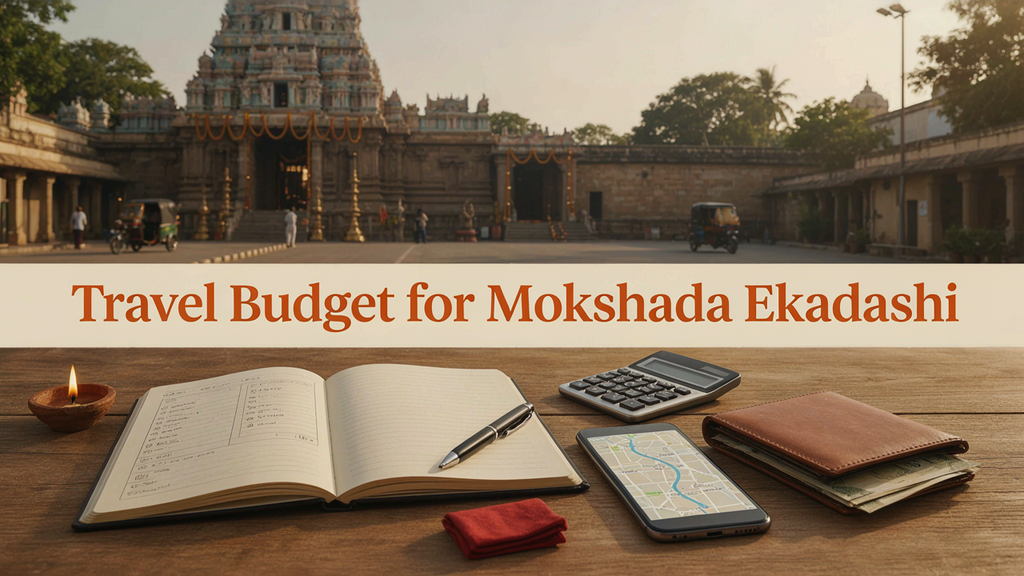
Your total cost depends on whether you observe the day at home, visit a local temple, or travel to a pilgrimage destination. The most economical option is usually a home observance or a visit to a nearby temple, because it avoids accommodation and intercity transport costs.
The table below compares spending patterns rather than inventing prices.
| Expense | Budget traveller | Mid-range traveller | Luxury traveller |
| Accommodation | Stay at home or choose a basic guesthouse | Standard hotel | Premium hotel |
| Food | Prepare suitable fasting meals | Mix of self-prepared and restaurant meals | Higher-end dining where appropriate |
| Local transport | Walking or public transport | Taxi or app-based rides | Private car or pre-arranged transfers |
| Temple activities | Public devotional programmes where available | Optional donations or organised activities | Private arrangements if genuinely offered |
| Intercity travel | Compare economical train or bus options | Convenient train or flight options | Flexible premium travel |
| Additional expenses | Basic essentials | More comfort and flexibility | Greater convenience and optional services |
How to manage your spending
- Decide whether you will observe the fast at home or travel.
- Set aside money for transport before booking accommodation.
- Check whether the temple offers guest accommodation or meals.
- Keep a separate amount for local travel and unexpected delays.
- Make donations voluntarily and according to your means.
There is no meaningful universal daily budget without a destination, currency, and travel plan. Hotel rates, transport fares, and food costs change with location, season, demand, and availability.
Image Caption: A simple travel budget checklist for a spiritual trip.
A Practical One-Day Mokshada Ekadashi Itinerary
A one-day schedule works well for people observing the fast at home or attending a local temple. Adjust the timing to your local sunrise, temple programme, health needs, and fasting tradition.
| Time or period | Suggested activity | Purpose |
| Early morning | Bathe and offer prayers | Begin the observance peacefully |
| Morning | Chant, read scripture or visit a temple | Focus on devotional practice |
| Late morning | Continue reading the Bhagavad Gita | Reflect on Krishna’s teachings |
| Afternoon | Rest, pray or listen to a spiritual discourse | Maintain a calm routine |
| Evening | Attend kirtan or arati if available | Join a devotional gathering |
| Night | Read or reflect quietly | Conclude the day thoughtfully |
| Following morning | Observe parana at the prescribed time | End the fast according to local rules |
If you are travelling to a temple
Keep the schedule flexible. Allow time for the journey, temple entry, queues, rest, and return transport. Do not make a demanding sightseeing plan if you are fasting or travelling with elderly family members.
If you plan to break your fast at a specific time, arrange your journey so that transport delays do not interfere with the prescribed parana window.
Image Caption: A peaceful daily schedule combining prayer, scripture reading, and temple worship.
Family-Friendly Activities and Peaceful Places
Mokshada Ekadashi does not require a picnic or a tourist outing. For families, the most meaningful activities may be those that help everyone participate comfortably in the observance.
Activities to enjoy together
- Read the Bhagavad Gita: Choose a short passage and discuss its meaning in simple language.
- Attend a temple programme: Check whether children are welcome and whether the event is suitable for your family.
- Practise devotional singing: Listen to or sing bhajans and kirtan together.
- Prepare suitable offerings: Let children help arrange flowers or organise a clean prayer space.
- Perform an act of charity: Donate useful items or support a suitable community service.
- Take a quiet walk: If appropriate, visit a nearby garden or peaceful public place before or after devotional activities.
Choosing an outdoor location
If you want to combine the day with a family outing, select a nearby park, garden, or other suitable public place rather than travelling long distances. Confirm opening hours, accessibility, transport, and any local restrictions.
A long excursion is not necessary to observe Mokshada Ekadashi. Keep the day centred on devotion and choose activities that suit the needs of everyone attending.
Image Caption: A family reading a spiritual book together in a calm home setting.
Photography and Scenic Ideas for Devotional Content
Photography can help document a spiritual trip, but respect for worshippers and temple rules should come first. Some temples restrict photography inside sanctums or during particular ceremonies.
If photography is permitted, consider these subjects:
- Temple exteriors and architectural details.
- Lamps, flowers, and devotional decorations.
- Peaceful courtyards or gardens.
- Religious books and a prepared prayer space at home.
- Scenic views around a pilgrimage destination.
- Public festival decorations and permitted devotional gatherings.
Photography etiquette
- Ask permission before photographing other people.
- Follow signs prohibiting cameras or mobile phones.
- Do not interrupt worship to take a picture.
- Avoid using flash where it may disturb devotees or damage sensitive displays.
- Do not photograph restricted areas or publish private moments without permission.
For a blog post about Mokshada Ekadashi, original photographs of your own preparations or a permitted temple visit can add useful context. If you use stock images, verify the licence and describe the scene accurately in the caption and ALT text.
Image Caption: A permitted exterior photograph of a Krishna temple decorated for a devotional occasion.
Local Customs, Safety and Packing Checklist
Respectful temple etiquette
Temple customs vary, but a few basic practices are helpful almost everywhere:
- Wear modest, comfortable clothing.
- Remove footwear wherever instructed.
- Follow queue arrangements and worship instructions.
- Keep your phone silent during prayers and spiritual talks.
- Ask before touching sacred objects or entering restricted spaces.
- Follow the temple’s rules about offerings, food, and photography.
Safety and practical travel tips
- Confirm your temple’s address and programme before leaving.
- Keep your phone charged and save important contact details.
- Carry identification, travel tickets, and necessary medication.
- Drink enough water if your fasting practice permits it.
- Avoid strenuous activities if fasting leaves you tired or light-headed.
- Keep personal belongings secure in crowded areas.
- Verify the local parana window instead of relying on a generic online time.
- If you feel unwell, prioritise your health rather than continuing a strict fast.
Packing checklist
Use this list for a local temple visit or a longer spiritual journey.
- Comfortable, modest clothing.
- Suitable footwear that is easy to remove.
- Phone, charger, and power bank.
- Identification and travel documents.
- Personal medication and essential health items.
- A copy of the Bhagavad Gita or devotional reading material.
- Japa beads or other personal prayer items, if used.
- Suitable fasting snacks, if needed.
- Water bottle, if permitted by your fasting practice.
- Small bag for personal belongings.
- Booking confirmations and temple contact information.
- A light jacket or umbrella if the local weather requires one.
Image Caption: A neatly packed bag containing prayer essentials and practical items for a temple visit.
FAQs
What is Mokshada Ekadashi Vrat 2026, and why is it celebrated?
Mokshada Ekadashi is a sacred Hindu fasting day dedicated to Lord Vishnu. Devotees observe this vrat to seek spiritual growth, forgiveness, and liberation from the cycle of birth and death.
When is Mokshada Ekadashi Vrat 2026?
Mokshada Ekadashi in 2026 falls in December, on the Ekadashi tithi of Shukla Paksha in the Hindu month of Margashirsha. Confirm the exact observance date with a reliable Panchang for your location.
What is the spiritual significance of Mokshada Ekadashi Vrat 2026?
This Ekadashi is traditionally associated with spiritual purification and liberation, known as moksha. Devotees pray to Lord Vishnu and seek blessings for themselves and their families.
How should I observe Mokshada Ekadashi Vrat 2026?
Devotees may observe a fast, worship Lord Vishnu, chant sacred names, and read religious scriptures. The fasting method can vary according to health, family customs, and personal devotion.
What is the connection between Mokshada Ekadashi and the Bhagavad Gita?
Mokshada Ekadashi is traditionally associated with the day Lord Krishna delivered the teachings of the Bhagavad Gita to Arjuna. This connection also links the occasion with Gita Jayanti celebrations.
What foods can I eat during Mokshada Ekadashi Vrat 2026?
Depending on personal tradition, devotees may eat fruits, milk, nuts, and vrat-friendly foods. Many avoid grains, beans, and regular meals while fasting.
Can I drink water during Mokshada Ekadashi Vrat 2026?
Yes, many devotees follow a fast that allows water, while others choose stricter fasting practices. People with medical conditions should prioritize their health and seek medical advice before fasting.
What is the importance of Lord Vishnu during Mokshada Ekadashi Vrat 2026?
Lord Vishnu is the central deity worshipped on this sacred day. Devotees offer prayers, flowers, lamps, and devotional food while seeking his blessings and spiritual guidance.
How do ISKCON devotees celebrate Mokshada Ekadashi Vrat 2026?
ISKCON devotees commonly focus on chanting the Hare Krishna maha-mantra, hearing Krishna’s teachings, and engaging in devotional service. Local temples may organize special programs and Bhagavad Gita readings.
What is the Mokshada Ekadashi Vrat 2026 Parana time?
Parana is the ritual breaking of the Ekadashi fast on Dwadashi. Its exact time depends on the local Panchang, so check a reliable calendar for your city before ending the fast.
Can I read the Bhagavad Gita during Mokshada Ekadashi Vrat 2026?
Yes, reading or listening to the Bhagavad Gita is a meaningful devotional practice for this occasion. Many devotees reflect on Krishna’s teachings about duty, devotion, and spiritual wisdom.
What mantras can I chant during Mokshada Ekadashi Vrat 2026?
Devotees may chant “Om Namo Bhagavate Vasudevaya” or the Hare Krishna maha-mantra. Repeating sacred names with sincerity is considered an important part of devotional practice.
Is Mokshada Ekadashi Vrat 2026 the same as Gita Jayanti?
They are closely connected and often observed on the same day. Mokshada Ekadashi focuses on fasting and devotion to Lord Vishnu, while Gita Jayanti commemorates the teachings of the Bhagavad Gita.
Can beginners observe Mokshada Ekadashi Vrat 2026?
Yes, beginners can participate through prayer, mantra chanting, scripture reading, and a suitable fasting routine. Choose a method that respects your health and personal circumstances.
What should I avoid during Mokshada Ekadashi Vrat 2026?
Many devotees avoid grains, beans, alcohol, and non-vegetarian food according to their traditions. They may also focus on avoiding anger, harmful speech, and negative behavior.
Why is Mokshada Ekadashi Vrat 2026 important in ISKCON?
ISKCON emphasizes devotion to Lord Krishna through chanting, scripture study, and devotional service. The observance also provides an opportunity to study the Bhagavad Gita and deepen spiritual understanding.
Can children and elderly people observe Mokshada Ekadashi Vrat 2026?
They can participate through prayers, chanting, and listening to spiritual teachings without undertaking a strict fast. Their food and hydration needs should always come first.
What is the difference between Nirjala and regular Mokshada Ekadashi fasting?
Nirjala fasting means abstaining from both food and water, making it a particularly strict practice. Regular Ekadashi fasting may allow water, fruit, milk, or specific foods, depending on tradition.
How can I find the correct Mokshada Ekadashi Vrat 2026 date for my city?
Consult a trusted Hindu Panchang or an official ISKCON temple calendar for your location. Dates and observance rules can differ because of local timings and religious calculation methods.
What are the main benefits of observing Mokshada Ekadashi Vrat 2026?
Traditionally, devotees believe this vrat supports spiritual discipline, devotion, and progress toward liberation. Its deeper purpose is to strengthen faith, encourage self-control, and inspire positive actions.
Conclusion
Mokshada Ekadashi Vrat 2026 is a spiritually meaningful occasion for devotees who wish to deepen their connection with Lord Vishnu and Lord Krishna. Through fasting, prayer, mantra chanting, and reading the Bhagavad Gita, devotees can focus on spiritual growth and self-discipline. The day also reminds people of the importance of devotion, compassion, and righteous living. Following the vrat according to your family tradition can make the observance more meaningful. Always confirm the date and fasting timings using a reliable local Panchang.
Observing Mokshada Ekadashi Vrat 2026 can be an opportunity to reflect on Krishna’s teachings and bring more devotion into everyday life. Whether you visit an ISKCON temple, chant at home, or read sacred scriptures with your family, sincere participation is what matters most. Choose a fasting routine that suits your health and personal circumstances. Check the correct Parana time before breaking your fast on Dwadashi. May this sacred occasion inspire peace, wisdom, and spiritual understanding throughout the year.
Read More: Nirjala Ekadashi 2026 Date and Timings: Vrat Rules, Puja Vidhi, Parana and Significance
