

Prabodhini Ekadashi Date 2026 is an important Hindu religious observance dedicated to Lord Vishnu. Also known as Devutthana Ekadashi or Devuthani Ekadashi, this sacred day marks the traditional awakening of Lord Vishnu after his four-month cosmic rest. Devotees celebrate the occasion with prayers, fasting, temple visits, and devotional activities. It holds special importance for people who follow Vaishnava traditions and observe Ekadashi throughout the year.
The Prabodhini Ekadashi Date 2026 falls on Sunday, November 22, 2026, according to commonly published Hindu calendar listings. It occurs during Shukla Paksha, the waxing phase of the Moon, in the Hindu month of Kartik. Many devotees consider this day spiritually significant because it symbolizes renewal, devotion, and the return of an auspicious period. However, the exact observance date and timings may vary according to location and regional Panchang calculations.
Understanding the Prabodhini Ekadashi Date 2026 also helps devotees prepare for traditional fasting and puja rituals. Some people observe a complete fast, while others consume fruits, milk, and permitted fasting foods according to their customs. Devotees may chant Lord Vishnu’s mantras, read sacred scriptures, light lamps, and offer prayers at home or in temples. Fasting practices should always be adapted to individual health needs and personal circumstances.
Another important tradition associated with the Prabodhini Ekadashi Date 2026 is Tulsi Vivah, a ceremonial marriage of the sacred Tulsi plant with Lord Vishnu or his form, Shaligram. Many Hindu communities celebrate Tulsi Vivah on Ekadashi or during the days immediately following it. The occasion is considered an important part of the Hindu religious calendar and is associated with the resumption of wedding celebrations in many traditions after Chaturmas.
In this complete guide to Prabodhini Ekadashi Date 2026, you will learn about the festival’s date, religious significance, traditional stories, fasting rules, puja rituals, and Parana timings. You will also discover how Devutthana Ekadashi differs from Devshayani Ekadashi and why devotees worship Lord Vishnu on this special occasion. Before observing the fast, check a reliable local Panchang for accurate timings and follow the customs that are meaningful to your family.
Quick Travel Overview
| Information | Details |
| Festival | Prabodhini Ekadashi / Devutthana Ekadashi |
| Country | India; also observed by Hindu communities worldwide |
| Main 2026 date | Friday, November 20, 2026, for the commonly followed Smarta observance |
| Vaishnava observance | Saturday, November 21, 2026, in calendars that follow Gauna Ekadashi |
| Main deity | Lord Vishnu |
| Lunar month | Kartik, Shukla Paksha |
| Best time for temple visits | Early morning or during the temple’s announced puja schedule |
| Recommended duration | A few hours for local worship; 1–3 days for a pilgrimage |
| Main experiences | Vishnu worship, Ekadashi fasting, bhajans, temple visits and Tulsi Vivah festivities |
| Language | Hindi, regional Indian languages and English in many tourist areas |
| Currency | Indian rupee (INR) |
| Transportation | Flights, trains, buses, taxis and local transport, depending on the pilgrimage destination |
| Approximate budget | Highly dependent on destination, accommodation, transport and meal choices |
Important: Prabodhini Ekadashi is a religious observance, not a single tourist destination. Travel details and budgets therefore depend on the temple or city you choose. The dates above refer to common Indian calendar calculations; always check the local Panchang and your religious tradition before fasting.
What Is Prabodhini Ekadashi?
Prabodhini Ekadashi is the eleventh lunar day of the bright fortnight of Kartik. The name Prabodhini is associated with awakening, while Devutthana means the rising or awakening of the gods.
According to Hindu tradition, Lord Vishnu enters a period of cosmic rest on Devshayani Ekadashi and awakens on Prabodhini Ekadashi. This marks the end of Chaturmas, a spiritually significant four-month period observed by many Hindus.
The festival is also known by several names:
- Dev Uthani Ekadashi
- Devutthana Ekadashi
- Devuthani Ekadashi
- Haribodhini Ekadashi
- Kartik Shukla Ekadashi
The day is especially meaningful to Vaishnavas, devotees who worship Lord Vishnu and his various incarnations. Many people observe a fast, recite sacred texts, chant Vishnu’s names and visit temples.
For travelers, it is an opportunity to learn about Hindu traditions through firsthand participation, provided they respect temple rules and local customs.
Prabodhini Ekadashi Date 2026 and Important Timings
The main Prabodhini Ekadashi observance in many Indian calendars falls on Friday, November 20, 2026. Some Vaishnava traditions observe Gauna Ekadashi on Saturday, November 21.
The difference arises because Hindu festival dates depend on the lunar Tithi and the rules followed by different religious traditions, not simply the date shown on a civil calendar.
Important dates at a glance
| Date | Observance | What it means |
| November 20, 2026, Friday | Main Prabodhini Ekadashi | Common Smarta fasting date |
| November 21, 2026, Saturday | Dwadashi and Tulsi Vivah period | Fast-breaking and marriage-ritual observances, according to local tradition |
| November 21, 2026, Saturday | Gauna/Vaishnava Ekadashi in some calendars | Alternative fasting date followed by certain Vaishnava communities |
| November 22, 2026, Sunday | Parana for those observing the November 21 fast | Fast-breaking day in the Gauna observance |
The dates are supported by published Hindu calendar listings, although specific rituals and timings differ by location and tradition.
What time does Ekadashi Tithi begin and end?
For New Delhi, Drik Panchang lists the Ekadashi Tithi as beginning at approximately 7:15 AM on November 20 and ending at approximately 6:31 AM on November 21, 2026. The same calendar lists a separate Parana window for the November 20 observance.
These are location-specific calculations. Do not apply New Delhi’s timings automatically to Mumbai, Ahmedabad, Bengaluru, Karachi or another city.
What is Parana?
Parana means breaking the Ekadashi fast. It is generally performed on the following Dwadashi day, following the rules of the person’s tradition and the appropriate local timing.
Before fasting, check:
- Your local sunrise and Ekadashi Tithi.
- Whether your family follows Smarta or Vaishnava observance.
- The recommended Parana window.
- Any guidance from your temple or religious teacher.
People with medical conditions, pregnancy, medication requirements or other dietary needs should seek appropriate medical advice rather than undertake a restrictive fast without guidance.
Religious Significance and the Story of Lord Vishnu’s Awakening
Prabodhini Ekadashi has an important place in the Hindu religious calendar because it marks the conclusion of Chaturmas.
Chaturmas is traditionally associated with spiritual discipline, prayer, fasting and restraint. Its observance varies between communities, but many devotees use the period to focus more closely on religious practice.
Prabodhini Ekadashi symbolizes a fresh beginning. Devotees welcome Lord Vishnu’s awakening through worship, lamps, flowers, devotional songs and offerings made according to their traditions.
The day is also linked with the beginning of an auspicious period for certain ceremonies, including weddings. The exact start of wedding season depends on regional customs, the Panchang and the muhurat selected.
Why is Tulsi important?
Tulsi, or holy basil, is especially sacred in many Vaishnava traditions. The festival period is associated with Tulsi Vivah, a ceremonial wedding of the Tulsi plant with Lord Vishnu, often represented as Shaligram.
Families may decorate a Tulsi plant or shrine, light oil lamps, offer flowers and perform prayers. The precise day and ritual arrangements vary by region.
Image Caption: A traditional Tulsi Vivah arrangement with a decorated holy basil plant, flowers and lamps.
Best Places to Experience Prabodhini Ekadashi in India
There is no single official destination for this festival. You can observe it at home, at a neighborhood temple or during a pilgrimage. If you want to travel, the following destinations offer distinct spiritual and cultural experiences.
These destinations are deeply associated with Krishna worship and Vaishnava traditions. Visitors can plan temple visits, attend devotional singing where available and explore the region’s religious heritage. Crowds, entry procedures and darshan arrangements vary by temple.
Pandharpur, Maharashtra
Pandharpur is a major pilgrimage center dedicated to Lord Vitthal, a form of Krishna associated with the Varkari devotional tradition. It is a meaningful option for devotees interested in Maharashtra’s bhakti heritage. Confirm temple access and any special arrangements before traveling.
Pushkar offers sacred ghats, a pilgrimage atmosphere and the famous Pushkar Lake. The annual Pushkar Fair is associated with this period of the Hindu calendar, but its exact dates and program should be verified for 2026 before making arrangements.
Varanasi is known for its sacred riverfront, temples and longstanding Hindu pilgrimage traditions. Visitors can explore the ghats, attend permitted worship services and learn about local religious customs. The city is a broader pilgrimage destination rather than a place exclusively associated with Prabodhini Ekadashi.
Travel tip: If your main goal is to observe a particular Ekadashi ritual, contact the temple directly. A famous pilgrimage site does not necessarily hold a public ceremony for every festival, and darshan arrangements may change.
Things to Do During Prabodhini Ekadashi
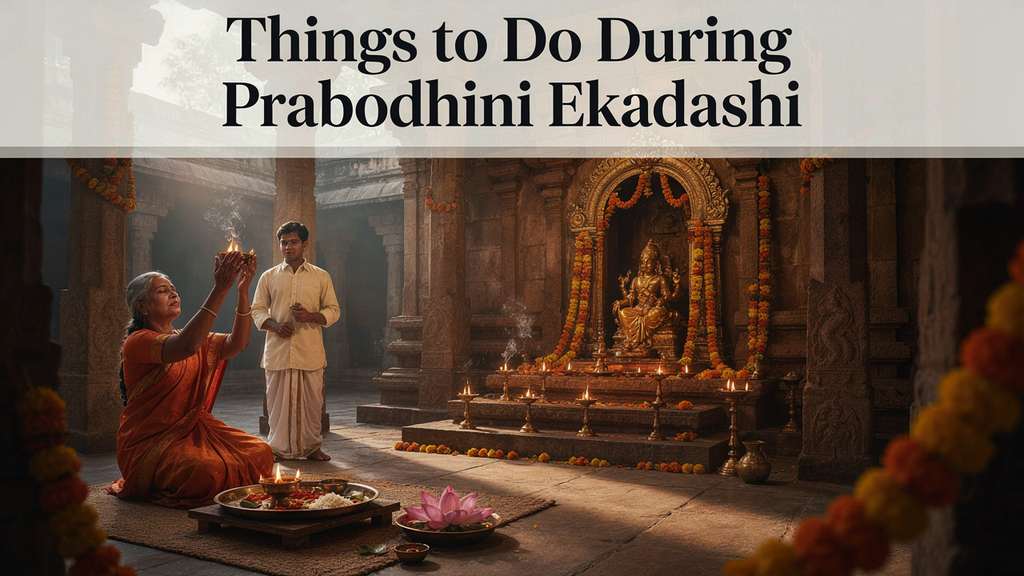
The most meaningful activities are usually religious and cultural rather than conventional sightseeing.
- Attend Vishnu Puja: Visit a temple that worships Lord Vishnu, Krishna or Vitthal, subject to its visitor rules.
- Observe a fast: Follow your family or community’s established fasting tradition.
- Listen to bhajans and kirtan: Check whether devotional singing or special programs are open to visitors.
- Read sacred texts: Some devotees read or listen to passages from the Bhagavad Gita, Vishnu-related scriptures or other texts used in their tradition.
- Participate in Tulsi worship: If your family or host community observes it, learn about the ritual respectfully.
- Explore local heritage: Visit nearby historic temples, ghats, museums or cultural areas outside worship hours.
- Enjoy vegetarian food: Choose a suitable meal after the fast or eat according to your own fasting rules.
Do not assume that every temple permits photography, non-Hindu visitors in all areas, or participation in every ritual. Ask before entering restricted spaces or handling religious objects.
Best Time to Visit for Prabodhini Ekadashi
For a festival-centered trip, plan around November 20–21, 2026, and allow flexibility if your chosen temple follows a different observance.
November is generally part of the cooler, post-monsoon travel period across much of northern India, but conditions vary considerably by region. Rajasthan can have warm afternoons and cool evenings, while southern and western destinations may have different weather patterns.
| Travel period | What to expect | Planning advice |
| November 20–21, 2026 | Main observance and related rituals in many calendars | Confirm your temple’s exact program |
| A day before the festival | Time to arrive, settle in and learn local arrangements | Useful for avoiding rushed travel |
| One day after your chosen observance | Potentially easier sightseeing after worship | Check the temple calendar and onward transport |
| Other days in November | General pilgrimage and cultural sightseeing | Verify local festivals and weather |
For outdoor sightseeing, mornings and late afternoons are often comfortable in many northern Indian destinations. This is general guidance, not a guaranteed weather forecast.
Should you arrive a day early?
Yes, if you are traveling a long distance or hoping to attend a specific ceremony. Arriving early reduces the risk of delays from traffic, crowded stations or sold-out accommodation. It also allows time to locate the temple, understand its entry arrangements and buy any permitted offerings.
How to Reach Your Chosen Pilgrimage Destination
Because Prabodhini Ekadashi is observed across India, there is no single airport, railway station or road route for the festival. Choose the destination first, then plan the journey around its transport network.
By air
Major cities such as Delhi, Mumbai and Jaipur can serve as gateways to different pilgrimage regions. The best airport depends on the destination you select.
- For Vrindavan and Mathura, compare flights to Delhi with onward road or rail travel.
- For Pandharpur, examine the available connections through nearby major transport hubs and confirm the final road journey.
- For Pushkar, compare travel through Jaipur and onward ground transport.
- For Varanasi, check flights serving Varanasi directly.
Flight schedules, fares and connections can change. Verify the current itinerary with the airline before booking.
By road
Intercity buses, private cars and taxis can be useful for reaching temples and smaller pilgrimage towns. Travel times depend on the departure city, traffic, road conditions and festival crowds.
If driving, plan rest breaks and check whether traffic restrictions or special parking arrangements apply near the temple. Do not rely on a map estimate alone during a major religious event.
By train
Rail travel can be convenient for popular pilgrimage destinations. Search for trains to the station serving your chosen city or town, and check the remaining distance to your accommodation.
Book through official railway channels or authorized providers. Check station names carefully, as a destination may have more than one station or may require a connecting road journey.
Local transportation
Depending on the city, options may include:
- Local buses
- Auto-rickshaws
- App-based taxis where available
- Traditional taxis
- Walking between nearby temples
- Hotel-arranged transport
Walking may be the easiest way to explore a compact temple area, but check pedestrian access, footwear rules and crowd-control arrangements.
Distance and Travel-Time Planning
Distances and journey times depend on where you start. The table below identifies possible gateways rather than suggesting that each journey has a fixed duration.
| Pilgrimage destination | Possible transport gateway | Final journey |
| Vrindavan and Mathura | Delhi or Mathura rail connections | Road or local transport, depending on arrival point |
| Pandharpur | Railway and road connections serving the region | Check the final connection to the temple |
| Pushkar | Jaipur | Road transfer to Pushkar |
| Varanasi | Varanasi airport or railway stations | Local taxi, auto-rickshaw or other permitted transport |
For an accurate distance estimate, enter your actual starting point and the exact temple address in a current mapping service. Check the result again near your travel date, especially if special festival traffic arrangements are announced.
Image Caption: Pilgrims walking through a historic temple area during a Hindu religious observance.
Where to Stay: Accommodation for Pilgrims
Accommodation depends on your chosen destination, budget and preference for staying near a temple or in a larger city.
Budget stays
Dharamshalas, guesthouses and simple hotels may suit travelers who prioritize religious visits and need only basic facilities. Availability, eligibility requirements and booking arrangements differ between properties.
Mid-range accommodation
Mid-range hotels can offer private rooms, more predictable amenities and convenient access to transport. They may be a good choice for families or travelers who prefer to rest comfortably between temple visits.
Luxury accommodation
Larger cities and established tourist centers may offer premium hotels and resorts. These are useful for travelers who want more facilities, although they may be farther from the temple or busy pilgrimage area.
Family-friendly accommodation
Look for properties with accessible entrances, suitable sleeping arrangements, nearby food options and reliable transport. Older adults and children may benefit from a location that reduces long walks and crowded transfers.
| Accommodation type | Best for | What to verify |
| Dharamshala | Budget pilgrims | Eligibility, facilities and reservation rules |
| Guesthouse | Short religious trips | Location, cleanliness and check-in hours |
| Mid-range hotel | Families and couples | Transport access, room arrangements and cancellation policy |
| Premium hotel | Comfort-focused travelers | Actual distance to the temple and total cost |
Book early if you plan to travel during a major festival. Rates vary by location, demand, room type and booking date, so compare current offers rather than relying on a fixed estimate.
Food and Fasting Traditions
Food is an important part of Ekadashi observance. However, fasting rules are not identical across all Hindu families or religious communities.
Some devotees abstain from grains and beans, others consume fruit and milk, and some observe a more restrictive fast. Water intake and the duration of fasting also vary. Follow the tradition you observe and seek medical advice if fasting may affect your health.
Common foods associated with Ekadashi
| Food | How it may be used |
| Fresh fruit | A simple fasting food for those whose tradition permits it |
| Milk or yogurt | Used by some devotees, depending on individual dietary rules |
| Nuts | A source of energy for those who include them |
| Potatoes and other permitted vegetables | Used in some fasting preparations |
| Buckwheat or water chestnut flour | Used in certain regional fasting dishes |
| Simple vegetarian meals | Often chosen after the fast, subject to tradition |
Not every food in this table is acceptable under every fasting practice. Confirm the rules that apply to you.
Where should travelers eat?
In pilgrimage towns, look for established vegetarian restaurants, hotel dining rooms and eateries that clearly identify ingredients. Ask about grains, pulses, cooking oils and cross-contamination if these matter to your observance or health.
Carry water and a small snack that complies with your fasting rules. Do not assume every restaurant will offer special Ekadashi meals.
Travel Cost and Budget for Prabodhini Ekadashi
There is no universal price for an Ekadashi trip. Your total expense depends on your home city, destination, travel class, accommodation and length of stay.
| Expense | Budget traveler | Mid-range traveler | Luxury traveler |
| Transport | Public transport or economical rail fares | Convenient train class or mixed transport | Premium train class, private transfers or flights |
| Accommodation | Basic guesthouse or eligible dharamshala | Standard private hotel room | Premium hotel or resort |
| Food | Simple vegetarian meals | Restaurant meals | Hotel dining and higher-end restaurants |
| Local transport | Walking and public transport | Taxis for selected journeys | Private car or arranged transfers |
| Activities | Temple visits and free public areas | Paid cultural activities where available | Private guides or tailored experiences |
Instead of giving unsupported prices, calculate your budget using current fares and accommodation rates for your actual dates.
To keep costs manageable:
- Reserve transport early where practical.
- Choose accommodation within a reasonable distance of the temple.
- Check whether the temple charges for any special service or booking.
- Keep a small cash reserve for local purchases.
- Allow extra time and money for unexpected transfers.
Suggested One-Day and Two-Day Itineraries
These itineraries are flexible planning examples, not official festival schedules. Adapt them to your chosen city and the temple’s confirmed arrangements.
One-day itinerary
| Time of day | Suggested activity |
| Early morning | Prepare for the day and attend temple worship if available |
| Morning | Spend time in prayer, devotional reading or a permitted temple visit |
| Afternoon | Rest, have an appropriate meal and explore a nearby cultural site |
| Evening | Attend a scheduled bhajan or aarti if open to visitors |
| Night | Return to your accommodation or home and prepare for the next day’s observance |
If you are fasting, avoid planning strenuous activities or a long walking tour without considering your energy level.
Two-day pilgrimage itinerary
| Day | Morning | Afternoon | Evening |
| Day 1: Arrival | Travel to the chosen city | Check in and identify temple entry points | Attend worship if available and rest |
| Day 2: Festival | Follow the local Ekadashi observance | Visit a nearby heritage or religious site | Attend an announced devotional program or return home |
If you observe the Vaishnava fast on November 21 rather than November 20, adjust the itinerary accordingly. Keep the Parana schedule for your own tradition in mind when arranging travel.
Family-Friendly Places and Peaceful Breaks
A religious trip can also include quiet, family-friendly sightseeing, provided you do not miss the worship or fasting arrangements that matter to you.
The most suitable places depend on your destination:
- Vrindavan and Mathura: Explore permitted temple areas and cultural sites, allowing extra time for walking and crowds.
- Pushkar: Visit the lakefront and public areas respectfully, checking local access and event arrangements.
- Varanasi: Explore accessible sections of the ghats and other heritage areas, taking care around steps and the river.
- Pandharpur: Focus on the pilgrimage area and local cultural heritage, checking access arrangements around the temple.
For families with young children or older adults, choose short walking routes, schedule rest breaks and carry drinking water. A picnic may be suitable in a permitted public area away from active worship spaces, but check local rules and avoid eating where food is prohibited.
Do not assume that a temple courtyard, ghat or sacred area is available for recreational picnics.
Photography, Local Culture and Festival Etiquette
Prabodhini Ekadashi can offer memorable cultural experiences, from decorated shrines and flower offerings to devotional gatherings and traditional Tulsi Vivah ceremonies.
Photography tips
- Photograph temple exteriors and public spaces where photography is permitted.
- Look for decorative details, lamps and flowers rather than interrupting worship.
- Ask permission before taking close-up photographs of people.
- Avoid flash photography where it could disturb worshippers.
- Never photograph restricted sanctums or ceremonies against temple rules.
Image Caption: Traditional lamps and floral decorations create a warm atmosphere during Hindu devotional celebrations.
Respect local customs
Remove footwear wherever required, dress modestly, follow queue instructions and observe signs about entry or offerings. Some temples have rules about food, bags, phones or access to particular areas.
If you are unfamiliar with a ritual, ask a temple volunteer or guide for an explanation. Visitors are generally better received when they show curiosity without treating sacred activities as performances.
Safety, Packing Checklist and Final Travel Tips
A successful pilgrimage begins with realistic planning. Festival crowds, local traffic, long queues and changes in temple arrangements can affect your day.
Safety tips
- Keep identification, cash and valuables secure.
- Use authorized transport and agree on fares before beginning a journey when appropriate.
- Confirm your accommodation address and return transport.
- Carry essential medication and follow your normal medical routine.
- Stay hydrated and avoid physically demanding activities if you are fasting.
- Check local weather and transport updates.
- Keep children and older relatives close in crowded areas.
- Verify any special entry, photography or dress requirements directly with the temple.
What to pack
- Comfortable walking shoes or sandals that are easy to remove.
- Modest clothing suitable for the destination and weather.
- A light layer for cool mornings or evenings where needed.
- Personal identification and booking confirmations.
- A charged mobile phone and power bank.
- Essential medication and basic personal supplies.
- Drinking water and suitable snacks for your travel needs.
- A small bag for permitted personal offerings.
- Cash for small purchases and a payment card where accepted.
- A copy of the local temple schedule and your relevant Panchang timings.
Before departure, verify the exact fasting date, Parana timing, temple schedule, transport connections and accommodation booking. These details are more useful than relying on a general festival timetable.
FAQs
What is the Prabodhini Ekadashi Date 2026?
The Prabodhini Ekadashi Date 2026 is Sunday, November 22, 2026, according to commonly published Hindu calendar listings. It is an important Vaishnava festival dedicated to Lord Vishnu.
Why is Prabodhini Ekadashi celebrated in 2026?
Prabodhini Ekadashi marks the traditional awakening of Lord Vishnu after his cosmic rest during Chaturmas. Devotees celebrate the day with prayers, fasting, and temple visits.
What is the significance of Prabodhini Ekadashi Date 2026?
Prabodhini Ekadashi signifies spiritual renewal and the beginning of an auspicious period for many Hindu religious activities. It is also associated with devotion to Lord Vishnu and the Tulsi Vivah tradition.
Which Hindu month includes Prabodhini Ekadashi Date 2026?
Prabodhini Ekadashi falls during the Shukla Paksha of Kartik month in the Hindu lunar calendar. The corresponding Gregorian date may vary according to regional calendar traditions.
How do devotees observe Prabodhini Ekadashi in 2026?
Devotees may observe a fast, worship Lord Vishnu, recite sacred prayers, and visit temples. Fasting practices vary according to health, family customs, and religious traditions.
What is the story behind Prabodhini Ekadashi Date 2026?
According to Hindu tradition, Lord Vishnu awakens from his cosmic sleep on this Ekadashi. The day symbolizes the renewal of divine activity and the return of an auspicious period.
Is Prabodhini Ekadashi also called Devuthani Ekadashi?
Yes, Prabodhini Ekadashi is also widely known as Devutthana Ekadashi or Devuthani Ekadashi. Other regional names include Devauthani Ekadashi and Utthana Ekadashi.
What are the fasting rules for Prabodhini Ekadashi Date 2026?
Some devotees observe a strict fast, while others eat fruits, milk, and permitted fasting foods. The rules depend on individual ability and family or regional traditions.
When should devotees break the Prabodhini Ekadashi fast in 2026?
Devotees traditionally break the fast during the prescribed Parana period on Dwadashi, the following lunar day. Exact timings depend on the location and the calendar followed.
What is Tulsi Vivah, and how is it connected to Prabodhini Ekadashi Date 2026?
Tulsi Vivah is a traditional ceremonial marriage of the sacred Tulsi plant with Lord Vishnu or his form, Shaligram. Many communities celebrate it on Prabodhini Ekadashi or nearby dates.
Which god is worshipped on Prabodhini Ekadashi in 2026?
Lord Vishnu is the principal deity worshipped on this sacred day. Devotees may also worship Krishna, Shaligram, and the Tulsi plant according to their traditions.
Can devotees perform puja at home on Prabodhini Ekadashi Date 2026?
Yes, devotees can worship Lord Vishnu at home with prayers, flowers, lamps, and devotional offerings. They may also read sacred texts and perform aarti according to family customs.
Is Prabodhini Ekadashi an auspicious day for marriage in 2026?
The day marks the traditional end of Chaturmas, after which many communities resume wedding celebrations. However, a specific wedding muhurat should be checked using the local Hindu calendar and family traditions.
What foods should be avoided on Prabodhini Ekadashi Date 2026?
Many devotees avoid grains, beans, and certain other foods during the fast. Specific restrictions differ across traditions, so follow the fasting rules customary in your household.
What is the spiritual benefit of observing Prabodhini Ekadashi?
Hindu religious traditions associate observing Ekadashi with devotion, self-discipline, and spiritual purification. Many devotees pray for peace, blessings, and progress on their spiritual journey.
Does Prabodhini Ekadashi Date 2026 change by location?
The Gregorian date can differ in some cases because of time zones, local sunrise, and regional Panchang calculations. Check a reliable calendar for your city before planning the observance.
Which mantras can be recited on Prabodhini Ekadashi in 2026?
Devotees may chant “Om Namo Bhagavate Vasudevaya” or recite Vishnu Sahasranama. Choose prayers that fit your tradition and personal devotional practice.
What is the difference between Prabodhini Ekadashi and Devshayani Ekadashi?
Devshayani Ekadashi traditionally marks the beginning of Lord Vishnu’s cosmic rest, while Prabodhini Ekadashi marks his awakening. They occur about four lunar months apart.
Where can I check the exact Prabodhini Ekadashi Date 2026 and Parana timings?
Check a trusted Hindu Panchang website or local temple calendar for the Ekadashi tithi and Dwadashi Parana timings. Confirm that the information matches your city and time zone.
Why is Prabodhini Ekadashi important for Lord Vishnu devotees?
The festival celebrates Lord Vishnu’s awakening and holds special importance for devotees who observe Ekadashi fasting. It is a time for prayer, spiritual reflection, and renewed devotion.
Conclusion
Prabodhini Ekadashi Date 2026 is an important occasion for devotees of Lord Vishnu, symbolizing spiritual awakening, devotion, and renewal. The festival is traditionally observed with fasting, prayers, temple visits, and the recitation of sacred mantras. Many families also celebrate Tulsi Vivah around this time, following their regional customs. Understanding the festival’s significance helps devotees prepare for the observance with care. Always confirm the local Ekadashi and Parana timings before making your plans.
By learning about Prabodhini Ekadashi Date 2026, you can better understand its religious importance, traditional stories, and associated rituals. Whether you observe a fast at home or visit a Vishnu temple, the day offers an opportunity for prayer and reflection. Follow the customs that are meaningful to you and choose fasting practices that suit your health. A reliable Panchang can help you check the correct date and timings for your location. Celebrate the occasion with devotion, gratitude, and respect for Hindu traditions.
Read More: Nirjala Ekadashi 2026 Karachi: Vrat Date, Fasting Rules, Parana Time and Puja Guide
