

Planning an important day often starts with choosing the right time for your activities. Aaj Ka Choghadiya for Saturday, October 3, 2026, helps readers understand traditional Shubh, Labh, Amrit, and other Choghadiya periods throughout the day. These timings can be useful for travel, ceremonies, purchases, and other important activities.
Choghadiya is a traditional Hindu timekeeping system that divides the daytime into different Muhurat periods. Aaj Ka Choghadiya can help you find favorable time slots based on your city and local sunrise and sunset. In this guide, you will find the Choghadiya table, Shubh Kaal, daily Muhurat, and useful information for October 3, 2026.
Quick Travel & Choghadiya Planning Overview
| Information | Details |
| Travel Topic | Choghadiya-based spiritual and cultural travel planning |
| Date Covered | Saturday, October 3, 2026 |
| Destination | Depends on the traveler’s chosen city or pilgrimage site |
| Main Purpose | Choosing traditionally favorable periods for beginning activities or travel |
| Day Choghadiya | Sunrise to sunset divided into 8 parts |
| Night Choghadiya | Sunset to next sunrise divided into 8 parts |
| Traditionally Favorable Periods | Amrit, Shubh, Labh and Char |
| Traditionally Less Favorable Periods | Rog, Kaal and Udveg |
| Best Travel-Related Period | Char is traditionally associated with movement and travel |
| Timing Standard | Local time based on the selected location |
| Accommodation | Choose according to the selected pilgrimage or travel destination |
| Budget | Varies by destination, transport, accommodation and season |
| Important Note | Exact timings should be checked for the city where the journey begins |
What Is Aaj Ka Choghadiya?
Choghadiya, also written as Chogadia or Chaughadia, is a traditional Hindu muhurta system used to divide the day and night into smaller periods. It is commonly consulted for deciding suitable times for starting activities, and traditional references particularly associate it with travel muhurta.
The system divides the period from sunrise to sunset into eight daytime sections and the period from sunset to the following sunrise into eight nighttime sections. Because sunrise and sunset vary by location and date, the length of each section also changes slightly.
There are seven principal Choghadiya names:
| Choghadiya | Traditional Description | Travel Planning Use |
| Amrit | Highly favorable | Useful for important starts and spiritual activities |
| Shubh | Favorable | Commonly selected for auspicious beginnings |
| Labh | Associated with gain | Useful for activities involving learning or constructive goals |
| Char | Neutral/moving | Traditionally considered especially suitable for travel |
| Udveg | Less favorable | Usually avoided for auspicious beginnings |
| Rog | Less favorable | Commonly avoided for auspicious activities |
| Kaal | Less favorable | Generally avoided for auspicious starts |
These classifications belong to the traditional muhurta framework rather than modern scientific travel planning. They should therefore be viewed as a cultural or religious scheduling practice, not a guarantee about what will happen during a journey.
Saturday, October 3, 2026 Choghadiya Pattern
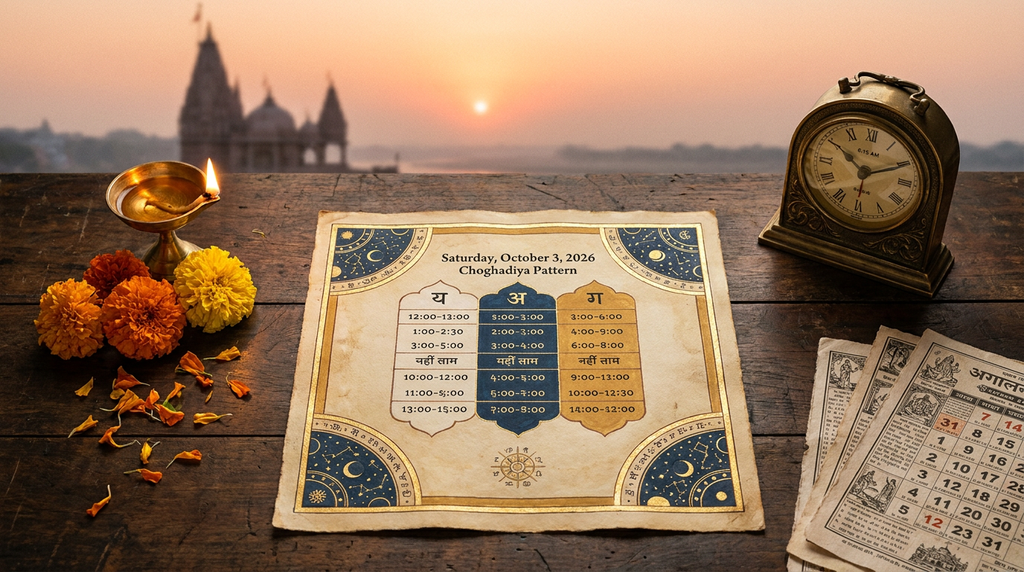
October 3, 2026 falls on a Saturday. The exact clock times depend on location, but the daytime sequence for this Saturday follows the traditional pattern shown in city-specific Panchang calculations.
For example, in Lahore, Pakistan, the published table gives a sunrise of 5:57 AM and sunset of 5:45 PM. The daytime periods are Kala, Shubh, Rog, Udveg, Char, Labh, Amrit and Kala.
In Karachi, Pakistan, sunrise is listed at 6:25 AM and sunset at 6:17 PM. The same basic sequence appears, but the clock times shift because the local solar day is different.
This difference is the main reason travelers should use a city-specific Choghadiya calculator before fixing a departure time.
Verified Lahore Example for October 3, 2026
| Period | Lahore Local Time | Traditional Reading |
| Kala | 5:57–7:26 AM | Less favorable |
| Shubh | 7:26–8:54 AM | Favorable |
| Rog | 8:54–10:23 AM | Less favorable |
| Udveg | 10:23–11:51 AM | Less favorable |
| Char | 11:51 AM–1:20 PM | Travel-related period |
| Labh | 1:20–2:48 PM | Favorable |
| Amrit | 2:48–4:17 PM | Highly favorable |
| Kala | 4:17–5:45 PM | Less favorable |
Source note: These are Lahore-specific published times for October 3, 2026 and should not be reused for other cities.
Verified Karachi Example for October 3, 2026
| Period | Karachi Local Time | Traditional Reading |
| Kala | 6:25–7:54 AM | Less favorable |
| Shubh | 7:54–9:23 AM | Favorable |
| Rog | 9:23–10:52 AM | Less favorable |
| Udveg | 10:52 AM–12:21 PM | Less favorable |
| Char | 12:21–1:50 PM | Travel-related period |
| Labh | 1:50–3:19 PM | Favorable |
| Amrit | 3:19–4:48 PM | Highly favorable |
| Kala | 4:48–6:17 PM | Less favorable |
Karachi’s nighttime periods then continue from sunset through the following sunrise. The published table lists Labh, Udveg, Shubh, Amrit, Char, Rog, Kala and Labh in sequence.
Image Caption: A traditional Choghadiya clock showing auspicious and inauspicious time divisions for daily travel planning.
How a Choghadiya Calculator Works
A Choghadiya calculator does more than count eight ordinary clock hours. It starts with the local sunrise and sunset.
For the daytime calculation:
Daylight duration ÷ 8 = length of one daytime Choghadiya
The nighttime calculation works similarly:
Night duration ÷ 8 = length of one nighttime Choghadiya
The resulting periods are then assigned their traditional Choghadiya names according to the weekday sequence and related planetary associations. The day/night divisions are therefore dynamic rather than fixed 90-minute blocks.
For example, the Lahore table for October 3, 2026 divides the approximately 11-hour-48-minute period between sunrise and sunset into eight sections of roughly 1 hour 28–29 minutes each. Karachi produces a similar structure but with different starting and ending times.
A useful calculator should therefore use:
- Date
- City or geographic location
- Local sunrise
- Local sunset
- Correct time zone
- Applicable traditional calculation method
Travelers crossing time zones should recalculate rather than carrying their old departure time into a new location.
Which Choghadiya Is Traditionally Used for Travel?
Among the named periods, Char has a particularly strong connection with travel. The traditional explanation associates Char with movement, making it especially appropriate for journeys. Amrit, Shubh and Labh are also generally classified as favorable periods and may be considered when planning an important start.
A practical travel hierarchy can therefore look like this:
| Travel Situation | Period Often Considered |
| Starting a pilgrimage | Char, Amrit or Shubh |
| Beginning a temple-focused excursion | Shubh or Amrit |
| Starting educational or cultural travel | Labh or Shubh |
| Beginning a road journey | Char, with other Panchang factors checked |
| Beginning a major spiritual itinerary | Amrit or Shubh |
| Flexible sightseeing | Use practical transport and opening hours first |
This does not mean a traveler must stop or cancel a journey whenever a less-favorable period begins. Real-world travel also depends on road safety, weather, transport schedules, health, opening hours, tickets, check-in requirements and other practical considerations.
How to Use Choghadiya When Planning a Spiritual Journey
The easiest approach is to treat Choghadiya as one layer of the travel plan rather than the entire plan.
Suppose you are visiting a temple city. First determine when your train, flight or road transfer actually arrives. Next check the local temple’s official visiting information. Then look at the Choghadiya periods and see whether your departure or the beginning of an important activity can reasonably fit into a traditionally favorable window.
A useful sequence is:
- Choose the destination and date.
- Check the local sunrise and sunset.
- Open a city-specific Choghadiya calculator.
- Identify Char, Shubh, Labh and Amrit periods.
- Check Rahu Kalam and other relevant Panchang considerations where your tradition uses them.
- Compare those periods with actual transport schedules.
- Keep enough buffer time for traffic, queues and delays.
- Confirm temple, museum or attraction timings before leaving.
This approach is more realistic than trying to force every part of a vacation into a narrow muhurta window.
Choosing Spiritual Destinations for a Choghadiya-Based Trip
Because Choghadiya is not tied to one destination, it can be incorporated into many forms of cultural and spiritual travel.
For example, travelers visiting Haridwar can combine time-based planning with riverfront experiences, temples and evening religious activities. Incredible India describes Haridwar’s Ganga ghats and Har Ki Pauri as major spiritual landmarks and identifies Haridwar Junction as the city’s railway station. The official tourism information also lists Jolly Grant Airport in Dehradun and Delhi’s Indira Gandhi International Airport among the relevant airport options.
Varanasi is another strong example for a spiritual itinerary. Its major experiences include the Ganga ghats, Kashi Vishwanath Temple, Assi Ghat and Dashashwamedh Ghat. The city’s official tourism material also highlights sunrise experiences, temple visits, cultural heritage and Ganga Aarti.
For a Choghadiya-based trip, the goal is not simply to visit the most famous place. It is to arrange the journey so that the traveler has enough time to experience it without sacrificing practical safety or convenience.
Places to Visit on a Choghadiya-Based Spiritual Trip
Har Ki Pauri, Haridwar
Har Ki Pauri is one of Haridwar’s best-known riverfront spiritual landmarks. The site is associated with the Ganga and is particularly known for the evening Ganga Aarti. Incredible India describes it as a major sacred ghat and identifies Brahmakund within Har Ki Pauri as the area associated with the evening aarti.
Suggested visit length: Allow flexible time because crowd levels, rituals and personal interests vary.
Best experience: Early morning riverfront atmosphere or evening aarti.
Travel tip: Do not plan to arrive at the exact beginning of a religious ceremony after a long road transfer. Build in a generous arrival buffer.
Varanasi Ghats
Varanasi’s riverfront is made up of numerous historic ghats. Dashashwamedh Ghat is associated with evening Ganga Aarti, while Assi Ghat is known for its early-morning spiritual activities.
Suggested visit length: Several hours for an initial experience; longer for travelers who want a relaxed riverfront exploration.
Best experience: Sunrise, walking, boat experiences where available, and evening cultural activities.
Sarnath Near Varanasi
Sarnath offers a different side of a Varanasi trip through its Buddhist heritage. It can be added when a traveler wants to combine Hindu pilgrimage traditions with broader Indian spiritual history. Incredible India identifies Sarnath as a significant Buddhist site near Varanasi.
Additional Temple and Heritage Stops
Depending on the destination, travelers can add:
- Major temples
- Sacred riverfronts
- Ashrams
- Historic shrines
- Museums
- Heritage markets
- Monasteries
- Spiritual learning centers
Always check the official site or local authority for current entry rules and hours.
Image Caption: Pilgrims and travelers exploring a sacred riverfront as part of a carefully timed spiritual journey.
Best Time for a Choghadiya-Based Travel Day
There are two meanings of “best time” in this context: the best season to visit a destination and the best part of the day according to Choghadiya.
The seasonal choice depends entirely on the destination. For example, Incredible India describes autumn as a favorable season for experiencing Varanasi, noting its pleasant weather and festive atmosphere.
The Choghadiya choice, however, depends on the date and local solar times.
| Planning Need | What to Check |
| Comfortable sightseeing | Local weather and seasonal conditions |
| Temple visit | Official temple opening schedule |
| Journey departure | Local Choghadiya |
| Evening ceremony | Ceremony timing first, Choghadiya second |
| Outdoor sightseeing | Weather, daylight and local safety |
| Family travel | Children’s needs, rest periods and transport |
| Long-distance journey | Actual departure schedule plus muhurta |
For October travel in many northern Indian destinations, weather can be more comfortable than the hottest summer months, but conditions differ across regions. Check the current forecast close to departure.
How to Reach a Spiritual Destination
Since Choghadiya is a scheduling method rather than one physical destination, transport details must be selected according to the pilgrimage city.
By Air
For Haridwar, relevant airport options listed by Incredible India include Jolly Grant Airport near Dehradun and Indira Gandhi International Airport in Delhi.
For Varanasi, Lal Bahadur Shastri International Airport is identified by Incredible India as a nearby airport for the city’s attractions.
Flight schedules and transfer services change, so confirm them close to your travel date.
By Train
Haridwar Junction is the railway station identified for Haridwar in official tourism information.
Varanasi’s tourism information identifies Varanasi Junction among the relevant railway access points.
For exact train numbers, departure times and availability, use the current railway booking system rather than an old travel article.
By Road
Road travel can be practical for nearby pilgrimage towns, especially when traveling with family or carrying luggage. Depending on the destination, travelers may use intercity buses, coaches, taxis or private cars.
Do not select a departure time solely because a Choghadiya period looks favorable. Leave enough time for traffic and rest, and never compromise safe driving to meet a muhurta.
Local Transport
Once you arrive, options can include:
- Auto-rickshaws
- Local buses
- Taxis
- Ride-hailing services where available
- Cycle-rickshaws in selected areas
- Walking
- Private drivers
- Boats in river destinations where officially operated
Availability varies by city, so confirm the current local transport situation.
Distance and Travel-Time Planning
There is no single distance to list for a Choghadiya travel guide because the starting point and destination are not specified.
Instead, build your own transport table:
| Starting Point | Destination | Distance | Approx. Travel Time | Best Transport |
| Your home city | Selected pilgrimage city | Check current route | Check current traffic/schedule | Air, rail or road |
| Airport | Hotel | Check local route | Check current conditions | Taxi/local transfer |
| Railway station | Main temple area | Check city route | Check current conditions | Taxi, auto or walking |
| Hotel | Main attraction | Check local map | Check current conditions | Walk/local transport |
This is more accurate than publishing a universal number that may not apply to the reader.
Choosing Hotels and Accommodation
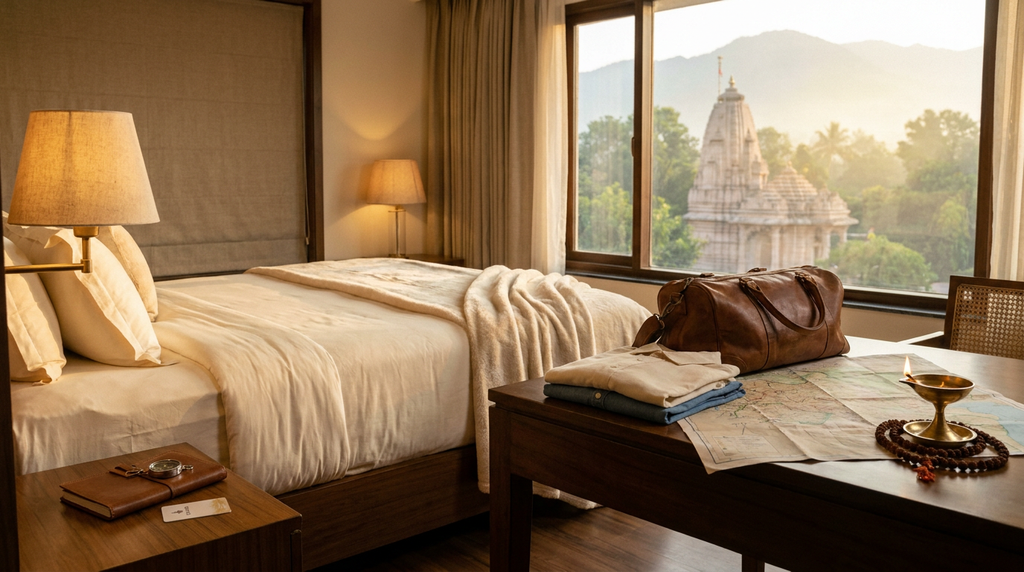
A Choghadiya article cannot responsibly name one “best hotel” because accommodation depends on the actual city.
For a spiritual trip, consider these location strategies:
| Accommodation Type | Useful For |
| Near major temples | Travelers with early religious visits |
| Near railway station | Short stays and frequent train travel |
| Near a riverfront | Travelers focused on ghats and evening rituals |
| City-center stay | Food, shopping and mixed sightseeing |
| Quieter outer area | Families seeking less street activity |
| Premium property | Travelers prioritizing comfort and services |
Hotel rates can change substantially according to dates, demand, room type and booking platform. Check the final price, cancellation policy, taxes, reviews and current facilities before payment.
For early-morning temple visits, location can matter more than luxury. A clean, comfortable property close to the day’s main activity may reduce unnecessary travel time.
Food and Local Cuisine for Spiritual Travelers
Food should also be planned around the destination rather than around Choghadiya alone.
In Varanasi, official tourism sources highlight local specialties including kachori-sabzi, tamatar chaat, choora matar, lassi, baati chokha and Banarasi paan.
Haridwar’s official tourism material highlights foods such as parantha, lassi, kachori and aloo puri, while also noting the city’s strong vegetarian food culture.
| Food Experience | Travel Tip |
| Temple-town breakfast | Eat early before long sightseeing days |
| Local vegetarian meal | Confirm ingredients if you follow dietary rules |
| Street food | Choose busy, clean and reputable vendors |
| Lassi or dairy drinks | Prefer hygienic establishments |
| Festival food | Expect different menus and crowds |
| Long road journey | Carry simple, safe snacks and water |
Travelers observing a fast or religious dietary practice should confirm ingredients and preparation methods before ordering.
Travel Budget for a Choghadiya-Based Journey
There is no honest single price for a Choghadiya trip. The total cost is determined by the destination and travel style.
| Expense | Budget Traveler | Mid-Range Traveler | Luxury Traveler |
| Accommodation | Basic room or guesthouse | Comfortable hotel | Premium hotel |
| Food | Local meals | Mix of local and hotel dining | Higher-end dining |
| Transport | Public/shared transport | Taxis and mixed transport | Private transfers |
| Attractions | Mostly low-cost or free sites | Paid attractions added | Premium experiences |
| Activities | Self-guided exploration | Guided experiences | Private tours |
| Daily Budget | Destination-dependent | Destination-dependent | Destination-dependent |
Before booking, calculate:
Transport + accommodation + food + local travel + entrance fees + activities + emergency buffer
Also account for peak religious dates, festival crowds, seasonal demand and exchange-rate changes when traveling internationally.
A Practical One-Day Choghadiya Spiritual Travel Itinerary
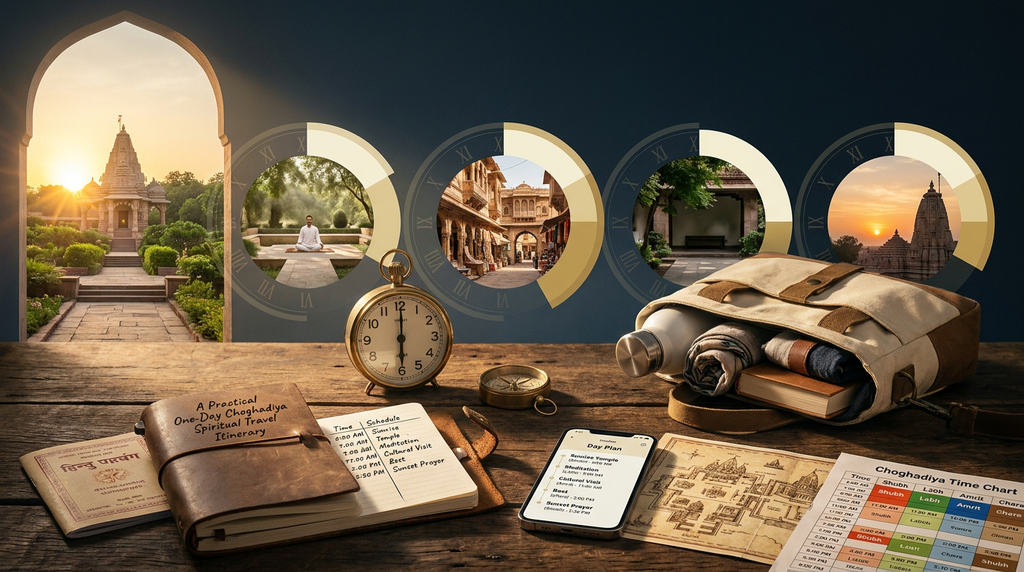
A good itinerary should use the time system without making the day rigid.
| Time/Stage | Activity |
| Early morning | Wake, prepare and check the day’s local Choghadiya |
| Morning | Begin travel or visit a nearby spiritual attraction according to the practical schedule |
| Late morning | Temple, heritage site or cultural exploration |
| Afternoon | Local lunch and rest |
| Later afternoon | Continue sightseeing or begin another suitable journey segment |
| Evening | Riverfront, aarti, cultural experience or relaxed dinner |
| Night | Return to accommodation and review the next day’s schedule |
Two-Day Version
Arrival, hotel check-in, nearby temple or heritage area, local meal and evening spiritual experience.
Early morning cultural or riverfront visit, major temple/attraction, lunch, market or heritage walk, then departure or overnight stay.
For Varanasi, a two-day plan can combine the ghats, temples, Sarnath and local food experiences. For Haridwar, travelers can combine the Ganga riverfront, Har Ki Pauri and nearby spiritual attractions.
Picnic and Family-Friendly Ideas
Choghadiya can be useful for families, but children often need more flexible schedules than solo pilgrims.
Suitable activities may include:
- Riverside viewing areas where permitted
- Public parks
- Gardens
- Scenic viewpoints
- Family-friendly heritage sites
- Short cultural walks
- Calm morning sightseeing
For a family trip, use Choghadiya mainly for important departures or planned spiritual activities. Do not make children wait for a narrow time window if they need food, rest or medical attention.
Where a river is involved, stay within marked or permitted visitor areas and follow local safety instructions.
Photography and Scenic Spots
A spiritual journey often produces some of the most memorable travel photographs, especially around historic riverfronts, temples, markets and traditional architecture.
Good photography opportunities can include:
- Sunrise over a sacred river
- Temple architecture
- Historic lanes
- Traditional markets
- Riverfront ghats
- Evening lamps and ceremonies
- Local crafts
- Quiet architectural details
Varanasi’s ghats and riverside heritage are particularly prominent in official tourism material, while Haridwar’s Ganga riverfront and Har Ki Pauri are major visual and cultural landmarks.
For religious spaces, avoid photographing people during private rituals without permission. Follow temple rules concerning cameras, phones and photography.
Image Caption: Sunrise over a sacred riverfront, showing how spiritual travel can combine traditional timing with memorable photography.
Local Culture, Customs and Spiritual Etiquette
Choghadiya belongs to a wider cultural tradition of Panchang and muhurta practices. Customs can differ between regions, temples and communities, so travelers should observe what is practiced locally.
Useful etiquette includes:
- Dress respectfully at religious sites.
- Follow footwear rules where applicable.
- Ask before photographing worshippers or ceremonies.
- Follow signs and queue systems.
- Avoid loud conversations near active worship.
- Do not touch sacred objects unless invited or permitted.
- Respect separate areas for worshippers.
- Follow local instructions during large religious gatherings.
Remember that a pilgrimage destination is also a living community. Treat residents, religious workers, vendors and fellow travelers with patience and respect.
Safety and Practical Travel Tips
Choghadiya should never override basic travel safety.
For road journeys, prioritize safe driving, appropriate rest and weather conditions. For mountain or monsoon-affected destinations, check current local conditions before setting out.
Keep these essentials in mind:
- Carry a valid government ID and required travel documents.
- Keep digital and physical copies of important reservations.
- Carry enough payment options for the destination.
- Keep some local cash where small vendors may not accept cards.
- Verify current transport schedules before leaving.
- Check official attraction and temple information before visiting.
- Use reputable accommodation and transport providers.
- Keep medicines and essential personal items accessible.
- Avoid unfamiliar links or unofficial booking requests.
- Save local emergency contacts before departure.
When traveling internationally, verify visa, passport, insurance and entry requirements through official government sources because these rules can change.
Packing Guide for a Choghadiya-Based Spiritual Trip
Your packing list depends on the destination, but a useful spiritual-travel kit includes:
- Comfortable walking shoes
- Modest, breathable clothing
- A light outer layer for changing temperatures
- Reusable water bottle
- Personal medicines
- Basic toiletries
- Power bank and charging cable
- Phone with offline maps
- Identification and travel documents
- Small day bag
- Sunglasses and sun protection where appropriate
- Hand sanitizer and tissues
- Light snacks for long journeys
- A small amount of local cash
- Any required religious or personal items
For temple visits, choose clothing that is respectful and practical for walking and waiting in queues.
How to Combine Choghadiya With Other Muhurta Information
Choghadiya is only one component of traditional time selection. Some travelers also consult Rahu Kalam, Abhijit Muhurat, Panchang, Tithi, Nakshatra, Yoga and Karana.
These systems do not always point to the same period. Drik Panchang notes that favorable Choghadiya can overlap with Rahu Kala or other adverse periods and advises checking those additional considerations according to the relevant tradition.
A practical rule is to decide what you are actually trying to time:
For a road or pilgrimage departure: Check Choghadiya and transport conditions.
For a temple ritual: Check the temple’s own schedule and the appropriate religious calendar.
For a major ceremony: Consult a qualified practitioner familiar with the family’s regional tradition.
For ordinary sightseeing: Safety, opening hours, weather and transport should remain central.
Related SEO Search Terms for This Guide
This article naturally covers related searches such as:
- Saturday Choghadiya 2026
- October 3 2026 Choghadiya
- today’s Choghadiya
- Choghadiya today
- Choghadiya table
- Choghadiya calculator
- Choghadiya for travel
- Shubh Choghadiya
- Amrit Choghadiya
- Labh Choghadiya
- Char Choghadiya
- Choghadiya travel muhurat
- daily muhurat 2026
- Aaj Ka Choghadiya today
- auspicious travel time
- Hindu travel muhurat
- spiritual travel planning
- Panchang travel timings
These phrases describe different search intents, so they are most useful when placed naturally in explanations rather than repeated mechanically.
FAQs
What is Aaj Ka Choghadiya for Saturday, October 3, 2026?
Aaj Ka Choghadiya shows the traditional auspicious and inauspicious time periods for Saturday, October 3, 2026.
The exact timings depend on the location and local sunrise and sunset.
How can Aaj Ka Choghadiya help with daily planning?
Aaj Ka Choghadiya can help you choose traditional Shubh Kaal for starting activities, travel, purchases, or important work.
It is commonly used as a daily Muhurat guide.
Is Aaj Ka Choghadiya different every day?
Yes, the timings change daily because Choghadiya is calculated according to the local daytime period.
Your city and the date can therefore affect the exact timings.
Which Aaj Ka Choghadiya period is considered Shubh?
Aaj Ka Choghadiya includes periods traditionally classified as Shubh, Labh, and Amrit.
These periods are generally preferred for beginning important activities according to traditional beliefs.
Can I use Aaj Ka Choghadiya for travel planning?
Yes, many people check Aaj Ka Choghadiya before starting a journey.
Choose a traditionally favorable period while also considering real travel schedules and safety.
Does Aaj Ka Choghadiya depend on the city?
Yes. Aaj Ka Choghadiya can vary by location because sunrise and sunset times differ from one place to another.
Always use timings calculated for your specific city.
What is the difference between Aaj Ka Choghadiya and daily Muhurat?
Aaj Ka Choghadiya divides the day into traditional time periods, while Muhurat refers more broadly to selected auspicious timings.
Both are used for traditional daily planning.
Can Aaj Ka Choghadiya be used for starting a business?
People who follow Hindu astrology may consult Aaj Ka Choghadiya before starting a business or important work.
For major decisions, practical business factors should also be considered.
Is Aaj Ka Choghadiya based on astrology?
Aaj Ka Choghadiya is part of the traditional Hindu Panchanga system and is based on calculations involving daytime periods.
Its use is based on traditional beliefs rather than scientific evidence.
Where can I find accurate Aaj Ka Choghadiya timings?
You should use a reliable Panchanga or Choghadiya calculator that allows you to select the exact date and city.
This helps avoid errors caused by differences in sunrise and sunset times.
Conclusion
Aaj Ka Choghadiya provides a simple way to explore traditional Shubh Kaal and daily Muhurat timings.
For Saturday, October 3, 2026, the exact periods depend on your location and local sunrise.
Checking the timings for your city can make traditional planning more precise.
You can use them for travel, ceremonies, purchases, or other important activities.
At the same time, practical schedules and personal circumstances should always be considered.
Using Aaj Ka Choghadiya is especially helpful for readers who follow Panchanga traditions in their daily routines.
Different Choghadiya periods have different traditional meanings and are used for different purposes.
Always verify the date, location, sunrise, and sunset before relying on a timing.
This keeps your planning accurate and avoids confusion between different cities.
With the right local information, Choghadiya can remain a convenient traditional planning tool.
Read More: Rahu Kalam Today Timing: Rahu Kaal on Friday, October 2, 2026
