


Rahu Kaal Today is an important part of the traditional Hindu Panchang, which helps people understand daily auspicious and inauspicious time periods. Many people check Rahu Kaal before starting a new business, planning a journey, performing religious ceremonies, or making important decisions. This guide explains Rahu Kaal timings for 2026 in simple English so you can understand their meaning and traditional importance.
Knowing Rahu Kaal Today can help you follow traditional Hindu astrology when planning your daily activities. According to these beliefs, Rahu Kaal is generally considered an unfavorable period for beginning important or auspicious work. However, everyday responsibilities and regular activities do not necessarily need to stop during this time.
The timing of Rahu Kaal Today changes according to the day of the week and your location. Traditionally, the period between local sunrise and sunset is divided into eight equal parts, with one part assigned to Rahu Kaal. As sunrise and sunset times change throughout the year, the exact Rahu Kaal timings also vary from one date and city to another.
When checking Rahu Kaal Today, it is helpful to consult a reliable daily Panchang that provides local timings. You can also explore other important details, such as sunrise, sunset, Tithi, Nakshatra, Yamagandam, and auspicious Muhurat periods. These details offer a broader understanding of traditional Hindu timekeeping and help you compare different periods when planning special occasions.
This complete guide to Rahu Kaal Today will help you understand its meaning, daily calculation, weekday timings, and traditional significance in 2026. Whether you want to plan a religious ceremony, schedule a business opening, or learn more about the Hindu Panchang, you will find useful information here. Remember that Rahu Kaal is based on astrological traditions and is not scientifically proven to determine the success or failure of an activity.
Quick Overview: Rahu Kaal and Daily Panchang 2026
| Information | Details |
| Topic | Rahu Kaal Today, daily Panchang and Muhurat |
| Year | 2026 |
| Cultural tradition | Hindu astrology and Panchang |
| Main purpose | Checking traditionally unfavorable periods |
| Timing method | Local sunrise, sunset and weekday |
| Typical duration | Around 90 minutes, varying with daylight |
| Related systems | Choghadiya, Yamaganda, Gulika Kaal and Shubh Muhurat |
| Geographic coverage | India and other locations where Panchang timings are observed |
| Best way to check | Use the exact date and local city |
| Travel relevance | Planning temple visits, pilgrimages and personal schedules |
Important: This is a year-round guide, not a verified daily timetable for every location. An exact Rahu Kaal time requires a specific date and city. Published timings can differ slightly depending on the calculation method.
What Is Rahu Kaal Today and Why Do People Check It?
Rahu Kaal is a recurring period in the Hindu Panchang traditionally considered unsuitable for starting certain important or auspicious activities. It is associated with Rahu, one of the shadow planets in Indian astrology.
Many people consult the daily Rahu Kaal timetable before making plans involving:
- Starting a new business or project.
- Performing a puja or beginning a religious ceremony.
- Signing an important agreement or making a major purchase.
- Planning the start of a pilgrimage or special occasion.
- Selecting a traditional muhurat for an important event.
The practice varies among families, communities and astrologers. Some people avoid only major new beginnings, while others follow additional Panchang rules.
Rahu Kaal does not mean that every activity during this period must stop. People continue their normal routines, work, travel and responsibilities. The traditional recommendation primarily concerns the initiation of selected auspicious activities.
For travel planning, checking the period may be part of a personal or religious routine, but it should not replace practical decisions about road safety, weather, transport schedules or health.
How Rahu Kalam Timings Are Calculated in 2026
Rahu Kaal is not a fixed clock period that occurs at the same time throughout the year. Under the commonly used calculation method, the interval from local sunrise to local sunset is divided into eight equal parts. The weekday determines which part is designated Rahu Kaal.
The calculation follows three basic steps:
- Find the local sunrise and sunset for the selected date.
- Calculate the total daylight duration and divide it by eight.
- Identify the segment assigned to that weekday.
For example, suppose sunrise is at 6:00 AM and sunset is at 6:00 PM. The daylight period is 12 hours, making each segment 90 minutes long. If it is Monday, Rahu Kaal occupies the second segment, from approximately 7:30 AM to 9:00 AM.
This is only an illustration. Actual timings change with the location and season, and the segment length may be shorter or longer than 90 minutes.
Why does location matter? Sunrise in New Delhi may differ from sunrise in Mumbai, Karachi or another city. A timetable prepared for one location should not automatically be used elsewhere.
Rahu Kaal Today: Weekday Timing Table
The following table shows which daylight segment is traditionally assigned to Rahu Kaal on each weekday. The example clock times assume sunrise at 6:00 AM and sunset at 6:00 PM.
| Day | Rahu Kaal segment | Illustrative timing |
| Sunday | 8th | 4:30 PM–6:00 PM |
| Monday | 2nd | 7:30 AM–9:00 AM |
| Tuesday | 7th | 3:00 PM–4:30 PM |
| Wednesday | 5th | 12:00 PM–1:30 PM |
| Thursday | 6th | 1:30 PM–3:00 PM |
| Friday | 4th | 10:30 AM–12:00 PM |
| Saturday | 3rd | 9:00 AM–10:30 AM |
These are reference times for a hypothetical 12-hour daylight period, not the verified Rahu Kaal timings for any particular date in 2026.
For an accurate daily calculation, check a location-specific Panchang that provides sunrise and sunset for the selected date.
How to Check Rahu Kaal Today for Your City

Finding the correct time is straightforward when you use a reliable daily Panchang.
Select the date
Choose the exact date in 2026. Do not rely on yesterday’s or tomorrow’s timetable.
Select the city
Choose the place where you will be performing the activity. Local sunrise and sunset affect the calculation.
Read the Rahu Kaal entry
Confirm the start time, end time and time zone. Make sure the result refers to the selected date and city.
Check the complete Panchang
If you follow traditional muhurat rules, also review Tithi, Nakshatra, Choghadiya and other relevant periods.
A useful reference is Drik Panchang, which publishes location-specific Rahu Kaal calculations. You can visit its and select the appropriate location.
What Is a Hindu Panchang? Five Important Elements
The Hindu Panchang is a traditional calendar used to understand lunar dates, weekdays and other astronomical time divisions. The word Panchang refers to five principal elements, each of which provides different information. The Government of India’s Rashtriya Panchang explanation describes the astronomical basis of Tithi, Nakshatra, Yoga and Karana.
| Panchang element | Meaning | Why people check it |
| Tithi | Lunar day | Religious observances and festivals |
| Vara | Day of the week | Daily timing calculations and traditional observances |
| Nakshatra | One of 27 lunar mansions | Traditional muhurat selection |
| Yoga | A time division calculated from the Sun’s and Moon’s positions | Astrological calendar readings |
| Karana | Half of a Tithi | Traditional auspicious-time selection |
A daily Panchang may also display sunrise, sunset, moonrise, moonset, Rahu Kaal, Yamaganda, Gulika Kaal and auspicious periods.
These entries should be read according to the calendar’s location and calculation convention. The Hindu calendar is lunisolar, so its dates and observances do not correspond to fixed Gregorian dates every year.
Image Caption: A traditional Hindu Panchang showing Tithi, Nakshatra, weekday, Rahu Kaal and daily muhurat details.
Rahu Kaal vs. Choghadiya: What Is the Difference?
Choghadiya and Rahu Kaal are related through their use in traditional time selection, but they are not the same system.
Rahu Kaal identifies one particular segment of daylight according to the weekday. Choghadiya divides the day and night into eight periods each, with the periods traditionally classified by their qualities. The names and interpretations commonly used include Amrit, Shubh, Labh, Char, Rog, Kaal and Udveg.
| Feature | Rahu Kaal | Choghadiya |
| Main purpose | Identifies a traditionally unfavorable period | Compares periods considered suitable or unsuitable for activities |
| Daily divisions | One of eight daylight segments | Eight daytime and eight nighttime segments |
| Calculation basis | Local sunrise, sunset and weekday | Daylight or nighttime divisions and traditional weekday sequence |
| Timing | Changes by date and location | Changes by date and location |
| Common use | Avoiding selected new beginnings | Selecting a preferred period for an activity |
| Typical display | Start and end times | A table listing periods and classifications |
Some people use both systems together. For example, they may look for a favorable Choghadiya while also checking Rahu Kaal and other Panchang restrictions.
The systems may not always identify the same period as favorable. Anyone following a specific family or religious tradition should use the rules appropriate to that tradition rather than assuming one table overrides every other consideration.
Image Caption: A daily Choghadiya chart comparing traditional auspicious and unfavorable time periods.
The Seven Choghadiya Periods and Their Meanings
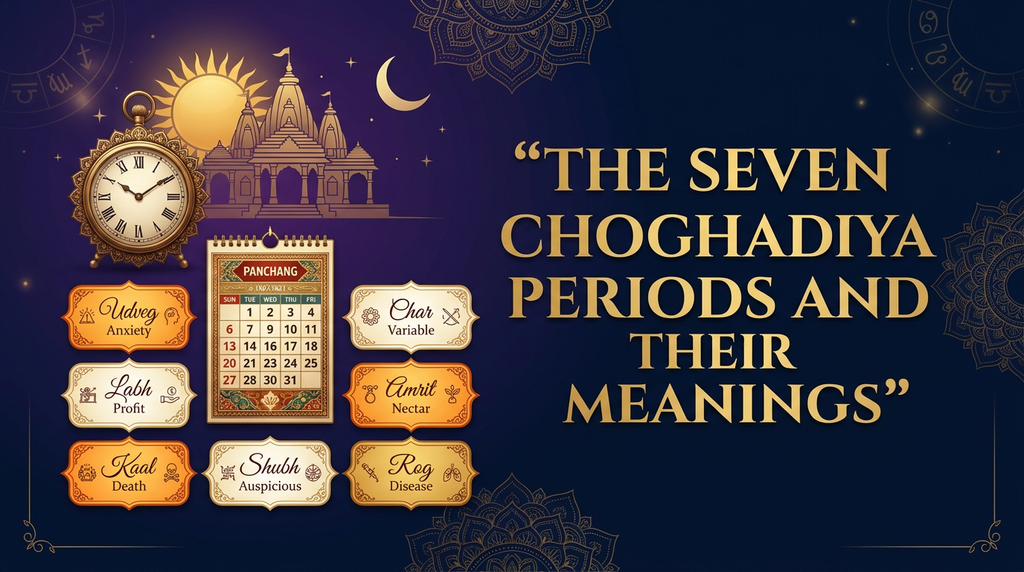
Understanding the seven Choghadiya names can help readers interpret the daily muhurat table. The classifications below reflect common traditional interpretations, not scientifically proven outcomes.
| Choghadiya | Traditional classification | Commonly associated activities |
| Amrit (अमृत) | Auspicious | Important beginnings and worship |
| Shubh (शुभ) | Auspicious | Religious ceremonies and traditional celebrations |
| Labh (लाभ) | Auspicious | Business activities and learning |
| Char (चर) | Generally favorable for movement | Travel and journeys |
| Rog (रोग) | Traditionally unfavorable | Usually avoided for auspicious beginnings |
| Kaal (काल) | Traditionally unfavorable | Usually avoided for new ventures |
| Udveg (उद्वेग) | Traditionally unfavorable | Usually avoided for auspicious beginnings |
Choghadiya has eight periods during daylight and eight during nighttime. Since there are seven names, one classification repeats in each sequence.
For a complete timetable, check the daytime and nighttime entries separately. Do not assume that the sequence of nighttime periods is identical to the daytime sequence.
Rahu Kaal, Yamaganda and Gulika Kaal Explained
Rahu Kaal is not the only time period that appears in a Hindu Panchang. Yamaganda and Gulika Kaal are two additional periods that some traditions consider when selecting a muhurat.
| Period | Traditional association | Common practice |
| Rahu Kaal | Rahu | Avoid initiating selected auspicious activities |
| Yamaganda | Yama | Often avoided for auspicious beginnings |
| Gulika Kaal | Gulika or Mandi, associated with Saturn in traditional astrology | Considered in some muhurat calculations |
These periods are calculated using divisions of the local daylight, although their weekday assignments differ. A Panchang may display all three alongside sunrise and sunset.
If you are following a particular religious tradition, check which restrictions apply to your activity. A general daily timetable is not necessarily a complete muhurat calculation for a wedding, housewarming, business inauguration or other major event.
It is also important not to confuse these periods with astronomical events such as eclipses. Rahu Kaal is a traditional time division, not an eclipse or a separate physical event in the sky.
Is Rahu Kaal Suitable for Travel and Temple Visits?
Travelers who follow Hindu astrology sometimes prefer to begin a journey during a favorable Choghadiya or a personally selected muhurat. Pilgrims may also consult the Panchang before leaving home for a temple or religious gathering.
However, traditions differ on whether the Rahu Kaal restriction applies to starting a journey, continuing an existing journey, or performing a specific religious activity. There is no single practice followed by every Hindu family.
For a practical travel plan, consider the following:
- Temple visits: Check the temple’s official opening hours and any entry or ceremony requirements.
- Road journeys: Prioritize daylight, road conditions, rest breaks and the driver’s condition.
- Train and air travel: Follow the actual departure time and arrive according to the transport provider’s instructions.
- Pilgrimages: Check weather, walking distances, local transport and seasonal crowd conditions.
- Family events: If your family observes Rahu Kaal, coordinate the schedule in advance rather than making last-minute changes.
A traditional muhurat can be included as a personal preference, but it should not cause you to miss a transport connection, delay urgent medical care or travel in unsafe conditions.
Image Caption: A family preparing for a pilgrimage after checking the local Panchang and travel arrangements.
How to Plan a Day Around Rahu Kaal and Shubh Muhurat
A simple daily planning routine can help you respect traditional preferences without making the schedule unnecessarily complicated.
| Planning stage | What to check | Practical action |
| Early morning | Date, weekday and sunrise | Review the local Panchang |
| Before an important beginning | Rahu Kaal and other relevant periods | Select a suitable time if you follow these customs |
| Before a journey | Transport schedule and local conditions | Confirm tickets and departure details |
| Before a religious visit | Temple timings and ceremony details | Check official visitor information |
| During the day | Changes to plans or weather | Keep your schedule flexible |
| Evening | Sunset and nighttime Choghadiya, if relevant | Check the correct night timetable |
For major ceremonies, a qualified practitioner familiar with your regional tradition may provide a more detailed muhurat. Such a selection can consider several Panchang elements rather than relying on Rahu Kaal alone.
For ordinary activities, there is no need to reorganize an entire day around a single time window. Use the system in a way that fits your beliefs and responsibilities.
Best Time to Check Rahu Kaal in 2026
The best time to check the timetable is before you make a decision that depends on a particular period. The correct timing is date-specific, so an annual reference chart alone cannot provide exact daily clock times for every city.
| When you check | Why it helps |
| The previous evening | Allows time to organize an early start |
| In the morning | Confirms the day’s current timetable |
| Before a major ceremony | Helps coordinate the planned beginning |
| Before setting out on a pilgrimage | Gives time to check transport and temple arrangements |
| After a schedule change | Ensures you are using the correct date and location |
October, November and December have different daylight patterns from the spring and summer months in many parts of India. Therefore, do not assume that a clock time copied from a summer timetable will remain accurate in late 2026.
For dates around a local midnight boundary or for travel across time zones, make sure the Panchang refers to the local calendar date at your destination.
Common Mistakes to Avoid When Reading a Panchang
A few simple checks can prevent confusion when comparing different Panchang websites or printed calendars.
- Using another city’s timing: A New Delhi table may not match the timing for Mumbai or another city.
- Treating 90 minutes as an exact duration: The period depends on the actual daylight duration.
- Ignoring the date: The weekday and sunrise/sunset values must correspond to the selected date.
- Confusing Choghadiya with Rahu Kaal: They are different systems with different classifications.
- Checking only one Panchang element: A complete traditional muhurat may involve several factors.
- Assuming every website uses identical conventions: Calculation methods, rounding and regional practices can cause differences.
- Treating astrological interpretations as scientific guarantees: These classifications represent traditional beliefs, not established predictions of success or failure.
If two reputable sources show slightly different times, compare their selected locations, time zones, sunrise definitions and rounding conventions before deciding which timetable to follow.
Digital Panchang Tools and Reliable Timing Resources
Digital calendars make it easier to look up Rahu Kaal without calculating the daylight segments manually.
Useful resources include:
- Drik Panchang for the selected date and location.
- India Meteorological Department for information about the astronomical concepts used in the Indian calendar.
- When using an app or website, confirm that the selected city is correct and that the displayed time zone matches your intended location. If you are checking timings while abroad, avoid assuming that Indian Standard Time applies to your local schedule.
For an important religious occasion, you may also want to compare the digital timetable with a regional Panchang used by your family or community.
Cultural Traditions and the Meaning of Muhurat

Muhurat is the traditional practice of selecting a particular time for an activity. It has a place in many Hindu family and religious traditions, including weddings, housewarmings, festivals, business inaugurations and other significant beginnings.
Rahu Kaal is one of the time periods some people consider when selecting a muhurat. Other people place more emphasis on a complete Panchang, family custom or guidance from a religious practitioner.
These practices can be meaningful as expressions of faith, continuity and cultural identity. They also vary across regions and communities, so it is best to avoid presenting a single interpretation as universal.
For visitors attending a religious ceremony, respectful behavior is often more important than knowing every astrological term. Follow local instructions, dress appropriately for the place of worship, and ask before photographing ceremonies or worshippers.
A balanced approach recognizes the cultural value of traditional calendars while leaving room for individual beliefs and practical needs.
Practical Checklist for Checking Rahu Kaal Today
Before relying on a daily timing table, use this checklist to make sure the information is relevant to your plans.
Daily Panchang checklist
0 of 8
Select the correct date in 2026.
Choose the exact city or destination.
Confirm the local time zone.
Check the day’s sunrise and sunset.
Verify the Rahu Kaal start and end times.
Review Choghadiya or other Panchang details if needed.
Confirm transport and venue timings independently.
Keep safety and urgent responsibilities as the priority.
Reset checklist
This checklist works for everyday planning as well as preparation for a festival, religious ceremony or pilgrimage. It also helps you avoid relying on an outdated screenshot or a timing chart prepared for another city.
FAQs
What is Rahu Kaal Today, and why is it important?
Rahu Kaal is a period considered inauspicious for starting important activities in Hindu astrology. Many people check its daily timing before planning religious ceremonies, business activities, or new beginnings.
How can I check Rahu Kaal Today timings?
You can check a daily Panchang or a reliable Rahu Kaal timetable for your city. The exact timing depends on the local sunrise and sunset times and the day of the week.
Does Rahu Kaal Today change every day?
Yes, Rahu Kaal changes daily because it is calculated using the local daytime period. Its timing also follows a specific weekday-based sequence.
Why should I avoid starting new work during Rahu Kaal Today?
According to traditional Hindu beliefs, starting auspicious activities during Rahu Kaal may be avoided. However, this is a cultural and astrological practice, not a scientifically proven prediction.
How is Rahu Kaal Today calculated?
The period between local sunrise and sunset is divided into eight equal parts. One part is assigned to Rahu Kaal according to the day of the week.
What is the Rahu Kaal Today timing on Monday?
On Monday, Rahu Kaal traditionally falls in the second eighth of the daytime period. The exact clock time depends on the local sunrise and sunset.
What is the Rahu Kaal Today timing on Tuesday?
On Tuesday, Rahu Kaal traditionally occurs during the seventh eighth of the daytime period. Check your local Panchang for the precise timing.
What is the Rahu Kaal Today timing on Wednesday?
On Wednesday, Rahu Kaal traditionally falls in the fifth eighth of the daytime period. Its exact start and end times vary by location and date.
What is the Rahu Kaal Today timing on Thursday?
On Thursday, Rahu Kaal traditionally occurs during the sixth eighth of the daytime period. Use local sunrise and sunset information to determine the correct clock time.
What is the Rahu Kaal Today timing on Friday?
On Friday, Rahu Kaal traditionally falls in the fourth eighth of the daytime period. The exact timing changes according to the local daylight period.
What is the Rahu Kaal Today timing on Saturday?
On Saturday, Rahu Kaal traditionally occurs during the third eighth of the daytime period. Check a date-specific Panchang for accurate local timings.
What is the Rahu Kaal Today timing on Sunday?
On Sunday, Rahu Kaal traditionally falls in the eighth eighth of the daytime period. This is the final segment before sunset.
Can I perform puja during Rahu Kaal Today?
Many traditions distinguish between starting new auspicious activities and continuing regular worship. Daily prayers and personal devotion can generally continue according to individual beliefs and family customs.
Is Rahu Kaal Today the same across all cities?
No, Rahu Kaal does not occur at the same clock time everywhere. Differences in local sunrise and sunset times affect the calculation for each city.
Can I travel during Rahu Kaal Today?
Travel is not necessarily prohibited during Rahu Kaal. Some people avoid beginning a journey during this period for traditional reasons, while practical needs and safety should guide travel decisions.
Is Rahu Kaal Today the same as Yamagandam?
No, Rahu Kaal and Yamagandam are two separate periods in the Hindu Panchang. Both are traditionally considered unfavorable for certain auspicious beginnings, but their timings differ.
Can I start a business during Rahu Kaal Today?
According to traditional astrology, people generally avoid choosing Rahu Kaal for business openings or major new ventures. You can check the daily Panchang for an alternative time if you follow this practice.
Does Rahu Kaal Today affect online work and meetings?
Some people apply traditional timing rules to important online meetings, launches, and business decisions. There is no scientific evidence that Rahu Kaal determines the success of these activities.
Where can I find Rahu Kaal Today and the complete daily Panchang?
You can consult a reliable Panchang website or calendar that provides Rahu Kaal, sunrise, sunset, Tithi, Nakshatra, and other daily details. Select your city to get locally calculated timings.
What is the difference between Rahu Kaal Today and an auspicious Muhurat?
Rahu Kaal is a specific daily period traditionally avoided for certain auspicious beginnings. A Muhurat is a selected favorable time for an activity and may consider several astrological factors.
Conclusion
Rahu Kaal Today is an important part of traditional Hindu timekeeping and daily Panchang practices. Many people check its timing before planning new beginnings, religious ceremonies, business activities, and journeys. Understanding how Rahu Kaal works can help you follow these customs with greater confidence. Since its timing depends on the local sunrise and sunset, always check a date-specific timetable for your city. Use this guide to understand the traditional meaning of Rahu Kaal and its place in everyday life.
By checking Rahu Kaal Today, you can learn which daytime period is traditionally associated with Rahu and plan your activities according to your personal beliefs. Remember that the exact clock time varies by location and date, so avoid relying on a fixed daily schedule. You can also consult a complete Panchang to understand other timings, including Yamagandam and auspicious Muhurats. Keep practical needs and important deadlines in mind when making decisions. A clear understanding of these traditions can make daily planning easier and more meaningful.
Read More: Choghadiya Muhurat 2026: Aaj Ka Choghadiya, Shubh Timings & Day-Night Muhurat Guide
