

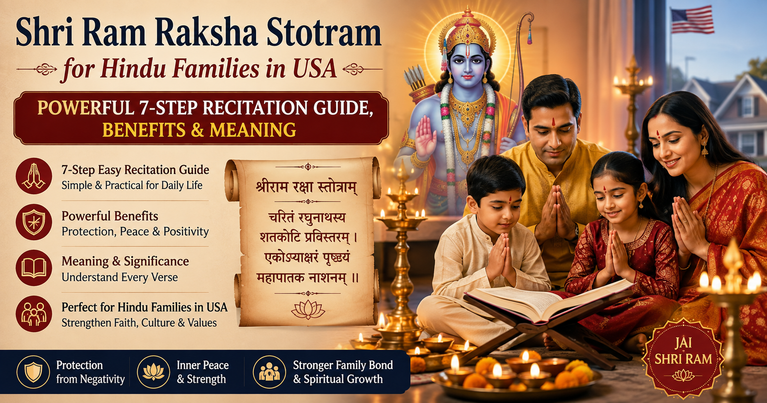
For many Hindu families living in the United States, maintaining a connection with Indian spiritual traditions can become an important part of everyday family life. Work, school, travel, and busy American schedules can make traditional practices harder to follow exactly as they may have been practiced at home in India. A simple family prayer routine can provide a meaningful way to stay connected with Dharma, Sanskrit, and devotion.
Shri Ram Raksha Stotram for Hindu families in USA offers one such traditional practice. The stotram is devoted to Lord Rama, who is widely respected in Hindu tradition as an ideal king, son, husband, and embodiment of righteousness. Families may include the prayer in a morning routine, evening worship, weekend puja, or special devotional observance.
The goal should not be perfection. Pronunciation can be learned gradually, children can participate at an age-appropriate level, and families can choose a schedule that works with their lives. What matters most is respectful practice, understanding, and sincere devotion.
Quick Answer
Shri Ram Raksha Stotram for Hindu families in USA is a traditional Sanskrit devotional hymn dedicated to Lord Rama. Hindu families may recite it as part of their daily prayer, meditation, or devotional routine.
There is no single rule that every family in the USA must follow. Families can adapt the practice to their schedules, temple traditions, language preferences, and level of Sanskrit knowledge. A simple approach is to create a clean prayer space, begin with devotion and attention, recite the stotram respectfully, and finish with a short prayer.
Traditionally, the Ram Raksha Stotram is associated with devotion to Lord Rama and the idea of spiritual protection. Its value for a family can also come from regular prayer, mindfulness, cultural connection, and passing Hindu traditions to children.
What Is Shri Ram Raksha Stotram?

Shri Ram Raksha Stotram, also called Ram Raksha Stotra, is a traditional Sanskrit hymn associated with Lord Rama.
The word Raksha means protection, while Stotram refers to a devotional hymn or prayer of praise. The text is traditionally connected with the sage Budha Kaushika Rishi and centers on Lord Rama and the protective power associated with devotion to him.
The hymn invokes different aspects and names of Lord Rama while expressing a devotional desire for protection and spiritual strength.
For Hindu families in the USA, the stotram can serve several purposes:
- Daily devotional practice
- Family prayer
- Sanskrit learning
- Cultural education for children
- Meditation and concentration
- Connection with Ramayana traditions
- A peaceful beginning or ending to the day
It is important to understand that traditional religious benefits are matters of faith and spiritual tradition rather than scientifically guaranteed outcomes.
Why Is Ram Raksha Stotram Important to Hindu Families?
Lord Rama holds a central place in Hindu religious and cultural traditions. Stories from the Ramayana are taught across generations and emphasize values such as truth, duty, courage, compassion, loyalty, and righteousness.
Reciting a Rama-centered prayer can therefore become more than a memorization exercise. Parents can use it as an opportunity to explain the values associated with Rama.
For example:
| Family Practice | Possible Learning Opportunity |
| Reciting the stotram | Sanskrit pronunciation and memory |
| Learning about Rama | Hindu mythology and cultural history |
| Discussing Ramayana stories | Dharma and moral values |
| Praying together | Family bonding and reflection |
| Visiting a temple | Community and cultural connection |
| Teaching children | Intergenerational tradition |
Traditional Meaning of Shri Ram Raksha Stotram

The central devotional idea of the stotram is seeking the protection and grace of Lord Rama.
Rather than viewing the prayer only as a request for protection from physical problems, families can approach it as a broader spiritual practice. Devotees may understand protection as including strength of character, courage during difficulties, clarity of thought, and spiritual guidance.
Different portions of the hymn praise Rama through his names, qualities, and associations.
The Meaning of “Raksha”
The Sanskrit word raksha relates to protection or safeguarding.
In devotional practice, protection can have both an external and internal meaning. A devotee may pray for safety while also seeking inner strength, discipline, courage, and peace.
The Meaning of “Stotram”
A stotram is a devotional hymn that praises a deity.
The purpose is not simply to repeat sounds. Understanding the general meaning can make the practice more meaningful, especially for children growing up in an English-speaking environment.
7 Simple Steps to Recite Shri Ram Raksha Stotram in the USA
Families do not need a large temple room or a complicated setup to begin.
Choose a Consistent Time
Pick a time that fits your household.
Common choices include:
- Early morning
- After bathing
- Before breakfast
- Evening after school and work
- Before bedtime
- Weekend family prayer time
Consistency is often more practical than choosing a difficult time that the family cannot maintain.
Prepare a Clean Prayer Space
A small home altar can be enough.
You may keep:
- A picture or murti of Lord Rama
- Sita, Lakshmana, and Hanuman images if appropriate for your tradition
- A small diya
- Flowers
- Prayer books
- A clean cloth
Families should follow their own sampradaya, household tradition, or guidance from their temple when specific rituals are important.
Sit Comfortably and Calm the Mind
Before beginning, take a moment to become quiet.
Turn off unnecessary notifications and encourage children to sit respectfully. A few slow breaths can help everyone focus.
Begin With a Short Prayer
You can start with a simple invocation such as:
“Shri Ramaya Namah.”
Families familiar with additional prayers may follow their customary opening.
Recite the Stotram
Recite the traditional text slowly and respectfully.
If you are learning Sanskrit pronunciation, use a reliable printed text, temple resource, or qualified teacher. Listening to an experienced Sanskrit or Hindu devotional teacher can also help.
Do not worry if you cannot memorize the entire hymn immediately.
Explain the Meaning to Children
After recitation, discuss one small idea.
For example:
“Today we learned about courage. How can we show courage at school or when something is difficult?”
This turns prayer time into an opportunity for values-based learning.
End With Gratitude
Finish with a short personal prayer or expression of gratitude.
Families may pray for the well-being of loved ones, teachers, friends, community members, and people facing difficulties.
Best Time to Recite Ram Raksha Stotram

There is no universal USA-wide time requirement for every household.
Traditional Hindu practices may prescribe particular times depending on the ritual or lineage, but a family devotional reading can often be incorporated into a practical daily schedule.
| Time | Why Families May Choose It |
| Early morning | Quiet atmosphere and fresh start |
| After morning puja | Fits naturally into worship |
| Evening | Convenient for working parents and students |
| Weekend morning | Easier for extended family participation |
| Festival days | Adds devotional focus to celebrations |
For families balancing school and work, a short, regular practice may be easier to maintain than an elaborate routine.
Shri Ram Raksha Stotram for Children
Introducing Hindu prayers to children in the USA can help families preserve cultural traditions while making the practice understandable.
Children do not necessarily need to memorize the entire stotram at once.
Age-Appropriate Approach
Young children
- Teach “Shri Ram”
- Introduce pictures from the Ramayana
- Encourage listening
- Explain simple values
Elementary-age children
- Practice short sections
- Explain important Sanskrit words
- Use repetition
- Discuss Rama’s character
Older children and teenagers
- Learn pronunciation
- Explore the meaning
- Read selected Ramayana stories
- Discuss Dharma and ethical choices
The goal is to build interest rather than create pressure.
Ram Raksha Stotram: Traditional Practice vs Modern Family Routine

Hindu families in America often combine traditional devotion with modern schedules.
| Traditional Setting | Modern USA Family Routine |
| Dedicated puja room | Small home altar |
| Fixed prayer schedule | Family-selected consistent time |
| Sanskrit-centered practice | Sanskrit with English explanation |
| Extended family participation | Parents and children |
| Temple-based learning | Home plus temple/community learning |
| Memorized recitation | Text-supported learning |
Adapting the schedule does not necessarily mean abandoning tradition. Families can preserve the central devotional purpose while making the practice manageable.
Traditional Benefits of Shri Ram Raksha Stotram
Devotees traditionally associate the Ram Raksha Stotram with spiritual protection and devotion to Lord Rama.
Commonly discussed traditional benefits include:
- Developing devotion toward Lord Rama
- Encouraging spiritual discipline
- Supporting regular prayer
- Creating a peaceful family routine
- Strengthening cultural connection
- Helping children learn Sanskrit prayers
- Encouraging reflection on Ramayana values
- Supporting concentration during prayer
These should be understood as traditional religious beliefs, not guaranteed medical, psychological, financial, or supernatural results.
A family should never use devotional practice as a replacement for professional medical, mental-health, legal, or emergency assistance.
Pros and Cons for Hindu Families in the USA
| Pros | Cons / Challenges |
| Supports family prayer | Sanskrit pronunciation can be difficult |
| Preserves Hindu traditions | Busy schedules may interrupt consistency |
| Helps children connect with culture | Children may initially find long recitations difficult |
| Encourages reflection | Meaning may be unclear without explanation |
| Can be practiced at home | Families may need guidance for accurate pronunciation |
| Works with different family schedules | Different traditions may follow different practices |
The best approach is to focus on sincerity, learning, and consistency rather than trying to make every family follow an identical routine.
Shri Ram Raksha Stotram and Hindu Life in America

Living in the USA can create unique opportunities for Hindu families.
Many children grow up speaking English at school while hearing different languages at home. Religious practices can provide a bridge between generations.
Parents can make the experience more meaningful by combining:
- Sanskrit prayer
- English explanations
- Ramayana storytelling
- Temple visits
- Hindu festival participation
- Family discussions
- Community activities
For example, after reciting the stotram on Sunday morning, parents could read a short Ramayana story and ask children what value they learned from it.
This creates a complete cultural learning experience rather than treating the prayer as an isolated activity.
A Simple Family Prayer Routine
Here is a practical 15–20 minute routine.
5 Minutes: Preparation
Clean the prayer area and gather the family.
5–10 Minutes: Recitation
Recite Shri Ram Raksha Stotram according to your family tradition and ability.
5 Minutes: Learning
Discuss one Sanskrit word, Rama’s quality, or Ramayana story.
Final Minute: Gratitude
Offer a simple prayer for family, friends, community, and those in need.
This routine can be adjusted according to age and family schedule.
Checklist for Starting a Ram Raksha Stotram Practice
- Choose a realistic prayer time
- Create a clean prayer space
- Keep a reliable text of the stotram
- Learn correct Sanskrit pronunciation gradually
- Begin with a manageable routine
- Explain the meaning to children
- Encourage respectful participation
- Follow your family’s Hindu tradition
- Consult a knowledgeable teacher when needed
- Keep the practice consistent rather than stressful
Common Mistakes to Avoid
Treating the Prayer Like a Race
Fast recitation can make pronunciation and understanding difficult. Slow down and focus.
Expecting Children to Memorize Everything Immediately
Long Sanskrit texts require time. Start with small sections.
Ignoring Pronunciation
Sanskrit pronunciation matters in traditional recitation. Use trustworthy learning resources or teacher guidance.
Making Children Feel Guilty
Religious education works best when children develop understanding and devotion rather than fear.
Treating Every Tradition as Identical
Different Hindu families and traditions may have different practices. Respect legitimate differences.
Focusing Only on Supernatural Results
The prayer can also be an opportunity to develop discipline, reflection, cultural knowledge, and devotion.
Forgetting the Meaning
Learning the general meaning can make repeated recitation much more meaningful.
Expert Tips for Hindu Families in the USA
Make It Sustainable
A simple routine that your family follows regularly can be more useful than an elaborate routine that lasts only a few days.
Teach Meaning Alongside Pronunciation
Children are more likely to engage when they understand what they are saying.
Use Weekend Family Time
If weekdays are too busy, reserve a longer devotional session for Saturday or Sunday.
Connect Prayer With Ramayana Stories
A short story can help children understand why Rama is respected in Hindu tradition.
Use Temple Communities
Local Hindu temples and cultural organizations can provide opportunities for learning, satsang, festivals, and traditional guidance.
Respect Your Family Tradition
If your family follows a particular sampradaya, guru tradition, or temple practice, follow its guidance for specialized rituals.
Avoid Perfectionism
Learning Sanskrit takes time. Accuracy improves through regular practice.
How Parents Can Make the Practice More Engaging
Parents can introduce small activities around the prayer.
For example:
Monday: Learn one Sanskrit word.
Tuesday: Read a short Ramayana story.
Wednesday: Practice pronunciation.
Thursday: Discuss one quality of Lord Rama.
Friday: Draw a picture related to the Ramayana.
Weekend: Complete a family prayer session.
This approach helps children see Hindu practice as a living family tradition.
What Does Ram Raksha Stotram Mean in Simple English?
In simple terms, the Ram Raksha Stotram is a devotional hymn praising Lord Rama and seeking his protection and grace.
Its traditional imagery connects different parts of life and the body with divine protection. For devotees, the prayer expresses trust in Rama and encourages spiritual courage.
A simple way to explain the purpose to a child is:
“We pray to Lord Rama with respect and ask for strength, guidance, and protection while remembering the good qualities he represents.”
Is Shri Ram Raksha Stotram Suitable for Daily Prayer?
For many devotees, yes. The stotram can become part of a regular devotional routine.
However, families should consider their own tradition and practical circumstances. Daily recitation is not something that should create unnecessary stress.
A family may choose:
- Daily recitation
- Weekly family recitation
- Festival-day recitation
- Occasional devotional practice
- Listening and learning before beginning full recitation
The right routine depends on the household.
How Hindu Families Can Combine Prayer With Travel
For families traveling across the USA, maintaining a small devotional routine can be simple.
A travel prayer kit might include:
- Small Rama image
- Digital or printed prayer text
- Small cloth
- Mala, if normally used
- Earphones for private learning
Families should follow hotel, airport, campground, or other location rules when using lamps, incense, or other ritual items.
A short silent prayer can also maintain continuity when a full home-style puja is not practical.
Internal Linking Opportunities for a Travel Website
A travel-focused Hindu culture website can create a strong internal-linking structure around this topic.
Suggested related articles include:
- Best Hindu Temples to Visit in the USA
- Hindu Temples in Texas: Visitor and Cultural Guide
- Hindu Festivals Celebrated Across the United States
- Diwali in the USA: Traditions, Events and Family Celebrations
- Hanuman Jayanti in the USA: Significance and Celebrations
- Ram Navami in the USA: Date, Rituals and Meaning
- How to Visit a Hindu Temple for the First Time
- Hindu Cultural Centers in Major US Cities
- Indian-American Family Travel Guide
- Best Spiritual and Cultural Places to Visit in the USA
These links can connect devotional content with relevant cultural and travel resources without forcing unrelated keywords into the article.
Suggested External Authority Sources
For research and fact-checking, consider reputable sources such as:
- Hindu American Foundation
- Smithsonian Institution
- Library of Congress
- Oxford Reference
- Encyclopaedia Britannica
- Major Hindu temple organizations in the USA
- Academic publications on Hinduism and Sanskrit
- Established university religious-studies departments
For religious details, prioritize established Hindu institutions, qualified scholars, and traditional sources rather than anonymous websites.
FAQs
What is Shri Ram Raksha Stotram?
Shri Ram Raksha Stotram is a traditional Sanskrit devotional hymn dedicated to Lord Rama. Devotees traditionally recite it as an expression of devotion and a prayer for spiritual protection.
Can Hindu families in the USA recite Ram Raksha Stotram at home?
Yes. Many Hindu devotional practices can be incorporated into a home prayer routine. Families can choose a suitable time and follow their own religious tradition.
What is the meaning of Ram Raksha Stotram?
The hymn praises Lord Rama and expresses a devotional desire for protection and grace. The word raksha relates to protection, while stotram refers to a devotional hymn.
What is the best time to recite Ram Raksha Stotram?
Families may choose a quiet morning, evening, or another consistent time. Specific traditional rules can vary according to lineage and practice.
Can children recite Shri Ram Raksha Stotram?
Yes. Children can learn it gradually. Parents can begin with listening, short sections, pronunciation practice, and simple explanations of the meaning.
Do I need to know Sanskrit to recite it?
No. Beginners can learn the pronunciation gradually. A reliable text and guidance from a knowledgeable teacher can help improve accuracy.
What are the traditional benefits of Ram Raksha Stotram?
Devotees traditionally associate it with spiritual protection, devotion, discipline, and remembrance of Lord Rama. These are religious beliefs and should not be presented as guaranteed outcomes.
Can I recite Ram Raksha Stotram while traveling?
Families can maintain a devotional routine while traveling. A quiet prayer or recitation may be practical when a full home altar is unavailable.
Should families recite it every day?
Daily practice can be meaningful, but it is not necessary for every family. A consistent routine that fits your tradition and lifestyle may be easier to maintain.
Is Ram Raksha Stotram the same as Ram Naam?
No. Ram Naam refers broadly to chanting or remembering the name of Lord Rama, while Ram Raksha Stotram is a specific devotional hymn.
Conclusion
Shri Ram Raksha Stotram for Hindu families in USA can be a meaningful way to connect prayer, family life, Sanskrit, and Hindu cultural traditions. Families do not need to create a complicated routine. A clean prayer space, respectful recitation, gradual learning, and a clear understanding of the devotional meaning can be enough to begin.
For children growing up in the United States, the practice can become an especially valuable cultural bridge. Parents can combine recitation with Ramayana stories, discussions about Rama’s values, temple visits, and Hindu festivals. This helps children understand not only what they are reciting but also why the tradition matters.
The most important goal is not perfection. Build a routine your family can maintain with sincerity and respect. Start small, learn the pronunciation carefully, explore the meaning, and allow the practice to become a natural part of family life.
If your family is beginning a Rama-centered devotional routine, choose one realistic time this week, create a simple prayer space, and take the first step together.
Read More:How to Recite Shri Ram Raksha Stotram in USA: 7 Simple Steps, Rules & Spiritual Guide
